Here’s where, how new growth in Lexington could happen under boundary proposal
The Lexington council will hear Thursday about a new proposal that would change the way the city expands its urban growth boundary.
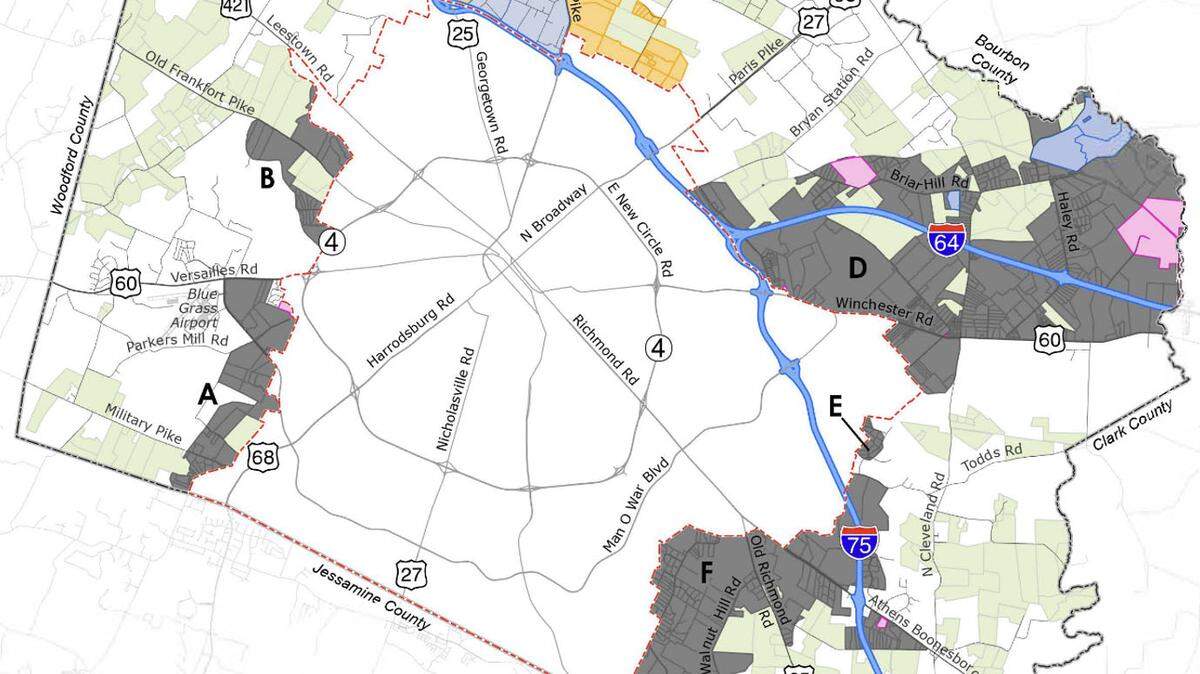
The proposal, which has been developed by a group that includes council members, developers and those in the agricultural community, also shows what areas will be preserved in the rural areas and areas that could be developed.
Under the proposal, the city will decide using a sustainable growth matrix if and when the city needs more land for various needs — industry, housing, commercial or retail spaces.
That determination will be made every five years after the comprehensive plan, which guides growth in Fayette County, is completed. Under the current proposal, that would occur in 2026.
If a specially-appointed task force, named by the mayor and council, determines there is need for more land, developers would submit proposals. The work group, called the Goal 4 work group, has recommended several areas that could be developed. Those areas — including sections along Winchester Road and near Athens Boonsboro Road and Interstate 75 — were determined to be areas that could be developed based largely on sewer service in those areas, said Vice Mayor Steve Kay, who co-chaired the Goal 4 work group.
In total, the group recommended 97,309 acres to be preserved for agricultural uses. It identified 27,491 acres as not protected.
The Goal 4 work group also looked at agricultural land, including those farmlands that have conservation easements on them, to determine what land should be preserved.
The largest area the group determined could be available for development is approximately 13,000 acres along the Winchester Road corridor. The area in the Athens Boonsboro Road has 5,528 acres. Another section of roughly 1,600 acres is around the Blue Grass Airport. The group also designated hundreds of acres between Georgetown Road and Newtown Pike north of I-75 for agricultural-based companies.
“This is not to expand the boundary,” Kay cautioned. “This is to identify areas that could be developed under certain situations at some point in time.”
What happens if the boundary expands?
If it is determined that more land is needed for certain needs, developers would submit a master plan or small area plan that would demonstrate the identified need. For example, if the sustainable growth matrix determines the city needs more housing, the developer must show how their proposal meets that need.
Developers would also have to show the fiscal impact to the city and how the development meets the comprehensive plan.
There can be multiple proposals. The planning commission and then the council can choose one or several plans.
Then the council will vote to expand the boundary and the zone change for the property.
The developer must complete the project in a certain period of time. If those timelines aren’t met, the property is removed from the urban service boundary.
Brittany Roethemeier, executive director of the Fayette Alliance, which advocates for rural interests, has monitored the Goal 4 group’s progress.
“This is the most comprehensive look at the (urban service boundary) since its inception in 1958 — it has required time, thoughtful analysis, research, and objectivity to ensure this new outline for how we think about growth is both sustainable and responsible,” Roethemeier said.
“We do have concerns about aspects of the report including the preservation map, infrastructure/sub area planning process, how the needs for expansion are identified, and the impacts of the competitive private RFP process for development,” Roethemeier said.” We believe more discussions and analysis are warranted before the report moves forward, and are hopeful that the Planning Commission, and ultimately the council, will be good forums for the same.”
Todd Johnson, of the Building Industry Association of Central Kentucky, a leading construction group, said his organization has not yet seen the final recommendations. Johnson said they will likely weigh in at the meeting on Thursday after reading the final report.
What happens next?
The city has been working for more than two years on a different way to determine when the growth boundary should be moved. Typically, the Urban County Planning Commission and the Lexington-Fayette Urban County Council vote during debate on the comprehensive plan whether to expand the growth boundary.
The boundary has not been expanded since 1996 when 5,400 acres was added. Roughly half of those acres have still not been developed. The urban service boundary was first introduced in Lexington in 1958.
The council will begin initial discussions about the Goal 4 proposal during Thursday’s meeting. The Urban County Planning Commission is also set to review the Goal 4 group’s recommendations.
Kay said the council and the planning commission can make changes to the Goal 4 proposal. The public is also invited to weigh in on the new plan at the 5 p.m. meeting Thursday in the council chambers at city hall.
It’s unlikely a final decision will be made by the end of December, when many council members including Kay, will step down from council.
The city has reason to move quickly. Some fear the Kentucky General Assembly will make the decision for Fayette County.
In 2019, a bill filed in the Republican-controlled state Senate would have categorized all agricultural land as vacant land and available for development, which would have nixed Fayette County’s growth boundary. Also, comprehensive plans would have to consider how much land a community will need over a 20-year period and be updated every five years in order to be used by a planning commission. After pushback from Lexington, Louisville and the Kentucky League of Cities, the proposal was dropped.