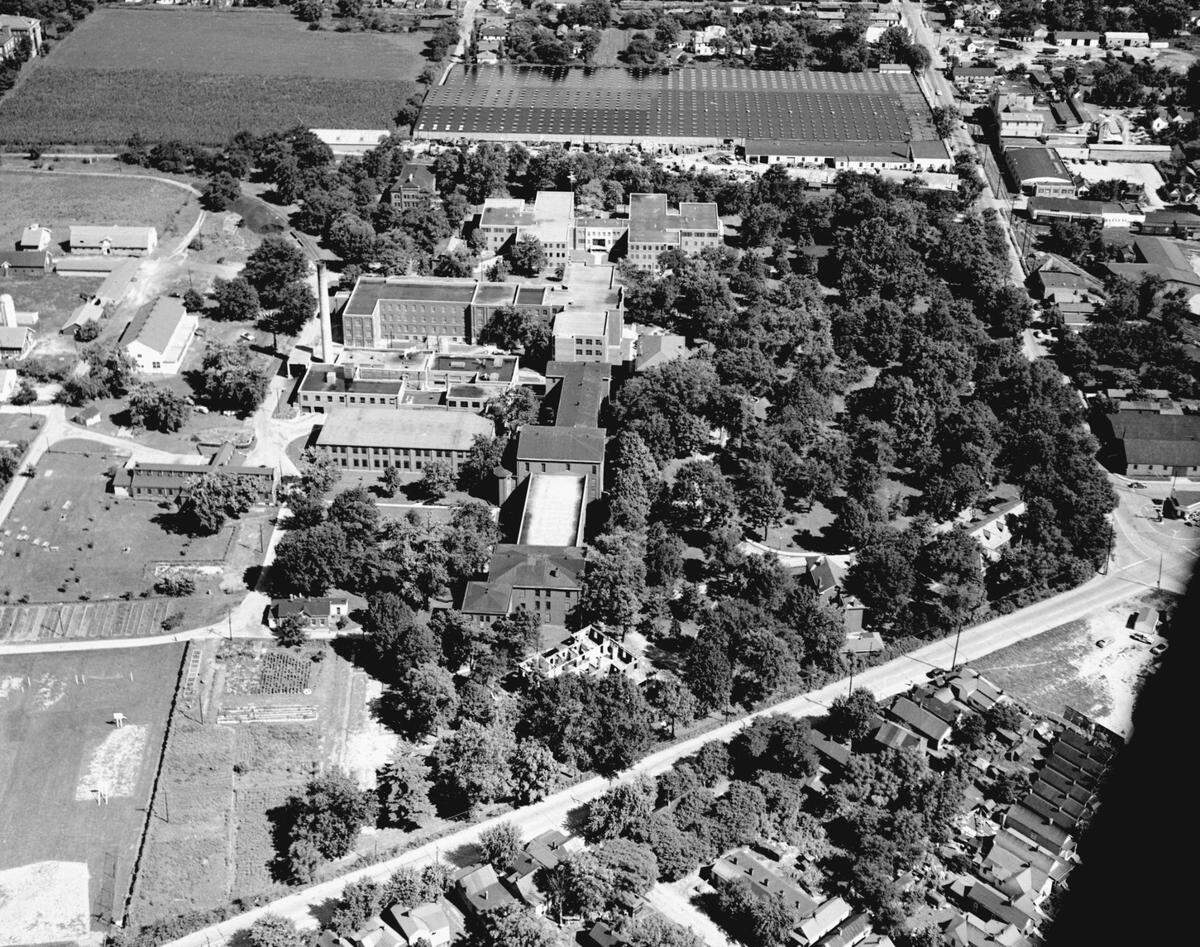
Eastern State Hospital: An early piece in Lexington’s health care system
Editor’s Note: As Lexington celebrates the 250th anniversary of its founding, the Herald-Leader and kentucky.com each day throughout 2025 will share interesting facts about our hometown. Compiled by Liz Carey, all are notable moments in the city’s history - some funny, some sad, others heartbreaking or celebratory, and some just downright strange.
May 1, 1824 — Eastern State Hospital is the oldest mental health facility west of the Allegheny Mountains, and the second-oldest public psychiatric facility in the country.
From the end of the 18th century, residents with mental health issues in Kentucky had limited options. Treatment was unheard of and because mental illness was thought to be caused by a moral or spiritual failing, those with mental health issues were often punished or shamed. Family members cared for them, and in severe cases they were boarded in almshouses or in jails; their care was paid for with public funds.
In 1773, a small hospital to deal with mentally ill people who were disrupting their communities was built in Williamsburg, Virginia. The Virginia legislature provided the funding, and over the years, the hospital grew as needs continued to increase.
The Kentucky territory sent its more severe mental health cases to Williamsburg, but for the most part, those with mental health illnesses were cared for in their own communities.
By 1816, Kentucky was a state, and Lexington was a bustling community. Leaders here saw a need arising for the care of the mentally ill in their own town.
They banded together to establish the Fayette Hospital to help the poor, the disabled and the “lunatic” members of society. The building’s construction was started the next year, but it was never completed. Some five years later, the Kentucky General Assembly passed legislation establishing a “lunatic asylum.”
Ten acres of land and the unfinished building of the Fayette Hospital were purchased and by May 1, 1824, the first patient to the newly named Eastern State Lunatic Asylum was admitted – a Black woman from Woodford County.
Because the original hospital was built as a medical facility rather than a psychiatric one, the wards were large and open with many beds. By 1825, the hospital suffered from overcrowding and a lack of basic necessities – like heat for all of the patients. Another two wings were added.
In the 1830s, even more additions were built onto the facility that allowed the superintendent, his family, the facility’s attending physicians and staff members to stay on the grounds.
In 1844, the hospital’s first medical superintendent, John Rowan Allen, took over. With him came a change to “moral treatment” of the mentally ill.
Prior to Allen, restraints and a lack of treatment were how the facility kept its patients under control. Allen brought about compassionate care and treatment for those with mental health issues. Dorothea Dix, a 19th-century activist for health care and mental health treatment, visited the facility twice.
However, the waning years of the Civil War saw a turn back to the old ways. The patient population increased causing the facility to be over-crowded and necessitating the use of restraints.
Between the late 1800s and the early 1900s across the country, treatment of the mentally ill bordered on the barbaric and inhumane – from physical restraints and ice baths to electroshock therapy. Changes to mental health care came from the work of people like Dix, and journalist Nellie Bly, who detailed her time undercover inside the Women’s Lunatic Asylum on Blackwell Island in New York, in her book “Ten Days in a Mad House.”
By 1945, the hospital had a population of 2,000. An isolated institution, the facility was separated from the rest of Lexington, with many of its employees living on the grounds. Patients at the facility did the work required to operate the hospital from farm work to building and grounds maintenance to cooking, serving and doing laundry.
In 1967, the patient population had dropped to 1,000. But support for mental health facilities was waning. Health care reform that included cost containment or other cost reductions were forcing the closures of inpatient facilities.
In 1993, the Bluegrass Regional Mental Health-Mental Retardation Board, Inc., began to investigate the possibility of taking over the facility. The alternative, the board feared, would be to lose even more options for inpatient care. The group signed a contract with the state and took over operations in 1995.
Nearly two decades later, the state entered into a $43 million contract to bring the facility under the University of Kentucky. A new facility consisting of one large building with three three-story towers was built that houses between 125 and 175 people.
A cemetery on the grounds holds the remains of some 4,400 people who died at the facility but were either unknown, were patients whose families couldn’t pay to have their bodies moved, or patients whose families never claimed their bodies.
Have a question or story idea related to Lexington’s 250-year history? Let us know at 250LexKy@gmail.com