Lexington council rejects 8-story apartment building near UK neighbors call ‘disaster’
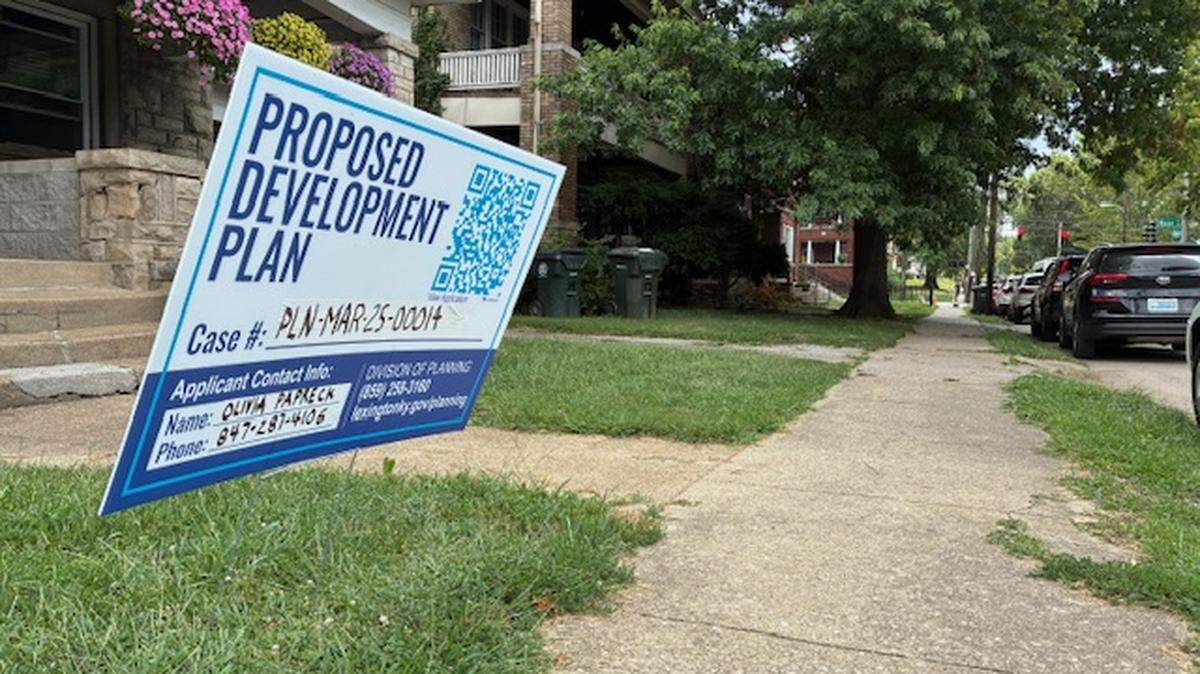
The Lexington-Fayette Urban County Council denied approval Wednesday for a 332-unit apartment building geared to University of Kentucky students on East Maxwell Street.
The council voted 8 to 7 during a special meeting to deny a zone change from a residential to a business for several properties on East Maxwell and Kalmia Avenue. The request comes amid increased property turnover as developers snap up parcels ripe for off-campus student housing.
The zone change considered this week included properties at 251, 253, 255, 261, 263, 271 and 273 East Maxwell St. and 256, 258, 262, 266, 268, 270 and 272 Kalmia Ave.
The proposed change would have allowed Chicago-based Core Spaces to build an eight-story, 332-unit building with multiple town houses at ground level, for a total of more than 1,000 beds. Plans show an interior parking garage with 436 parking spaces.
Core Spaces buildings are branded as the HUB. The HUB has multiple Lexington properties, including one on South Limestone and another on Virginia Avenue.
If it had been approved, it would have been the third new, major student housing complex in the area of East Maxwell. The other two — one six stories, and the other eight — were approved earlier this year.
The vote came after a marathon seven-hour public hearing Tuesday night where neighbors of the proposed development told the council the area has been overrun with private, towering student apartment buildings. The block to be demolished — between East Maxwell, Rose Street and Kalmia — consists of older but well-maintained multi-apartment buildings and homes. Moreover, those apartments are affordable, residents said.
After the council ultimately denied the zone change, Councilwoman Whitney Elliott Baxter told other council members she was disappointed with their lack of political courage.
“I am disappointed,” Elliott Baxter said. Developers have come to the city to try to help it solve its housing crisis, “but we keep saying no. It’s absolutely infuriating.”
The zone change illustrates increasing tensions between UK, the surrounding neighborhoods and the city over who is responsible for housing students. Recently, the university has pushed to expand its student body even while the city faces an affordable housing crisis.
Branden Gross, a Lexington lawyer for Core Spaces, said the city and UK need more student housing. The proposed development would replace housing rented to about 80 people now. The new complex would have more than 1,000 beds.
That will help the city address a shortage of housing and keep UK students from spilling into other neighborhoods, Core Spaces officials said Wednesday.
Various studies show the city needs more than 22,549 housing units to meet demand. Those same studies indicate Lexington needs an additional 14,000 rental units.
“We need more rental housing than we need for-sale housing right now,” Gross said.
The city’s comprehensive plan, which guides development, calls for density near the university and along major corridors. The area is not in an historic overlay or H-1 district. There are few areas downtown not covered by an H-1 historic district. That means the development is being concentrated on a few blocks on East Maxwell Street.
“We are failing to meet the basic needs for shelter for citizens of our community,” he said.
The city’s planning staff recommended approval of the zone change, and the Urban County Planning Commission voted 8 to 2 during a Sept. 15 meeting to approve the zone change.
3 high-rises in 3 blocks on East Maxwell Street
Multiple people who live near the proposed development said the city should hit pause before it approves another large development largely aimed at UK students.
The proposed HUB complex is near a six-story, under-construction student apartment complex from Stavroff Development. Next to that is another recently approved student complex. That building, eight stories and home to 825 bedrooms, is being built by Subtext, a St. Louis-based private student housing developer.
Maureen Peters, who lives near the proposed HUB site, said she has concerns about the increased traffic in the area. Those developments are just now ramping up, and the effects on traffic and the neighborhood are not yet known.
“This council should hit pause for this neighborhood until we had a better understanding of the long-term consequences and a plan to deal with it,” Peters said.
Although Stavroff Development has promised the project would not affect local parking, residents can no longer park on East Maxwell and Stone streets along that development, Peters pointed out. Moreover, East Maxwell Street has to be shut down to allow large construction equipment on the site. If all three apartments are approved, it will be a traffic nightmare, she said.
“It happens three to four times a week,” Peters said of the temporary closures.
Carrick Moon lives on Stone Avenue.
“We need to slow down to assess the impact of the ongoing development,” Moon said.
Many people in his neighborhood live in affordable apartments, he continued, and many are students and the elderly who fear being booted from their homes and not being able to find suitable, affordable housing.
Moon said Lexington should not be another “cookie cutter” city. The multi-house units in that block are unique and should be preserved, Moon said.
Traffic was also a concern.
“It’s already incredibly busy,” neighbor Mark Barker said. Maxwell is a narrow, two-lane street. There are no loading or unloading zones.
“The way that they are planning it out is a disaster,” Barker said. If the city doesn’t stop and consider traffic now, “How are you going to fix it?”
Daniel Crum, a senior planner, said a traffic study conducted by Core Spaces/HUB showed Maxwell Street could handle the additional traffic if all three apartment complexes were approved.
More than a dozen people spoke in favor of the development.
Daniel Burton said he supported the development as students need more housing options, particularly options close to UK.
“They are providing housing stock that the university has decided they are not going to do,” Burton said.
Zach Smith, a former UK student, said more density closer to UK will free up apartments elsewhere in the city.
More than 12 multi-family units will be razed
A dozen buildings on the block will be razed to make room for the Subtext building. Other historic buildings in the area have already been bulldozed to make room for the Stavroff development.
Most of the buildings Core Spaces wants to bulldoze were built in the 1920s, Betty Kerr, director of historic preservation for the city, said during the September Urban County Planning Commission meeting.
Kerr said the block was part of a planned neighborhood of single-family homes and smaller apartment buildings. It was one of the first neighborhoods designed to mix students with other residents. All the structures are listed on the National Register of Historic Places. However, it is not in a historic district.
Jessica Winters, a lawyer who represents nonprofit Blue Grass Trust for Historic Preservation, said the Aylesford Place neighborhood and the South Hill neighborhood associations are opposed to the razing of the properties and the zone change.
Winters said the city’s comprehensive plan also incentivizes preservation of historic neighborhoods.
“The cost in terms of lost history is too high,” Winters said. “The comprehensive plan does not support the demolition of an entire block of historic register places.”
Winters said there has been too much change in East Maxwell Street in a short period of time.
“This is too much, too soon,” she said.
Council conflicted on HUB zone change
Councilwoman Hannah LeGris, who represents the 3rd District, which includes East Maxwell Street, said she could not support the zone change because it would tear down well-maintained historic properties. The addition would also mean an influx of nearly 3,000 students to the neighborhood in a short period of time.
The Aylesford neighborhood should not have to bear the brunt of the city’s push for more density, LeGris said.
“I think the university needs to construct more housing in line with their enrollment goals,” LeGris said.
The councilwoman also called for restarting the Town and Gown Committee, which included city and university officials and often discussed things like housing. It was disbanded more than a decade ago.
Councilwoman Emma Curtis said more student apartments do not solve Lexington’s housing crisis. Instead, it’s making it worse. The HUB development is only affordable for students who have rich parents. Curtis said she could not afford to live there on her council salary.
“It’s predatory, and it’s wrong,” Curtis said. “We aren’t elected to serve UK’s bottom line.”
Jay Blanton, a spokesman for UK, said the university is providing housing on its campus and more is scheduled to come online soon.
“The development in question is a private one,” Blanton said. “It is not associated with the university. We always want to be a good partner with the city. We believe that are, but we also know we can and must continue to find ways to be an even stronger partner for Lexington and Kentucky. We are committed to that.“
More than 8,000 UK students are living on campus this semester, a record number.
Other council members said the city needs more rental units. Building up rather than out has been the preference of many city residents, Vice Mayor Dan Wu said. Yet, when it comes to infill projects, residents oppose more density.
Wu encouraged his colleagues to follow the philosophy of doing the most good for the most people and support the zone change.
Those who voted against the zone change were LeGris, Curtis, James Brown, Tyler Morton, Jennifer Reynolds, Chuck Ellinger, Lisa Higgins Hord and David Sevigny. Council members who voted for the zone change were Elliott Baxter, Wu, Liz Sheehan, Hil Boone, Joseph Hale, Amy Beasley and Shayla Lynch.
This story was originally published November 20, 2025 at 1:08 PM.