A small Lexington church has walls of sacred, artistic treasures. See inside
Thousands of drivers race down Man o’ War Boulevard every day, never noticing the small white building in a grove of trees between Grassy Creek and Clay’s Mill.
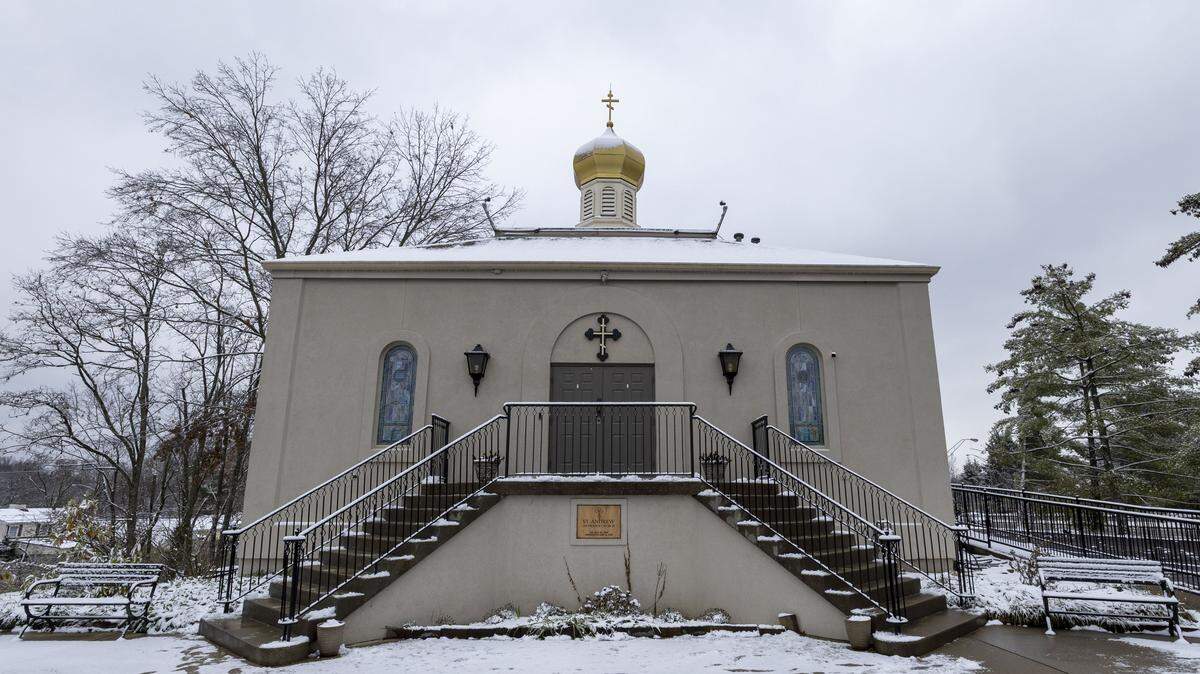
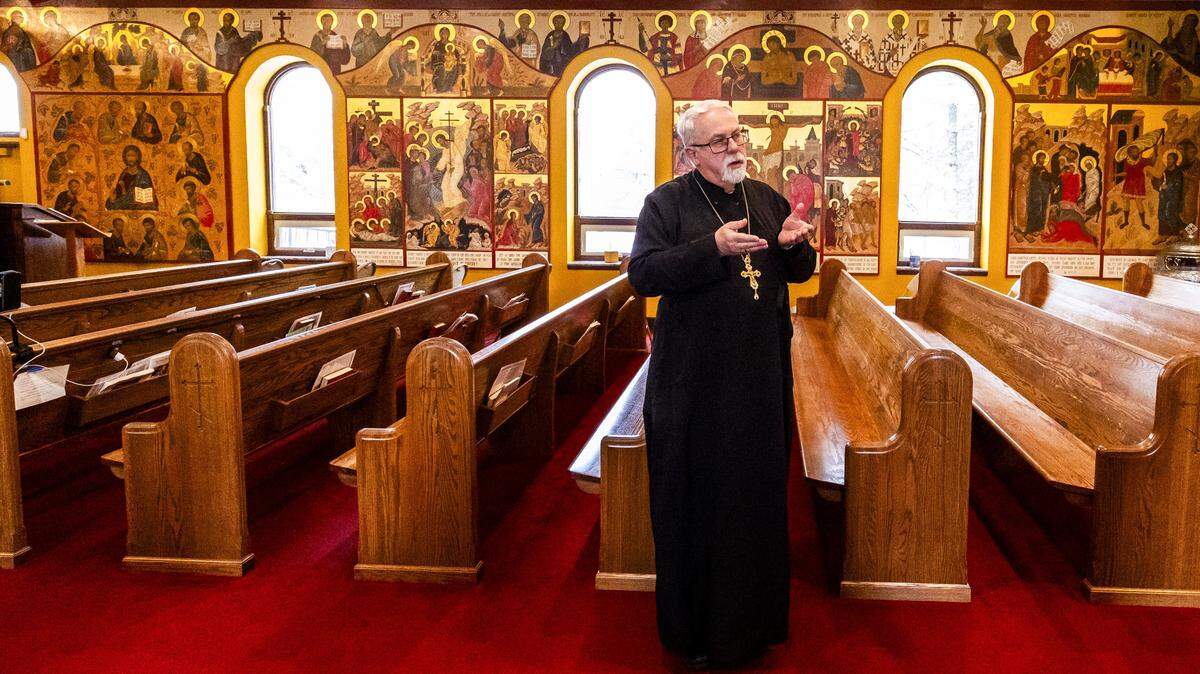
A passenger might notice the small white building is topped with a solitary onion dome, painted gold, like a tiny approximation of a Russian building plopped down in south Lexington. And if they were curious enough to get onto Higbee Mill and make it to St. Andrew Orthodox Church, they would find that small, square building opens into an extraordinary universe — a jewel box of glittering gold leaf and sumptuous colors — of religious worship brought to life through divine depictions of the life and death of Christ.
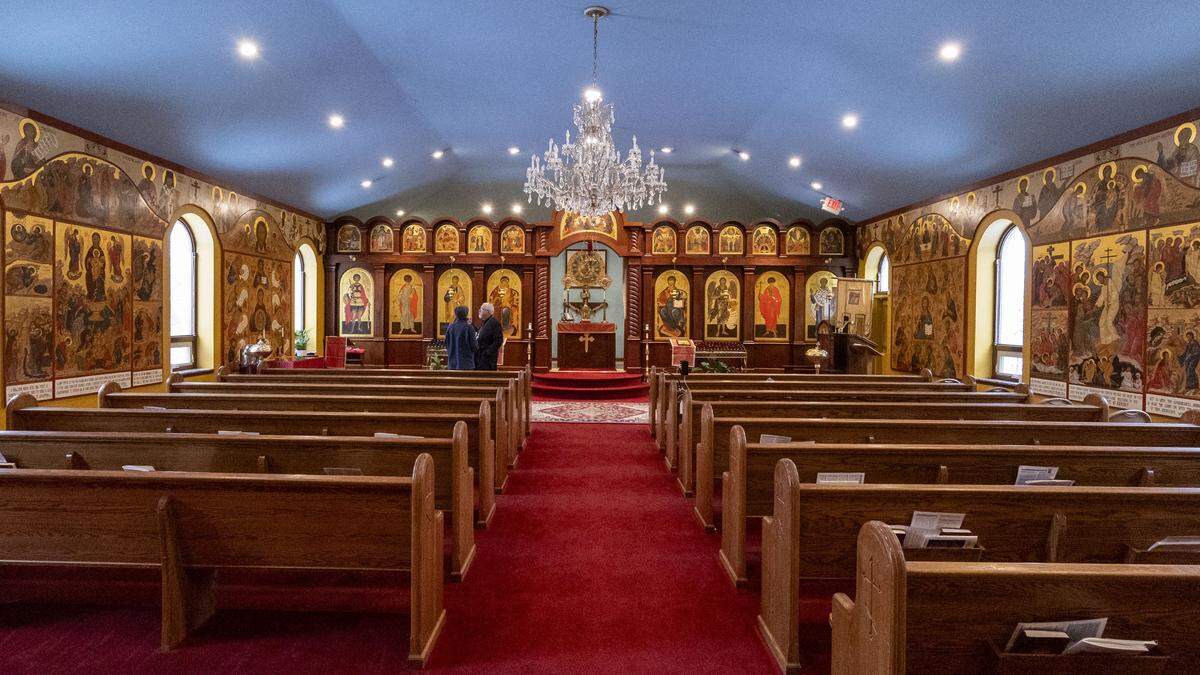
“The center of the church is seen as a meeting place between heaven and Earth, God and man, we have a part of heaven in our midst,” said Father Tom Gallaway who became St. Andrew’s priest in 1988. “It reveals to us the spiritual, invoking us into greater prayer and unity in our worship.”
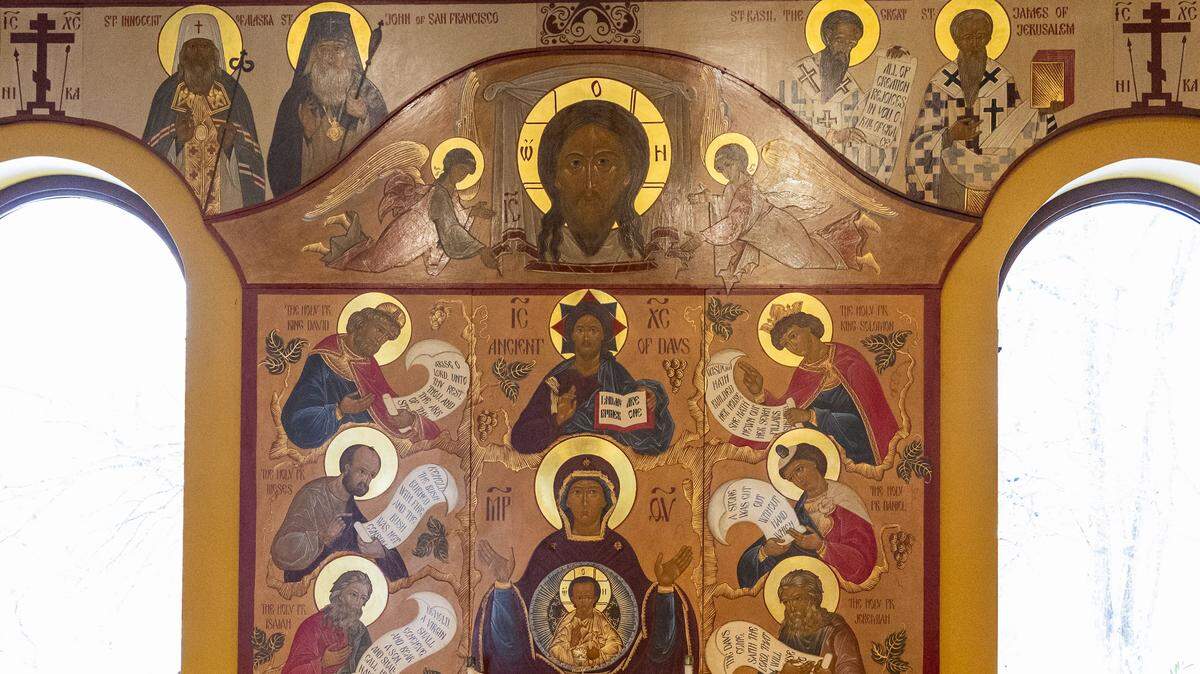
In the simplest description, the Eastern Orthodox church is a major branch of Christianity that traces a direct line to the Apostles, a church riven with plenty of its internecine fights, but none that included a Reformation, a Pope, or many changes to the liturgy. The ancient tradition of painted icons is integral to the Russian Orthodox, Greek Orthodox or in the case of St. Andrew, Antiochian Orthodox.
So all Orthodox churches have icons. But not all of them have what St. Andrew displays: a pale blue ceiling above three walls of floor-to-ceiling icons by one of the most important painters of modern iconography, a woman who left a doctorate in biophysics to learn the craft of iconography in secret in the Soviet Union before fleeing to the United States: Ksenia Pokrovsky.
“There’s no doubt she is one of the most significant iconographers of the modern era,” said Michael Makin, a Russian professor at the University of Michigan who recently visited St. Andrew’s. “Moreover, she’s female in a world that used to be only male monastics. She was not only a brilliant iconographer, but representative of new trends in the Orthodox Church.”
A small group created a new Orthodox church in Lexington
Pokrovsky and St. Andrew came together as a part of a small but growing third branch of Christianity in the U.S., aside from Catholics and Protestants. It has always been home to the diaspora from Russia, Greece, and the Middle East. In November, the New York Times explored the recent growth of converts to the Orthodox Church, particularly among young, conservative men.
St. Andrew started out as a tiny mission church in the 1980s, where a group of worshipers met in a chapel at what was once the Episcopal Seminary at Good Shepherd Episcopal Church on Main Street. Many of the early congregants had grown up in the Orthodox Church elsewhere — people like Iskander Martha, a Palestinian Christian who arrived in Lexington in 1966.
“Back then there was nothing but Greek Orthodox, and the entire service was in Greek,” said Martha, who has operated Charlie’s Auto Center on Delaware Avenue since 1968. “But it’s hard to go to church when you don’t understand what’s being said, so a few of us, about six families, we just decided to go ahead and open up a small church.”
Others grew up in Protestant traditions but were attracted to the ancient liturgy. Mary Kathryn Lowell, for example, grew up Baptist then became Episcopalian. But she was doing graduate work in Byzantine and Russian history, and became intrigued by the nascent parish and its worship — with chants, incense and language — still modeled on the earliest Christianity.
“I like to say I read my way to the Orthodox Church,” she said. “But I became convinced this is the Church that Christ founded. This was the original church.”
The group raised enough money by the 1990s to buy a plot of land off Higbee Mill and build the small building they still use today. They got a full-time priest in Gallaway. But one thing was missing — the icons that are such an integral part of an Orthodox service.
Gallaway got a call from a friend about a woman who had just moved to Boston from Moscow. She didn’t speak English, so her husband, a former physics professor, translated over the phone. She offered to send them one of her pieces as a trial. Lowell recounted opening the package in her book “Treasure in a Box,” about St. Andrew’s icons.
“When the courier opened his knapsack in the lobby of the Galt House Hotel, and unfolded a 12-inch by 18-inch stack of icons linked together like an accordion,” Lowell wrote. “I was dumbfounded. Here was a masterpiece enclosed in a box. ... I was convinced we needed to look no further for an iconographer.”
Ksenia Pokrovsky was hired.
An artist learned her craft in secret
When the church was built, Gallaway had commissioned a local craftsman to build the “iconostase,” another required feature of Orthodox churches. This wall, made of solid mahogany, serves as a partition between the nave (center of the Church) and the sanctuary of the altar. It’s usually covered with icons.
Pokrovsky came to Lexington to measure all the spaces of the iconostase, and the spaces of the four walls of the church.
Then she returned to Boston to paint on wooden panels, using the ancient methods of egg tempera, vegetable dyes, and minerals to make her rich colors. Gold leaf was applied to all the backgrounds.
She had learned iconography in secret starting in 1969, according to Lowell, because icon painting was outlawed by the Soviet government as part of its ban on religion. She studied secretly with “Mother Juliana,” whose real name was Maria Nikolayevna Sokolova, widely credited with preserving the art form of iconography, and imparting it to students like Pokrovsky.
But when her family’s priest and friend, Father Alexander Men, was killed in 1991, she and her family decided to move to the United States.
She started to receive numerous commissions from the Orthodox communities around the United States. One of her most famous works is “Synaxis Of All Saints Who Have Shone Forth In North America,” which represents the entire history of the Orthodox Church in this country.
The ‘Treasure in a Box’
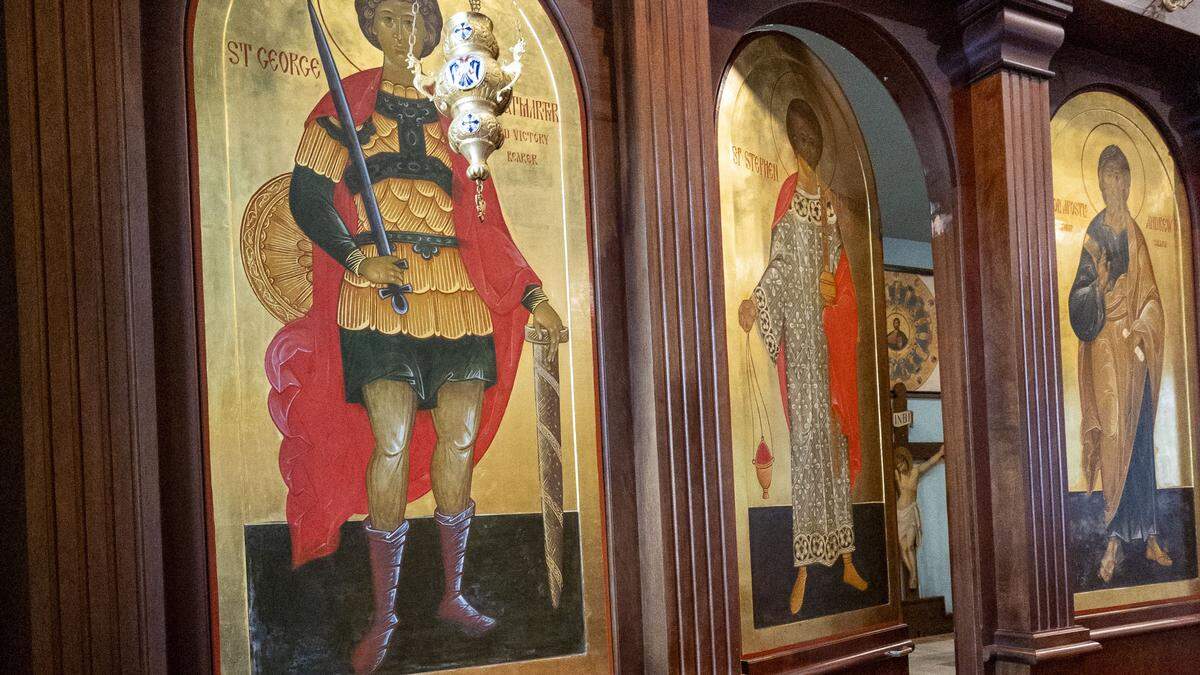
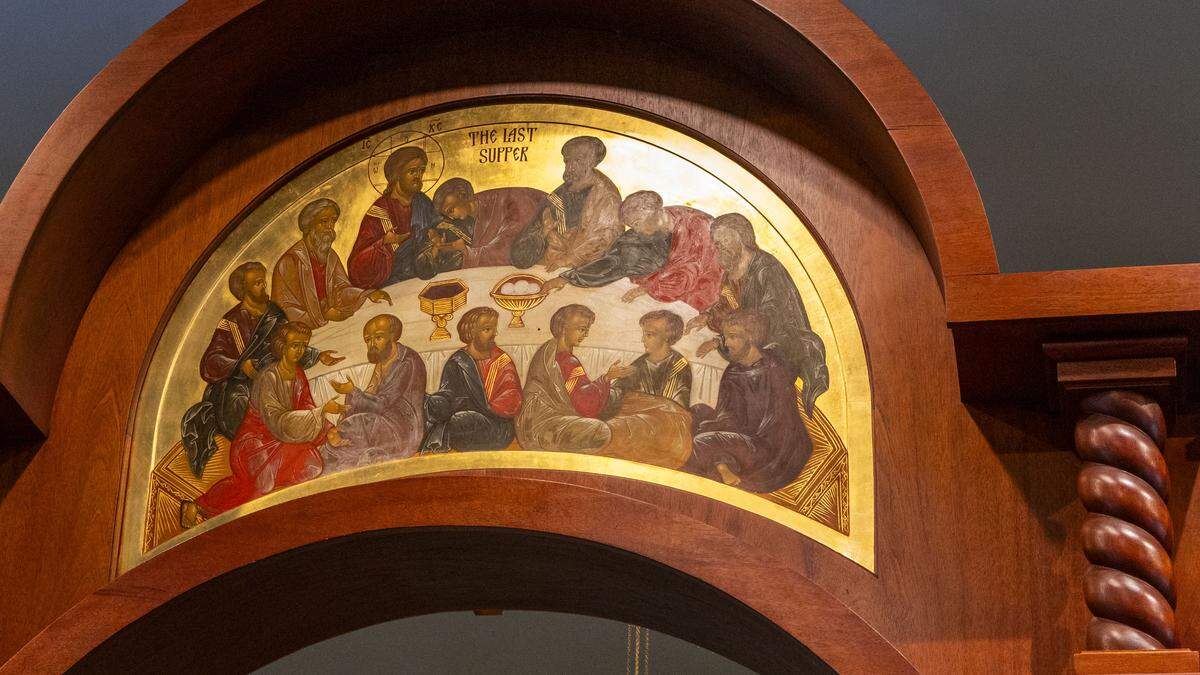
Pokrovsky began with the icons of the iconostase, which included The Last Supper in the center, atop the “royal doors” that lead to the altar. The row of saints below include St. Andrew, of course, Christ Enthroned, St. John, St. Philip, St. Stephen, St. Nicholas, and St. George. In a row on top of the saints are smaller icons of feast days, including the Nativity, the Annunciation, the Transfiguration and Pentecost.
These were installed in 1993. At that time, Pokrovsky said to Lowell: “These icons are fresh, they will need many prayers of the people to activate them.”
Lowell wrote that she thought it was strange at the time, but realized “in every authentic icon an artist makes for the Church ... there is an invitation to united one’s self to the Company of Heaven.”
There have been many ancient and modern fights over iconography throughout the centuries, but Gallaway said it’s important to understand that congregants don’t pray to icons. They pray with icons: “Our vision is to look to the eternal, and it’s modeled on the visions we have of haven from the Scriptures. So it’s a vision of heaven.”
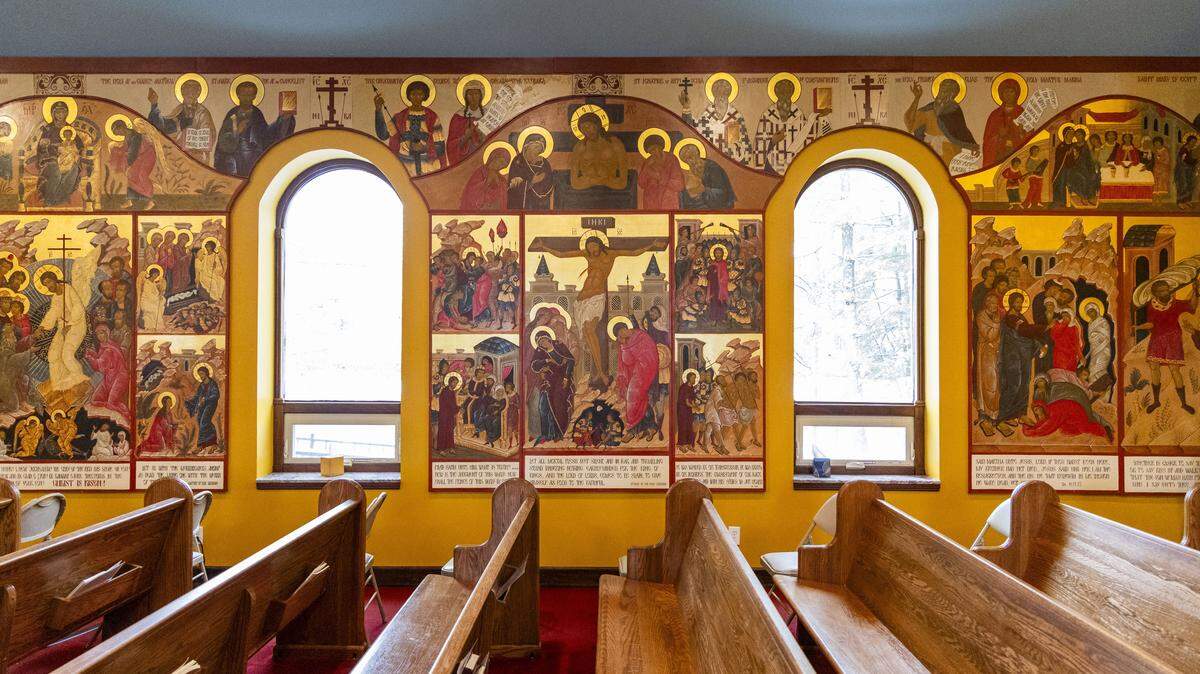
In subsequent years, the church fundraised enough for Pokrovsky to paint entire panels to adorn the walls of the church, which like all Orthodox churches, faces east. The right, or south wall, is filled with scenes from the life of Jesus Christ, the left is dedicated to his mother, Mary. Pokrovsky knew the church was mostly English speaking, and wrote her descriptions in English. She also used the north wall to pay homage to American Orthodox saints, men like St. Raphael of Brooklyn, the founder of Antiochian Orthodox Mission in America, and St. John, Bishop of Shanghai and San Francisco.
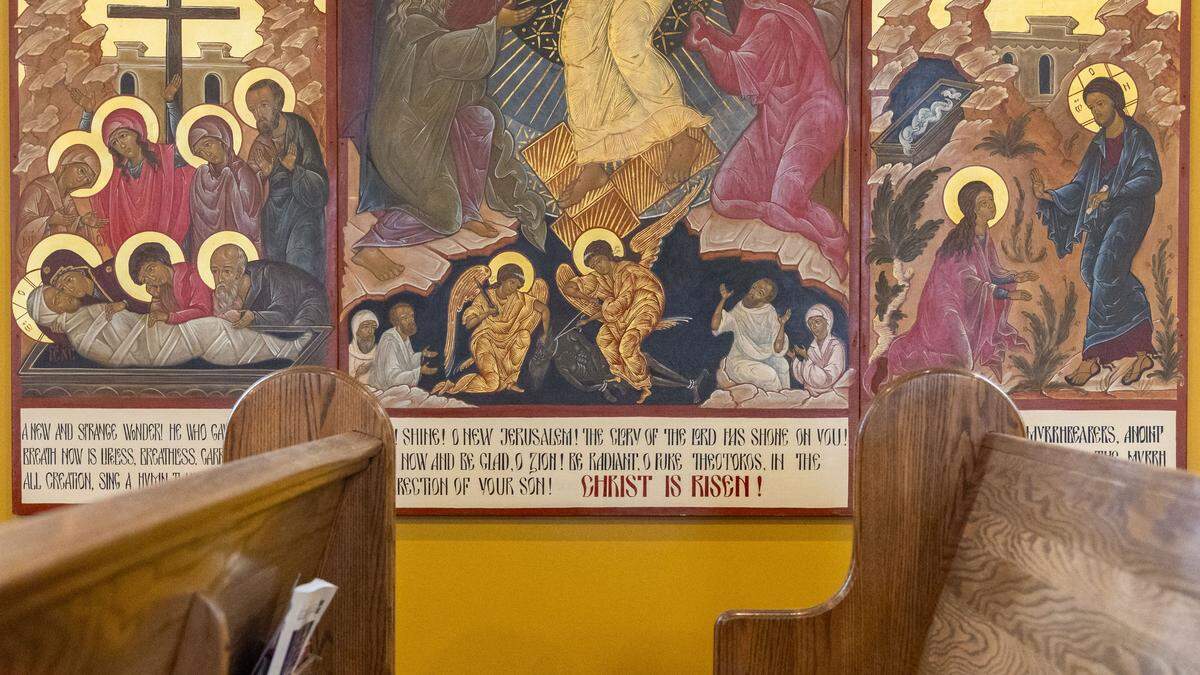
She also included the many saints of Alaska, where the former Russian territory already had a strong Orthodox tradition, including Peter the Aleut, who was martyred by Spanish soldiers in California in 1815.
‘She has written the Gospel’
Pokrovsky died in 2013. In a Youtube video from 1993, she narrates in Russian as she paints the icon of St. Philip for St. Andrew, describing the cinnabar, and ocher she used in the traditional colors of the paint.
Father Gallaway calls the painting of icons a microcosm of salvation.
“It’s a spiritual journey from the darkness of sin to light, being crowned with the reign of glory with the gold leaf,” he said. “And every icon becomes a microcosm of creation because of the elements you use: animal, vegetable, mineral and human, all from a once fallen world reflecting back the glory of God.”
St. Andrew is growing. The parish has bought more land next door, and is discerning what it will do in the next few decades. But the treasures in the current box are fixed on the walls and will remain in place for many years to come.
The church begins its holy preparations waiting for the birth of Christ, and its congregation can meditate on that birth in the surrounding images. As Lowell wrote: “To step inside the humble walls of St. Andrew is to experience a transfer from the outer world of busyness and confusion into an ordered cosmos of beauty and theological instruction.
“Ksenia’s genius of mind and depth of theological knowledge produced a pictorial reference for every sermon that can be preached on the mystery of our salvation. Like the great iconographers before her, many of them nameless, she has written the Gospel in line and color.”
This story was originally published December 18, 2025 at 5:00 AM.