Questions arise over Lexington’s $1 million contract with medical debt nonprofit
Nonprofit officials with a $1 million dollar contract with the city of Lexington to erase medical debt for Fayette County residents defended its high administrative costs — more than a third of the contract — after some questioned why so much money was going to the organization’s bottom line.
Courtney Story, vice president of government initiatives for Undue Medical Debt, said the $336,394 the group is charging the city is not for traditional overhead costs. The remaining $663,606 goes to buying and paying off medical debt.
“The rest of what is being described as ‘administrative’ is often misunderstood. It is not overhead,” Story said. “These are direct program costs that Undue only incurs because we are abolishing debt for Lexington residents. These costs include all items in the program budget minus our indirect costs. Each are essential to identifying eligible debts, purchasing them, abolishing them, meeting federal and local compliance requirements, and notifying every resident whose debt is relieved.”
The Lexington-Fayette Urban County Council approved the $1 million allocation to the organization in late 2024 using interest earned on federal coronavirus funds. The three-year contract defining the terms of the partnership was approved in June.
Last week, Undue Medical Debt delivered its first round of letters to 6,484 residents who had $12,641,416.24 in medical debt forgiven, Wu announced at a news conference Nov. 18.
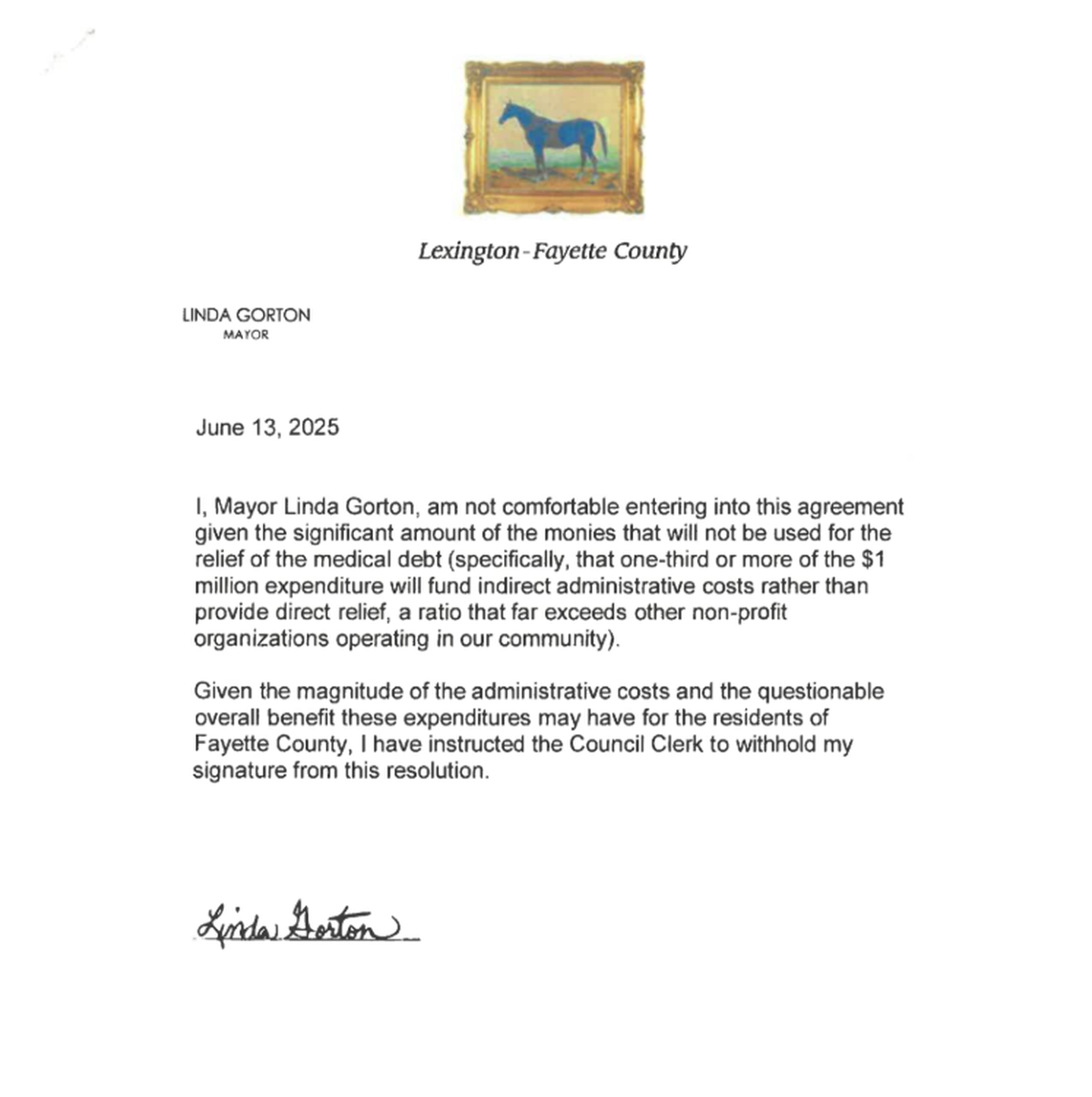
Concerns about Undue Medical Debt’s high administrative costs prompted Mayor Linda Gorton to take the unusual step of not signing the national nonprofit’s contract in June.
“I, Mayor Linda Gorton, am not comfortable entering into this agreement given the significant amount of the monies that will not be used for the relief of the medical debt (specifically, that one-third or more of the $1 million expenditure will fund indirect administrative costs rather than provide direct relief, a ratio that far exceeds other non-profit organizations operating in our community),” according to a June 13 letter attached to Undue Medical Debt’s contract.
Ordinances and resolutions adopted by the council but not signed by the mayor pass by default.
Vice Mayor Dan Wu, who pushed the city to enter into the contract with the national nonprofit, said he doesn’t think it’s fair to compare Undue Medical Debt’s administrative fees to others.
“Normally when we partner with a God’s Pantry or whoever, you know they’re doing x-amount of services. We kind of know how those things break down, and then we know what their administrative costs are, et cetera. (Medical debt relief) is an entirely different beast altogether,” Wu said in an interview.
“For me, the ultimate question came down to: it’s a million dollar investment, and it’s a potential $90 million worth of relief. Those two numbers are the only two numbers that I’ve cared about,” Wu continued. “I think it’s very fiscally responsible to get that kind of ratio.”
In total, the group has promised to buy and erase up to $90 million in Fayette County residents’ medical debt over three years. Roughly 32,000 Fayette County residents are estimated to have their medical debt erased in that time.
What are the administrative costs?
According to numbers included in Undue Medical Debt’s contract, the city is giving the group approximately $220,000 per year to buy medical debt. Such organizations buy medical debt the same as collection agencies, often for pennies on the dollar.
The remaining costs of the contract are for various other expenses, including salary and hours worked for 24 Undue Medical Debt employees, including its CEO, according to the organization’s grant budget submitted as part of its contract with the city.
Story said the following expenses are incurred by Undue Medical Debt as it identifies, processes and eliminates medical debt. Direct program costs include:
- Purchase price of the debt
- Purchasing the data needed to determine which accounts qualify
- Printing and mailing notification letters
- Personnel supporting Lexington specifically — debt acquisition, program management and grant management
- Software, security systems and data-processing tools required to handle protected health information and certify the debt is fully extinguished
- Reporting, which is extensive under government contracts and includes financial reporting, HIPAA-compliant documentation and abolishment data
How much is too much?
Many charitable giving guides caution donors not to give money to organizations with high overhead and administrative costs.
The Better Business Bureau’s Wise Giving Alliance, which ranks and analyzes nonprofits, gives higher ratings to nonprofits that give more than 65% of their total budget to programming or delivering services. Undue Medical Debt did not disclose its IRS 990 tax form to the alliance, according to its website. The program is voluntary.
Lexington also ranks and evaluates nonprofits for its extended social resources program, a competitive grant process for local nonprofits. That program does not have a rule on how much a nonprofit can charge the city for administrative costs, city officials said. Those grants are for a host of different services operated by nonprofits from feeding programs, homeless services to youth violence intervention programs.
However, those groups with high overhead costs often receive lower scores by internal city review panels, said Craig Cammack, a spokesman for the city.
“Each grant application is reviewed and scored by an evaluation committee,” Cammack said. “One of the criteria used in scoring an application is a review of the budget for the program, including a breakdown of any salaries, consultant costs, operating expenses, etc. needed for the program. In general, higher overhead costs can result in lower evaluation scores.”
Those grants are also for specific programs, he said.
“The ESR grants are focused on supporting programs, not agencies as a whole. We don’t allow ESR grants to add a flat administrative fee,” Cammack said.
Gorton was not the only elected leader worried over Undue Medical Debt’s administrative costs. In a May Lexington-Fayette Urban County Council meeting, Councilman Dave Sevigny said he, too, was concerned $336,394, or 34% of the total grant, was going to administrative costs.
“I used to be a salesperson. I know how to work a deal. So I kind of feel like we got a little worked on,” Sevigny said.
Sevigny also raised concerns about the contract as Undue Medical Debt was a sole-source bidder. That means bids or requests for proposals from other groups were not solicited.
While he and other council members were disgruntled with the high administrative fees, the council unanimously approved the contract.
In that May meeting, the council decided to require a six-month update on the work-to-date done in the program — how much debt has been canceled, how much of the $1 million has been spent and other details will be included in the presentation. That presentation is scheduled to take place the Tuesday, Jan. 13 council work session.

Questions over the benefits of paying off medical debt
In her June letter, Gorton said she had other concerns about the program in addition to the high administrative costs.
“Given the magnitude of the administrative costs and the questionable overall benefit to these expenditures may have for the residents of Fayette County, I have instructed the Council Clerk to withhold my signature from this resolution,” Gorton wrote.
A spokesperson for the mayor declined to elaborate on what Gorton meant by “unquestionable benefit.”
“There are a lot of studies out there by reputable institutions — they’re easy to Google,” said Susan Straub, a spokesperson for Gorton. “The Mayor relied on those studies in making her decision.”
An analysis from the National Bureau of Economic Research found erasing medical debt already sent to collections did not increase access to credit nor improve mental or financial wellbeing for debtors. The analysis found those who had their debt relieved were not more likely to seek additional care than those whose debt was still owed.
The authors hypothesize relief for debt sent to collections may happen too late in the health care process for debtors to have a substantial benefit.
In a response to the paper, Undue Medical Debt’s President Allison Sesso argued the authors looked at an old model for how the nonprofit does business.
Between when the authors started research and the paper’s publication, Sesso said the organization implemented a number of changes to their former model, including expanding who was eligible to have their debt forgiven and purchasing debt directly from hospitals before it is sent to collection agencies.
These changes directly address concerns highlighted in the paper, Undue Medical Debt said.
Wu thinks the benefit to Fayette County residents is clear.
“Medical debt is a financial burden, period. It negatively impacts people’s credit scores. And to me, the biggest negative impact is the fact that people are not seeking out regular health care because they owe money,” Wu told the Herald-Leader.
CORRECTION: This article was updated at 12:54pm Dec. 4 to correct the process for how ordinances and resolutions adopted by council are passed without the mayor’s signature.
This story was originally published November 26, 2025 at 10:14 AM.