Lexington council is using ‘work groups’ to develop laws. Is it legal?
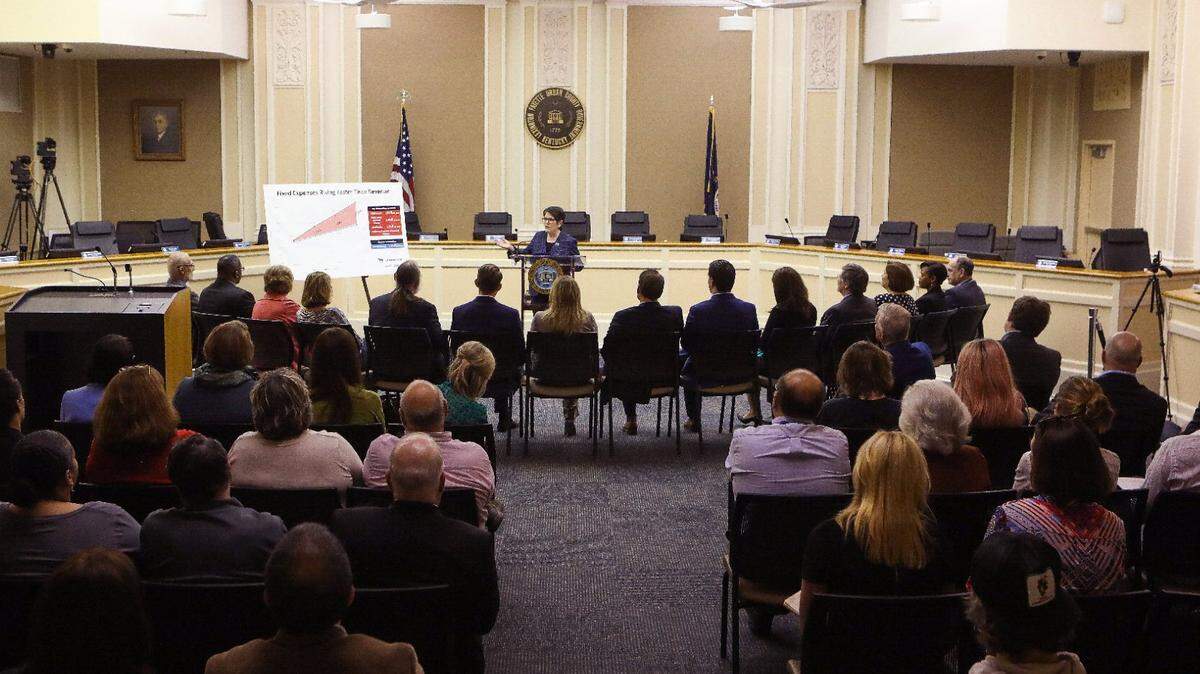
A committee of the Lexington Fayette Urban County Council voted narrowly March 10 to advance regulations that would allow some solar energy projects on agricultural land.
The topic has been contentious for years in the city. But before the vote, the regulations were largely vetted and debated at meetings of a work group involving four council members and city staff.
The meetings were open to neither the public nor other council members, and they were not advertised.
The regulations passed the council’s General Government and Planning Committee, one of the council’s four standing committees, 6-4, despite pushback and questions about the makeup of the earlier work group and who was allowed to give input on the new rules.
And it’s not just fellow council members — lawyers who specialize in Kentucky open meetings law also say the meetings should have been public.
Jeremy Lister-Perlman, a lawyer with Kaplan Johnson Abate and Bird in Louisville, said the Kentucky attorney general’s office “has made clear that when an entity ‘consists of members appointed by public agencies to discuss public business’ and ‘forms public policy’ it falls under the definition of a public agency and must comply with the requirements of the Open Meetings Act.”
In a 2019 open meetings opinion, the attorney general’s office said meetings of state department heads of information technology should be open, because that group functions as the “primary governance body for information technology in the executive branch of state government.” The opinion found that because the group was crafting policy and was appointed by public agencies, its meetings should be public.
Michael Abate, a lawyer with the Kentucky Press Association as well as Kaplan Johnson Abate and Bird, said work groups should not be used to bypass public input or debate.
“The whole point of the Open Meetings Act is that the public has a right to see how public policy is being made. The council is turning that on its head by holding closed-door working groups with elected and appointed officials to hash out public policy in secret,” Abate said. “That violates the law and should concern all citizens.”
Some council members defended the closed meetings.
Liz Sheehan, 5th District council member and organizer of the solar work group, said her understanding is that because the group — and others like it — are less than a quorum of the full council, they are not subject to open meeting laws.
“In the working groups that I’ve participated in, we haven’t had a quorum of a committee or a quorum of the council,” she said. “My understanding is that it doesn’t fall under this kind of open records or open meeting law.”
Still, one council member who served on the work group said its meetings should have been open.
Council member Hil Boone, who represents Lexington’s rural 12th District and was a member of the solar work group, said working farmers and farm interests had little say in crafting the rules that govern agricultural land.
“Anybody locally here that is actually farming and using the land for agriculture should have had the opportunity to voice concerns and/or be a part of the conversations,” Boone said after the March 10 meeting.
Boone said council members who weren’t in the work group did not know the dates or contents of the meetings.
“They would ask me, ‘So what’s going on with that work group?’” Boone said.
The other council members in the work group were Tyler Morton and Dave Sevigny.
Work group, committee or subcommittee?
This isn’t the first time the Lexington council has turned to small work groups to develop recommendations on sometimes thorny and controversial topics. Other work groups created over the past three years have made recommendations on local regulations for sober living homes and changes to the city’s short-term rental ordinances.
Vice Mayor Dan Wu, who has the authority to create meeting bodies through the city charter, said work groups like the one focusing on solar are not clearly regulated in city documents.
“In the council rules or in the charter, they’re not really even mentioned,” he said.
The charter and council rules and procedures documents outline how a council subcommittee or special committee are created. The bodies have existed in recent years to focus on revising public engagement rules or improving various governmental boards and commissions.
Those subcommittees must be open to the public. For Wu, there is only one major difference between a subcommittee and a work group or task force.
“The difference between a task force and a working group versus anything with ‘committee’ in it — whether it’s subcommittee, ad hoc committee, oversight committee — is committees, generally speaking, consist of only council members. Whereas with task forces and working groups, we’re bringing in people from the community or people from outside of council,” he said.
The solar working group was staffed by two members of the city’s planning division. Past groups have included staff from the department of law or other city staff, representatives from external organizations or members of the public.
Sheehan said she thinks task forces are their own distinct bodies from subcommittees and work groups that are clearly defined in the council rules and procedures.
The council rules and procedures provide outlines for ad hoc and “investigative committees,” but don’t specifically use the words “task force.”
Wu said when other council members want to form a task force or work group, they typically consult him for approval or at least let him know they plan to form a group. But that’s not a rule or an outlined procedure.
“It’s not required to go through me, and it’s not required for me to approve it, he said. “Sometimes stuff gets run by me, sometimes they don’t.”
Some city officials defend closed meetings
As for deciding when meetings should be open to the public, that decision comes down to the individual members of the group, Sheehan said.
“With every group that I have been a part of, we have had a conversation about public input,” she said. “Nobody is trying to hide anything. Even within a working group, the whole idea is that you’re going to be reporting out through our other public processes eventually. ... We have a very public process for all of our ordinances, and we want people to engage in those things.”
Susan Straub, a spokesperson for the city, said city law department officials do not recall a council member asking if the solar work group’s meetings were subject to the state’s open meetings law.
Because there was not a quorum of council members — fewer than eight people on the 15-person council — the work group may not have violated the state’s open meetings laws, Straub said.
“The Department of Law does not interpret a loosely defined working group comprised of less than a quorum of either a majority of the council itself, or one if its standing committees, to necessarily be subject to the (Open Meetings Act),” Straub said.
But a 2025 Kentucky Attorney General guide on the state’s open meetings and Open Records Act shows that subcommittees of public bodies are subject to open meetings.
“A committee of a public agency, even if its function is purely advisory, is a public agency for open meetings purposes and a quorum of its members is calculated on the basis of the committee’s membership and not the membership of the public agency that created it,” the guide said.
Agricultural groups shut out
Brittany Roethemeier, executive director of Fayette Alliance, which often advocates on behalf of rural interests and has voiced opposition to solar panels on agricultural land, said she and other agricultural groups were not invited to the work group, nor were they notified when those meetings were held.
“As a community member and director of an organization that is a community stakeholder in planning, zoning, and development issues in Lexington-Fayette County, I believe that if our elected officials form a work group whose ultimate goal is to recommend public policy to the Urban County Council on what is clearly a highly controversial topic, those meetings, at the very least, should be open to the public,” Roethemeier said.
Engage Lexington, the city’s public engagement website, listed summaries of the meetings after they were held. According to the website, there were 11 meetings of the work group between September 2025 and February 2026.
But Roethemeier said many of those summaries were not detailed. It’s not clear what experts spoke.
“What confuses me the most is: If none of that was documented, was the work group’s purpose only to inform the four members of the work group? If that information wasn’t documented or conveyed to the other (council members), how would it help them or the public make a decision about solar energy proposals?” Roethemeier said.
After the March 10 meeting, Morton, who represents the 1st Council District and was a member of the solar work group, said it was meant to inform its members.
“We were diving into trying to get more information internally from our internal resources,” he said, as well as bringing in outside experts to teach the members more technical knowledge.
“We’ve met over half a dozen times now. While it’s been more of an internal process to do that learning piece, now we’re in the external piece where our public, our community and stakeholders can give their input, can share their concerns and share it with the bodies that are experts,” he continued. “I would just emphasize that the final decision hasn’t been made. It’s just going through the process.”
Sevigny, who represents the 10th District, had a similar stance.
“There was a fair amount of information that we didn’t have when we approved the first (zoning ordinance on solar) that we wanted to go deeper on,” he told the Herald-Leader on March 10. “And to be honest with you, there are people that also just create noise in a room,” he added. “We were focused more on concrete kind of solutions and answers versus opinions, because there were a lot of opinions that we’ve already gotten.”
Yet the solar, sober living and short-term rental work groups were not solely fact-finding groups. All three groups made recommendations to the council on substantial changes to city ordinances.
How solar turned into a hot-button issue
The debate about what types of solar projects should be allowed on agricultural land has turned into a divisive topic in Lexington. Council will take a final vote March 26 on a proposal to lease land to Edelen Renewables to put solar on part of the closed Hayley Pike landfill. That vote has been delayed multiple times over the terms of the lease agreement and the future of a model airplane club that has a lease for the landfill.

Lexington’s dispute over solar farms started in 2024 when Silicon Ranch, a private solar company from Nashville, pushed for regulatory changes in pursuit of building a 797-acre solar farm off Haley Road. That effort was unsuccessful, and in September, the council adopted city-wide zoning regulations for solar panels on households, businesses and on farmland.
Those regulations prohibited ground-mounted solar installations — often called solar farms — larger than 5 acres from being built on rural farms, despite some council members advocating to allow them.
The new regulations, which would allow solar farms with several restrictions, were largely similar to the September proposal that did not pass, some council members argued during the March 10 meeting of the General Government and Planning Committee, when the new rules were advanced.
Debate about the new rules and the work group’s recommendations will continue.
The group’s recommendations will be sent to the Rural Land Management Board, which oversees the purchase of development rights program and sets agricultural policy in the rural area, and the city’s environmental commission.
On April 28, the full council will decide whether to send the new agricultural solar policy to the Urban County Planning Commission.
The commission will discuss and potentially revise the rules before sending them back to the council for further debate and a final vote of approval.