Trump wants to end cashless bail. How would that affect KY courts?
President Donald Trump’s executive order to end cashless bail is unlikely to affect Kentucky, where courts across the state still use cash bail for most crimes.
But legal advocates in the commonwealth worry the order could affect how judges handle lower-level crimes, such as shoplifting and vandalism, which typically do not involve such cash bails. The change, they say, could empower Kentucky lawmakers to make the state’s pre-trial rules even stricter.
“There could be judicial officers out there that believe that the executive order is meant to abolish any kind of non-financial release,” said Kentucky attorney and policy analyst Scott West. “I would hope that would not be the case, because I would think that interpretation would make the order unconstitutional.”
Cashless bail became popular in some large cities and states that prioritized criminal justice reforms in recent years. Progressive prosecutors and governors cited studies that showed cash bail disproportionately affects low-income defendants, who often don’t have bail money, forcing them to remain incarcerated before trial.
Cities such as Washington, Chicago and Baltimore, and states such as Illinois and New York, adopted policies that lessened or outright eliminated cash bail, releasing many suspects ahead of trial on their own recognizance or on conditional release, such as GPS monitoring or mandatory community service.
But late last month, Trump’s executive order mandated that cities and states across the U.S. abolish cashless bail. He called such efforts a “failed experiment” that increases crime, though studies so far have not found an increase in crime in places that adopted cashless bail programs.
In Kentucky, no jurisdiction has broadly implemented non-financial bail reforms. Overall, cash bail is the commonwealth’s primary method of release.
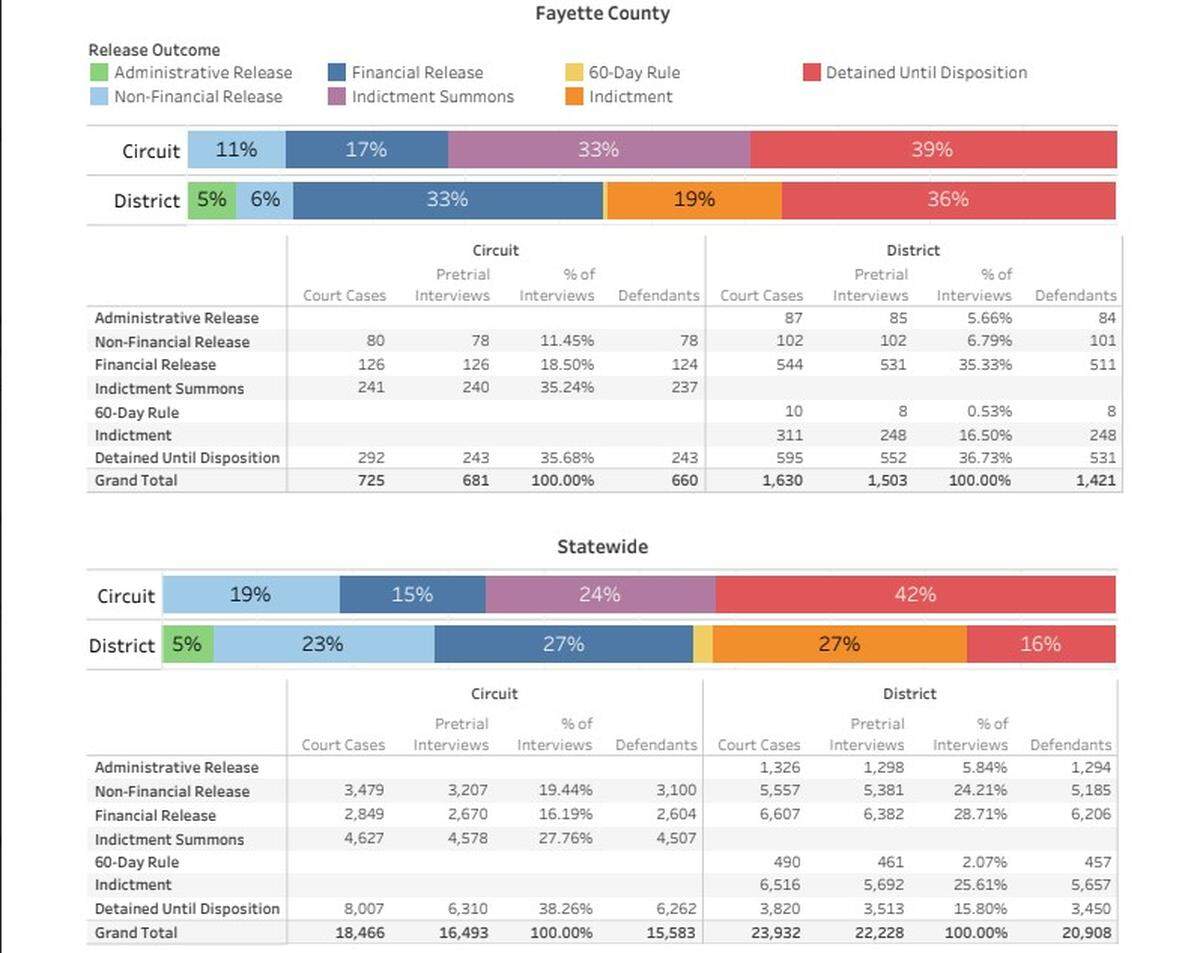
Statewide, 15% of defendants in circuit court, which handles felony cases, posted bail and remained free until their case was completed during the first six months of 2025, according to data from the Administrative Office of the Courts. In Fayette County, that number was 17%.
Significantly more people remained incarcerated while awaiting trial for a felony. Statewide, 42% of circuit court defendants were detained until their case was completed during the first six months of the year. In Fayette County, that number was 39%.
How Kentucky’s bail system works
When a person is arrested in Kentucky, one of their first meetings is with an officer from the state’s pretrial services agency. The officer conducts a risk assessment to determine two factors: the defendant’s likelihood to appear in court, and the likelihood they won’t commit new crimes.
The officer’s findings and a release recommendation are given to a judge, who decides whether to grant the defendant bail.
For lesser crimes, defendants can be released on their own recognizance. More serious crimes typically involve cash bail or, for the most serious crimes, like murder and rape, no bail at all.
But risk assessments can be misleading, said Fayette Commonwealth’s Attorney Kimberly Baird.
For example, if a juvenile committed a crime before adulthood, those charges would not appear on the assessment. So a young adult could score as having no criminal history, with a low risk for reoffending, even if they have significant juvenile criminal history.
Risk assessments also haven’t changed the number of people held while awaiting trial, according to the U.S. Commission on Civil Rights. A 2021 study from the commission found that since judges can overrule the findings of an assessment, such assessments have not reduced the number of pretrial detainees.
The judiciary’s decision-making has proven to be inequitable in Kentucky, too. A 2019 report by the Kentucky Center for Economic Policy found significant variations in pretrial release practices across different counties.
The analysis showed that where you live could affect whether you’re released ahead of trial. For example, Henderson County had an 11% rate of release on non-financial bond in 2019, compared with nearby Daviess County’s 52%.
With five different judges in Fayette County’s criminal court, there are five different potential outcomes, Baird said.
“I wish that were the case that there could be one particular system that says, ‘It is what it is,’ but it really is a case-by-case basis,” Baird told the Herald-Leader. “I would be concerned about removing judicial discretion, but I do wish there was a way to make it more even.”
Could Trump’s order affect Kentucky bail practices?
In Trump’s executive order, issued Aug. 25, the president ordered the federal government to cease funding jurisdictions that support cashless bail policies.
“When these individuals are released without bail under city or state policies, they are permitted — even encouraged — to further endanger law-abiding, hard-working Americans because they know our laws will not be enforced,” the order reads.
While Baird doesn’t think that Trump’s order takes direct aim at Kentucky’s bail policies, she said it is a real possibility that the state’s GOP-dominated legislature could.
The legislature has passed several laws in recent years that they’ve argued are “tough on crime,” most notably House Bill 5, a 2024 law that requires Kentuckians convicted of three violent felonies to face life imprisonment and adds an illegal camping law used mostly to target homeless people.
Baird noted that Trump’s order could empower lawmakers to pust such agendas further.
West, the policy analyst, added that the idea of eliminating defendants’ release on their own recognizance has already been discussed in some parts of Kentucky.
“I’ve heard prosecutors on the other side many times argue against own recognizance. I don’t expect that to decline, and this executive order may give that argument new breath,” West said.
Cash bail disproportionately affects low-income Kentuckians
Financial bail has been criticized for extending the detentions of people charged with low-level offenses who are unable to pay, effectively penalizing them for their poverty.
For example, if two people are charged with the same crime and have a $10,000 bail, the one who can afford it would be released, ahead of trial, while a person who cannot would remain in custody, ultimately losing job security and financial stability.
The high rates of impoverished, incarcerated Kentuckians contribute to what cash bail opponents say punishes the poor and people of color.
Damon Preston, head of Kentucky’s Department of Public Advocacy, said the state still has a long way to go to create a cohesive justice system.
“You want a system that is consistent across jurisdictions,” Preston said. “You would like someone to get treated the same in Hazard, Bowling Green, and Lexington. You want it to work the same amount.”
Opponents of cash bail also say jail overcrowding is a direct result of people being unable to afford bail. Overcrowding can lead to higher costs on local government budgets. It can also lead to individuals taking plea deals, so they can be released.
According to the Vera Institute of Justice, Kentucky counties spend an average of 15% of their annual budgets on jail expenses, amounting to about $90 per jailed resident. The expenses include correctional officers, healthcare staff, food, uniforms and equipment.
Attorney General Pam Bondi has until Sept. 25 to provide Trump with a list of states that have, in her opinion, “substantially eliminated cash bail as a potential condition of pretrial release from custody for crimes that pose a clear threat to public safety.”