
‘Drastic.’ Failing grades tripled in Fayette middle and high schools during pandemic.
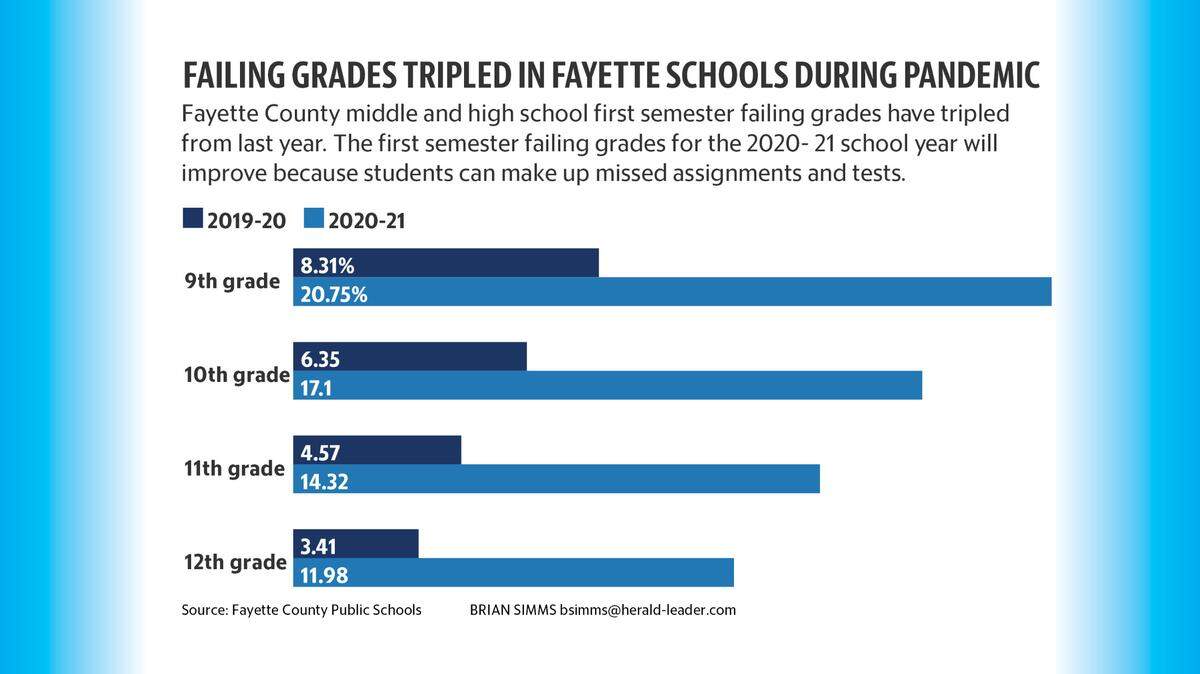
First semester failing grades currently recorded for Fayette middle and high school students in 2020-21 have tripled compared to the first semester of 2019-20 before the COVID-19 school shutdown.
Data obtained under the Kentucky Open Records Act from Fayette County Public Schools of first semester failing grades for the 2019-20 school year, and first semester failing grades for the 2020- 21 school year as of February 13, 2021 show similar troubling patterns to that found elsewhere in the United States:
School districts from coast to coast have reported the number of students failing classes during the COVID-19 pandemic has risen by as many as two or three times, the Associated Press reported in December.
Tracy Bruno, middle schools director for Fayette schools, said district officials were concerned about the “drastic uptick” in failing grades. Principals, who recently attended a workshop on the data, are constantly tracking course failures to see if the situation is improving, he said. And so are teachers.
In Fayette County, 7,899 total final failing grades in middle and high school, or 5.23 percent of all grades, were given in first semester 2019-2020.
A total of 23,488 failing grades for middle and high school, or 15.98 percent of all course grades, have been recorded for the first semester this academic year as of Feb. 13.
The 2020-21 grades provided by the district are not final first semester grades because teachers are still in the process of working with students to complete missing assignments and retake tests, which could in turn raise some grades. Every Fayette school has developed a written plan to ensure students have additional time to make up missing assignments and tests until the end of the school year in May.
In contrast, the 2019-20 grades released by the district actually reflect final first semester grades because teachers already completed this process and had the ability to work with students through the end of the 2019-20 school year last May.
More than half of the failing grades in 2020-21 were given to students who were not participating, including not logging in online, and not turning in assignments, district officials said.
The rise in failing grades is one of many challenges confronting the district during the COVID-19 pandemic, as all classes have shifted to virtual instruction since March 2020.
Fayette schools had originally planned for 6, 9, and 12 graders to return to in-person learning for the first time since March 2020 at the same time as 3-5 graders. District officials anticipate having students in grades 3 through 5 return to campus March 3-5 and K-2 students on Feb. 22. But a shortage of transportation and child nutrition workers is delaying the return of grades 6, 9, and 12.
The district has another challenge in addition to the failing grades:
Of the approximately 40,521 students in the district, officials have not been able to make contact this year with 122 students in grades K-12 who have never logged on or participated from home. Staff made home visits to the students’ home address in district records, spokeswoman Lisa Deffendall said, and still couldn’t make contact. Sixty-four of those students are in grades 6-12.
On any given day, the total student participation rate for all grades K-12 while students learn from home is currently about 94 percent, Deffendall said.
In providing the grade data, Fayette County schools provided the total number of failing and passing grades earned by all middle and high school students for the first semester in this year and last. The district also provided the number of failing and passing grades earned by students who had an attendance rate of 90 percent or higher during the 2019-20 school year and a class participation rate of 90 percent during the 2020-21 school year.
In every grade from 6th through 12th, the percentage of failing grades for all students ranged from two to five times higher this academic year than last. For example, the percentage of failing grades in the ninth grade in 2020-21 was 20.75 percent, up from 8.31 percent the previous year.
When students showed up for classes and participated, fewer failing grades were given. But failing grades in 2020-21 for students who participated were still three times higher than in the first semester last year, increasing from 2.99 percent to 9 percent.
The numbers provided by the district are the sum totals of passing or failing grades earned, and do not represent failing students -- one student could account for eight failing or passing grades.
WFPL News recently reported that In the first term of fall 2019, about 15 percent of about 92,000 Jefferson County students received a failing grade. During the same time period in 2020, while students were learning remotely, nearly a quarter had at least one failing grade, an analysis found.
“Most groups of students, including white and middle- and upper-income students, saw a sharp increase in failing grades during the first six weeks, or first grading term, of the 2020-2021 school year,” WFPL News reported.
The Kentucky Department of Education recently said in new guidance that school districts should use innovations this spring to prevent failure and retention for students who have gotten behind academically.
At the Prichard Committee for Academic Excellence, Brigitte Blom Ramsey, President & CEO, has “been hearing from parents and families across the state with concern about increases in failing grades.”
“Previously A students are now failing,” Ramsey said. “Families of high schoolers are concerned about their students getting into college.”
The fact is, Ramsey said, long term non-traditional instruction, or NTI, is not working for many students.
“This moment has really called for new, innovative ways of teaching and learning, but our teachers nor our students have had time to develop and master those techniques,” she said.
The Prichard Committee is in the process of completing a survey of parents and teachers on grading expectations statewide. That report is expected later this month.
Teaching and learning has looked different during the pandemic, said Fayette high school director James McMillin, so grading and assessment practices will have to look different.
Fayette officials said school leaders are reviewing data every two weeks to ensure that students are making progress. Schools develop plans that are individualized to each student and are frequently monitored.
Fayette school officials are recording participation data daily during remote learning, which allows staff members to look for students with low attendance and engagement. Then, district and school leaders determine the reasons why students are not engaged or are absent.
Denis Beall, the principal of Beaumont Middle School, has been calling one child every morning with their parent’s permission before class starts just to make sure he is up and ready to go to class, Bruno said.
Leestown Middle School principal Joe Gibson has delivered WiFi hotspots to homes. When COVID-19 precautions prevented school staff from entering families’ homes, E.J. Hayes Middle principal Dave Hoskins helped a student log on to the internet from the child’s front porch, said Bruno.
Among high schools, McMillin said every principal is visiting students at home, looking at a list of students who aren’t participating, and manning phones to help with students’ technology problems.
Bruno said truancy charges haven’t been filed this school year and teachers are showing “grace.”
The goal, said Fayette officials, is that by this summer, failing grade data will look more like a normal school year when classes are in person.
Penny Christian, the president of the 16th District PTA that includes Lexington, said she is not too concerned about the increase in failing grades because she thinks students were held more accountable this academic year and there is a plan in place to help them recover.
“I do think if you put things to paper and you let people see that...this grade is an issue, this class is an issue, what it does for teachers, what it does for families and what it does for the district is that it gives you a starting point for what you need to fix,” Christian said.
Christian said she thought allowing the makeup work is “completely appropriate” from an equity standpoint.
“If you have kids and families who are more concerned with being evicted or not having food, then I would suspect their grades would not be a priority,” said Christian.
The Fayette district, meanwhile, is planning what officials are describing as a robust and rigorous summer program to accelerate student learning in preparation for the 2021-22 school year.
In the fall of 2021, students will also be offered before and after school support, such as mentoring and tutoring for academic and social-emotional needs.
This story was originally published February 19, 2021 at 11:27 AM.