
Should KY schools buy wearable panic buttons for teachers? Some experts aren’t convinced.
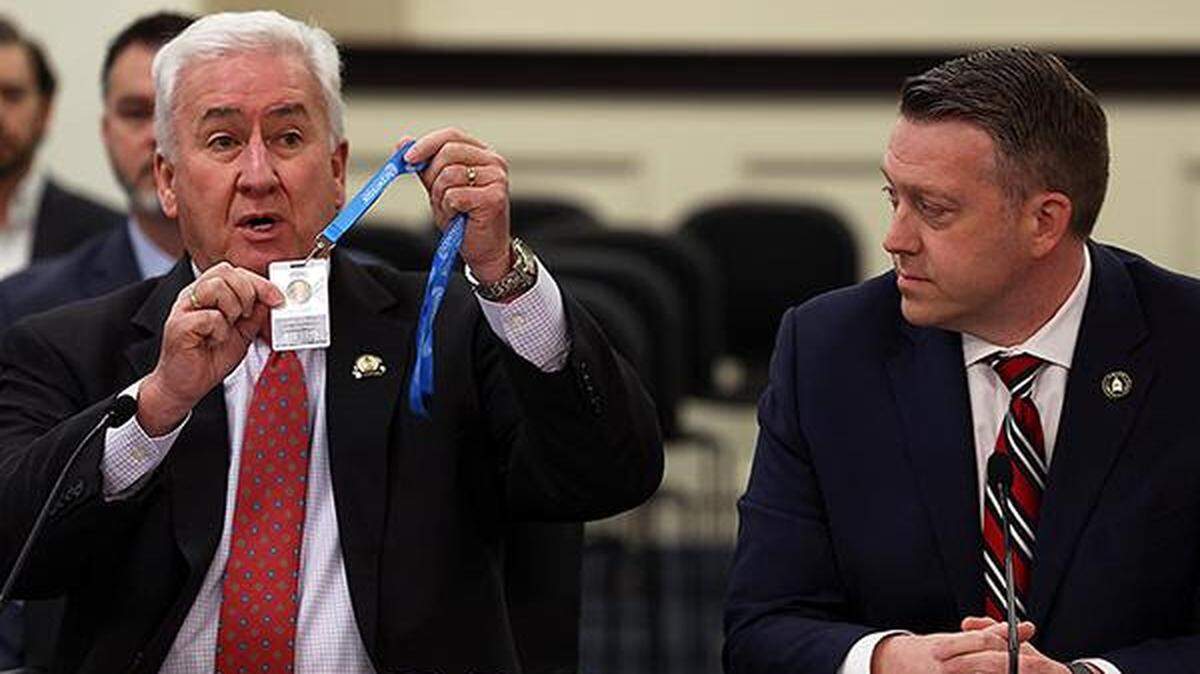
A bill that encourages Kentucky schools to equip staffs with wearable panic buttons has received a legislative committee’s approval, but some school safety experts say the technology is only part of the solution.
House Bill 14 is co-sponsored by Rep. Kevin Jackson, R-Bowling Green, and Rep. Chad Aull, D-Lexington. They told members of the House Primary and Secondary Education Committee meeting the legislation would, beginning in the 2025-2026 school year, allow but not require districts to implement a wearable panic alert system at each school.
Jackson showed lawmakers one that looks much like an I.D. badge on the front and has a silent panic button on the back.
Approved by that committee on Feb. 19, House Bill 14 now goes to the full House of Representatives.
After a September 2024 school shooting that killed two students and two teachers at Apalachee High School in Georgia, “authorities said the devices played a role in law enforcement’s swift response” in apprehending the suspect, according to USA TODAY.
Jackson said the wearable panic buttons are also used in schools when students have medical emergencies or when there are student fights, not just in the event of an active shooters.
The signal can go to the front office, to school officers, or to outside law enforcement depending how many times the button is pushed.
Not the whole solution
Three school safety experts who raised concerns about the use of the systems in the USA TODAY article also talked to the Herald-Leader.
“Technology can be part of the solution, but it’s important to understand the limitations of various products (including panic buttons) and how they can prevent an emergency and/or facilitate its resolution before purchasing them,” Nikita Ermolaev, a Senior Research Engineer for IPVM, an authority on physical security technology, told the Herald-Leader Monday.
“We need prevention, not just crisis response,” University of Virginia Education Professor Dewey G. Cornell added.
Multiple studies show that school shootings are most often prevented by someone making a report that they are concerned about someone planning an attack, and then the school following up on that report to determine whether it is serious, Cornell said.
He noted schools can also distinguish serious threats from threats that are not serious, so that they do not overreact to student misbehavior that does not pose a serious risk.
Behavioral Threat Assessment and Management is a safe, effective and fair process and “ is also far less expensive than the millions that are spent on school hardening measures. We can help troubled students long before they bring a gun to school,” Cornell said.
He said there are many schools in Kentucky using behavioral threat assessment and more should be encouraged and funded to do so.
“There really is no evidence that the panic buttons are going to prevent a school shooting. By the time you hit the panic button, you’re already in panic mode and at that time it’s too late. So this is a reactionary tool,” Kenneth Trump, president of the Cleveland-based National School Safety and Security Services told the Herald-Leader.
Trump, who said he was not related to President Donald Trump, said while there are uses other than school shootings for the panic buttons, such as medical emergencies, the underlying drive is the emotional anxiety around school shootings. There’s just not the data there to show if they are more effective in notifying authorities., he said.
Trump said he also has concerns about how school districts can afford the wearable panic buttons.
Aull said House Bill 14 does not currently fund the cost of the system, but establishes the framework for funding in the biennial budget next year.
“The entire cost (across Kentucky) on the high end would be $6 million and on the low end, it would be about $2 million,” Aull said “And the draft here is a 50/50 match, so the local school district would have some skin in the game as well as the General Assembly.”
There are about 4,000 K-12 school campuses across Kentucky, he said.
Aull said in some cases, there are ongoing maintenance fees of up to $7,000 to $8,000 per campus.
In Fayette County, school district spokesperson Dia Davidson-Smith said, “FCPS is out ahead of this bill due to an aggressive pre-planning initiative and development of a balanced safety approach. This is outlined in the FCPS 10-Point Safety Plan. “
Davidson-Smith said FCPS has a video that is in post-production that will talk about the benefits of these devices and how to effectively train district staff on using them.
COVID school recovery funds, commonly known as ESSR, were used to cover most of the costs, she said, “ but we are still just shy of full implementation. “
“While these wearable panic buttons will help when notifying police and other first responding agencies, school safety is a multi-layered approach and can never be solely dependent on one piece of equipment or plan to effectively increase safety in our buildings,” Smith said.
State Rep. Tina Bojanowski, D-Louisville, a teacher on the House committee, said Jefferson County Public Schools is in the process of implementing a panic alert device.
Some other districts, including Meade County Schools, are already using such a system, Jackson said.
What House Bill 14 would do
Under the legislation, beginning with the 2025-2026 school year, each school district may implement a wearable panic alert system at each school.
In the bill, “wearable panic alert system” means a silent security system by which the user manually activates a device that sends a silent signal to local 911 public safety and emergency responder agencies that indicates a school security emergency. It would require immediate response from authorities.
The wearable panic alert system must connect emergency service technologies to ensure real-time coordination among multiple emergency responder agencies and be capable of initiating a campus-wide lockdown notification.
The state Department of Education must provide a list of approved wearable panic alert systems.
At a minimum, an approved system must alert designated school personnel by smartphone application, phone call, text message, or other technology when an emergency response is initiated on-site using the mobile panic alert system.
It must provide emergency responders with the location and movements of the activator of the wearable panic alert system to help them during an emergency.
It also must Integrate designated school personnel with emergency responders to provide real-time updates during an emergency; and be capable of ingesting data from panic button activations, school safety camera and video data, and other real-time school safety data sources.
Schools will be professionally mapped.
A school district that procures a wearable panic alert system must ensure before the school year begins, all school building personnel receive training; insure all security data, including cameras and maps, are accessible by local law enforcement agencies.
The Kentucky Center for School Safety can distribute wearable panic alert grants to support the school safety fund program in the biennial budget under the bill.
Jackson said vendor representatives helped write the bill, but the bill doesn’t designate a vendor that school districts have to use.
Alyssa’s Law
HB 14 is also called Alyssa’s Law.
Fourteen-year-old Alyssa Alhadeff was among the victims when a gunman killed 17 people at Marjorie Stoneman Douglas High School in Florida in 2018.
Alyssa’s mother Lori Alhadeff testified virtually at the committee meeting in favor of House Bill 14.
She is the founder of the non-profit Make Our Schools Safe. makeourschoolssafe.org , is the website which provides information on Alyssa’s Law. Alhadeff said seven states have passed it.
She said the panic button system doesn’t replace other safety measures, but enhances it.
“ The principle of Alyssa’s Law is simple. Time equals life. And we need to get our kids and teachers to safety quickly and reduce the response time of first responders,” Alhadeff said.
This story was originally published February 26, 2025 at 4:00 AM.