
Kentucky auditor says Fayette schools have been ‘uncollaborative’ during audit
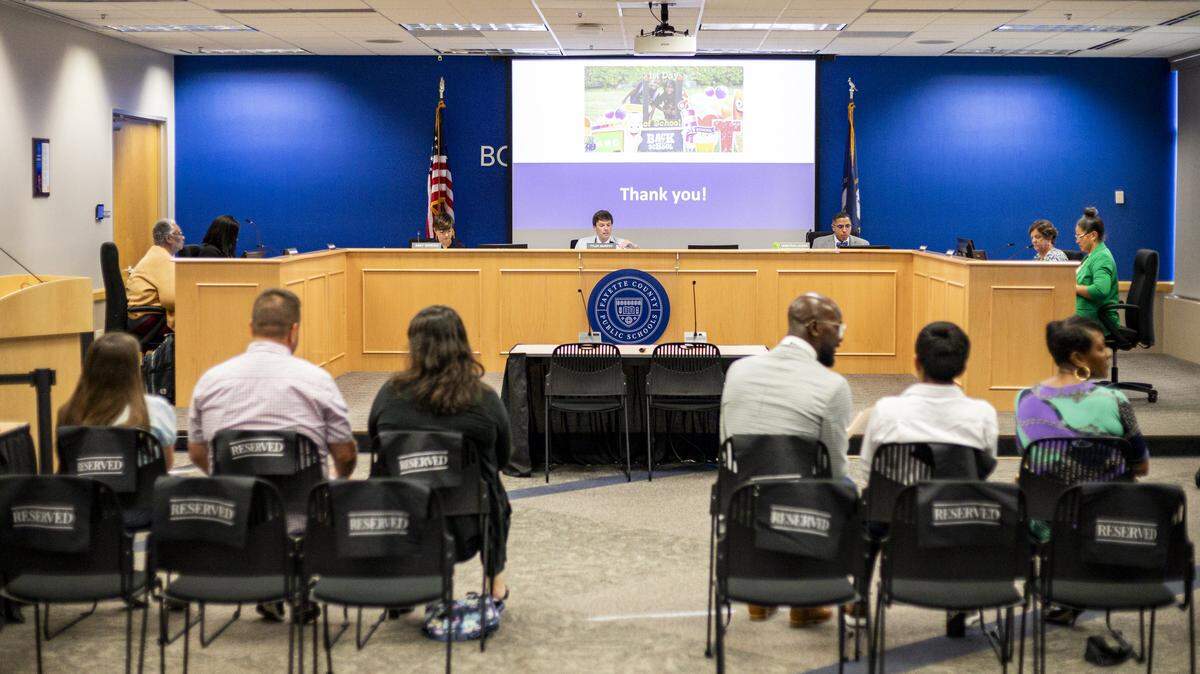
Kentucky Auditor Allison Ball’s office on Monday revealed letters that show they were told “no” when they asked to attend a closed discussion about Fayette County Public Schools’ budget issues as part of their examination of FCPS, and cited other examples of “uncollaborative behavior” from the district.
Ball’s office declined to say when their examination of FCPS might conclude. Ball, a Republican, launched an audit of FCPS last year as the district faced intense scrutiny and several investigations over spending and budgetary problems.
Ball’s office says the district and the Fayette County Board of Education have not been as helpful as the auditor’s office would like, and has even used information from the auditor’s office to seek out other investigations.
“To preserve the integrity of our investigation and avoid any additional gamesmanship from the FCPS board, we believe it is necessary to avoid sharing the anticipated completion date at this time. As an example of this uncollaborative behavior, details from our exam conversations with FCPS were used by them to build (a request for proposals) for an outside auditor to complete an unnecessarily duplicative exam,” Ella Morton, a spokesperson for Ball’s office, told the Herald-Leader Monday.
Ball’s office also provided the Herald-Leader with a March 3 letter from Bryan D. Morrow, executive director in Ball’s Office of special examinations, to Fayette County Board of Education Chair Tyler Murphy and a response to Ball’s office that same day from school board attorney Joshua Salsburey.
Morrow said that Ball’s office wanted to have a representative in a closed school board meeting March 4 which was being held to discuss financial issues, according to Morrow’s letter. Morrow said the closed-session meeting appeared to be directly related to the examination being done by Ball’s office.
Salsburey rejected the request, saying in response, “the Board is not in a position to include the APA in tomorrow night’s closed session, for several reasons: First, while I cannot divulge details about the Board’s closed session discussions, I can tell you the Board does not anticipate any substantive discussion of the APA’s pending review during that time.”
“Second, the closed session is not merely confidential – it will involve privileged attorney client communications that the Board would want not to waive or compromise,” said Salsburey. “Third, the Board may not reach a decision about anything tomorrow night, but once it does, I anticipate being able to send you a copy of whatever related documentation the Board adopts in open session, which should help address the APA’s desire to avoid duplication in its pending examination.”
The Fayette school board has not taken any action against Liggins in public meetings.
In a response Tuesday morning, FCPS said it wants to keep its discussions between the district and the auditor’s office.
“Fayette County Public Schools has already shared its position regarding the March 4 meeting request directly with the Auditor’s office, and we do not have anything further to add beyond that communication,” district spokesperson Miranda Scully said. “We believe it is most appropriate for these discussions to remain between the two offices rather than be debated in the media.
Our focus remains on the important work underway — supporting our students, strengthening our systems, and continuing to move the district forward.”
Ball’s office told the Herald-Leader in February that as part of its special examination of the school district, it is considering the recent findings from an independent investigation that showed Liggins failed to exercise proper oversight of the district’s finance and budget departments.
The report, requested by the school board and written by attorney Leigh Latherow, found Liggins violated multiple internal policies during the district’s budget problems last year.
Latherow found Liggins failed to keep the school board properly informed of the district’s budget situation and did not exercise proper oversight of the district’s finance and budget departments, including its expenses, forecasting and contingency fund tracking.
The district approved an $827.2 million budget for the fiscal year that began July 1, but its contingency fund, or rainy day fund, has dwindled. The district previously said it was facing a since-resolved budget deficit of several million dollars.
Liggins acknowledged making mistakes after Latherow’s investigation was completed.
“As superintendent, I relied too heavily on the leaders and team working in the area of budget and finance every day when I should have been asking sharper questions and demanding more comprehensive detail,” Liggins said in a statement. “My leadership had been intentionally centered on student outcomes, academic growth and the overall health of our school system. “While those priorities guided my focus, I regret that I was not more hands-on in the day-to-day operations of budget and finance.”
Liggins has said he now has direct oversight over those departments.
Not the first audit for FCPS
In November 2025, the FCPS audit committee recommended that the Texas firm Weaver and Tidwell conduct an audit of the district.
A staffer at Weaver and Tidwell did not immediately respond to an email Monday from the Herald-Leader asking when that audit would be complete. Scully on Monday said she didn’t know when the audit would be complete.
Another investigation finds ‘systemic’ issues
Earlier in March, another independent investigation into Fayette County Public Schools’ budgeting practices “identified systemic deficiencies in forecasting, financial monitoring, and internal communication,” according to the investigation.
The law firm of Tueth, Keeney, Cooper, Mohan and Jackstadt, in Missouri, found there was unauthorized use of the district’s contingency — or rainy day — fund, which resulted from breakdowns in communication among senior personnel and repeated failures to timely identify and address emerging budget deficits.
Liggins asked for the law firm’s investigation, which was centered on Liggins’ staff rather than him.
Liggins said there was no “intentional misconduct” found in the investigation, but admitted there were “significant systemic deficits in budgeting and financial processes, as well as breakdowns in communication and collaboration, that must be addressed.”
The district acknowledged last year it was facing a projected $16 million budget shortfall, and a contingency fund that was expected to be big enough to fill that gap actually held much less money than expected, district officials said.
After the investigation was finished, Liggins said steps have been taken to put the district’s finance and budget departments under his oversight, and said he’s strengthening communication and accountability in those departments.
“I am reviewing this investigation’s conclusions and recommendations to determine what additional actions are needed to strengthen the district’s financial practices,” Liggins said.
Liggins also said FCPS is now operating under a balanced budget with a contingency fund “well above state requirements.”
This story was originally published March 24, 2026 at 9:14 AM.