
Kentucky's public universities face a tough financial future, credit agency warns
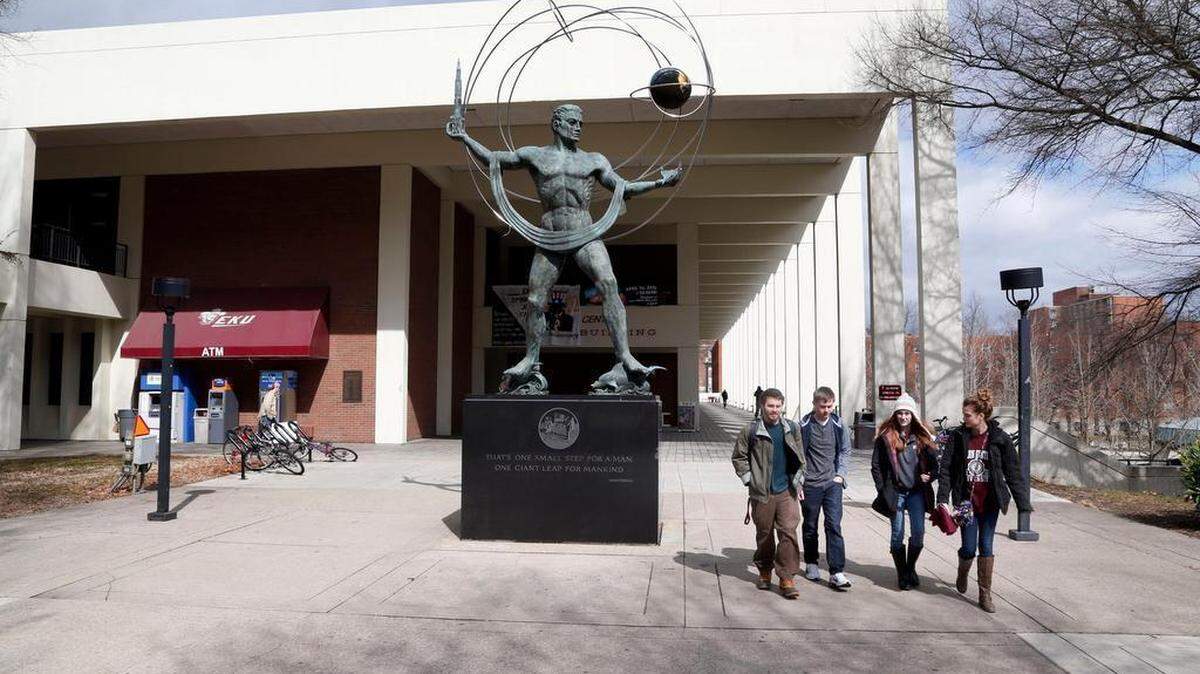
Kentucky's nine public universities face a tough future because of worsening state budget cuts, growing pension obligations and a shrinking number of high school graduates who will struggle to afford the fast-rising tuition, according to a new report.
"Competition for enrollment will continue to heighten with a lagging pool of high school graduates in Kentucky and adjacent states," national credit ratings agency Moody's warned in a report released Monday.
"Softened demand and limited pricing flexibility are also hindered by Kentucky's weak socioeconomic profile," analysts for Moody's wrote. Rising tuition could be unaffordable for many families because "the state has posted persistently lower wealth levels, and a large percentage of its population is below the poverty rate compared to national averages."
The 10-page report analyzed the financial challenges facing Kentucky's universities, including the University of Kentucky, the University of Louisville and the Kentucky Community and Technical College System.
Operations have suffered across all the universities, with job eliminations and program closures occurring as state funding dropped by 21 percent, or roughly $190 million, from 2008 to 2017, according to the report.
While lawmakers slashed state support for higher education, the burden shifted to students and their parents to make up some of the difference. Tuition revenue soared by 50 percent on average from 2008 to 2013 and then by 13 percent more from 2013 to 2017. In-state tuition at UK and U of L topped $12,000 a year in 2017, not counting housing, student fees or other costs, according to the report.
However, there may be limits to how much Kentucky's universities can rely on tuition hikes, Moody's warned.
Apart from the state's relative poverty compared to the rest of the nation, Kentucky is expected to produce fewer incoming freshmen in coming years. There was a slight 2 percent drop in graduating high school seniors from 2012 to 2017, from 47,290 to 46,388, a trend that is likely to continue.
To overcome this population trend, the report said, Kentucky universities will have to draw more of their students from outside Kentucky and charge them the more expensive out-of-state tuition. UK already has boosted its out-of-state enrollment by 13 percent since 2008, with many students coming from Ohio, Illinois, Indiana, Georgia and Tennessee. By contrast, Northern Kentucky University, Eastern Kentucky University and Morehead State University all have lost out-of-state enrollment since 2008, the report said.
Overall, UK and U of L are in a stronger position than the smaller regional universities to weather the storm ahead, Moody's said.
For one thing, many employees of regional universities are enrolled in the state's two major pension systems, which collectively face more than $40 billion in unfunded liabilities. That means those schools must dedicate more of their budgets every year — many tens of millions of dollars — to paying down their pension obligations.
EKU's net pension liability in the 2015-17 budget, for example, was $592 million, Moody's said. (EKU's total debt, including its pension liability, was 3.1 times its operating revenue — the highest for any of the universities and "well in excess of the 1.2 times median for all public universities," Moody's advised.)
UK and U of L provide defined-contribution retirement plans to their employees and do not participate in the state's pension systems, so they are not carrying that massive liability on their books.
Also, UK and U of L have "greater scale" than the regional universities — more students, more programs, more money, Moody's said.
For example, UK has a medical school and a law school, a nationally recognized athletic program and $3 billion in operating revenue and $1.8 billion in spendable cash and investments. This "provides a greater financial cushion compared to a regional institution such as Morehead State, with $134 million in operating revenue and $41 million in spendable cash and investments."
When Kentucky's universities are forced to compete against each other for a dwindling supply of students, UK is going to have an edge because it can market itself better and make "large strategic investments in capital projects and academic programming," Moody's said. In fact, UK recently has spent $2.1 billion in improvements to campus buildings, and it entered a partnership with a private company to add $450 million in new student housing on campus with nearly 6,900 beds.
This story was originally published June 26, 2018 at 11:50 AM with the headline "Kentucky's public universities face a tough financial future, credit agency warns."