These bills would help KY’s bursting prisons and jails. Here’s why they’re stalled.
This winter, Democratic Gov. Andy Beshear and members of the Republican-led General Assembly have called for “criminal justice reform” to shrink Kentucky’s expensive inmate population — currently 34,940 between the prisons and jails — and more wisely deal with addicts who commit nonviolent crimes.
“Our incarceration rate has skyrocketed since 2004,” Beshear recently told the Herald-Leader. “It’s absolutely unsustainable.”
Lawmakers filed more than a dozen bills this session to address the problem from different angles, such as making bail more affordable for poor people incarcerated for months while awaiting trial; limiting probation and parole revocations so fewer people on supervised release are put behind bars; giving juries control over “mandatory minimum” prison sentences; and granting work release to more of those jailed for non-payment of child support so they can clear their debts.
Collectively, these bills could save taxpayers many millions of dollars a year, according to legislative staff estimates. But most of them haven’t even gotten a committee hearing. Some, like the affordable bail bill, have cycled through multiple drafts behind the scenes as opposing interest groups argue over their wording with sponsors.
Time is running short. Fourteen days remain in the 60-workday legislative session as of Monday. Similarly ambitious efforts have failed in past sessions.
“At this point, I can’t tell you what will and will not make it,” said House Judiciary Chairman Jason Petrie, R-Elkton.
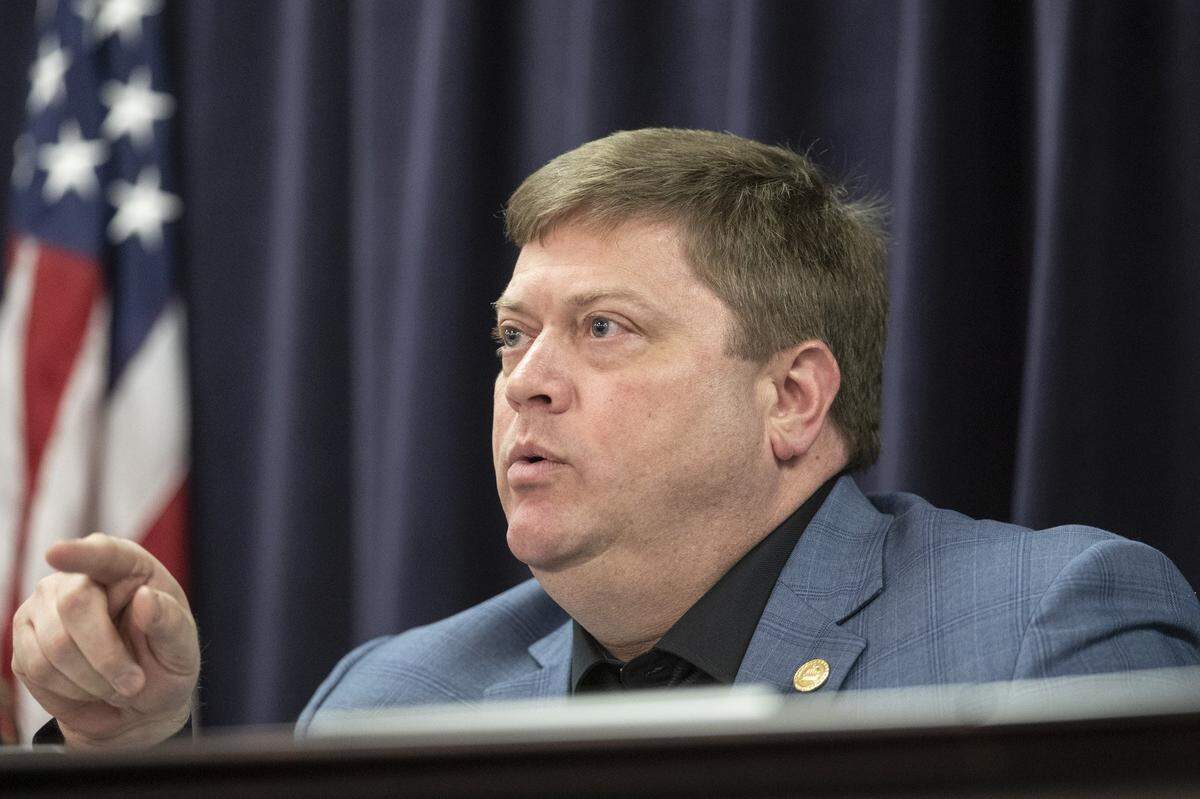
Petrie is sponsoring or co-sponsoring several of the criminal justice reform measures, including the affordable bail bill, and his committee is one bottleneck through which they must pass.
A few bills slowly moving through the legislature could produce “ripple effects,” collectively making the justice system fairer and more efficient, Petrie said. Anything more sweeping than that will be a challenge, he said.
“A major difficulty is that when you ask people what criminal justice reform is and whether we need it, everyone will say ‘Yes.’ But then when you ask, ‘What modifications do we need to make?’, if there are 30 people in the room, you’ll have 40 answers,” Petrie said.
“Now, you try to get those 40 answers from 30 people down onto 20 bills that can be voted on and moved by an even greater number of people, and there’s your problem,” he said.
The stakes are high. Spending at the Kentucky Corrections Department is expected to hit $676 million by Fiscal Year 2022 — a 43 percent increase over the last decade. From a human rights standpoint, all the state’s prisons are full and many of its local jails are dangerously overcrowded while other states are enjoying a decline in incarceration rates without a corresponding rise in crime.
Finding ways to be “smart on crime” has become a popular theme among many conservatives as well as liberals. There are plenty of Republican sponsors of criminal justice reform bills this year. One is state Sen. John Schickel, R-Union, a retired jailer and police officer who filed Senate Bill 235 to give individual juries some discretion in how severely certain felonies are punished. Schickel’s bill awaits a hearing before the Senate Judiciary Committee.
However, advocates say their efforts face two significant obstacles.
One is that lawmakers still fear being labeled as soft on crime in election campaigns. The other is that so many groups from across the ideological spectrum have an interest in the justice system, including locally elected jailers, prosecutors and judges who consider their bosses to be their own communities, not a reform-minded governor and General Assembly in Frankfort.
The Kentucky Fraternal Order of Police, for example, publicly criticizes bail reform, saying it has led to the release of dangerous criminal suspects in other states. Simultaneously, reform groups in Kentucky protest that recent drafts of Petrie’s affordable bail bill would be “a step backward” from the status quo because he is adding too many narrow restrictions in order to please critics in law enforcement.
“You’ll get these different groups that support you on one bill but then oppose you on others,” said Amanda Hall, who lobbies the legislature on criminal justice reform for the ACLU of Kentucky.
“It can be tough to get a read for where people are going to stand,” Hall said. “The jailers association will like a bill but the FOP (Fraternal Order of Police) won’t. The business groups will support us on certain bills but then the retailers federation has concerns about any effort to raise the felony theft threshold above $500 because they have problems with shoplifting in their stores.”
The theft bill Hall referenced, House Bill 424, is one of the few to advance so far this winter. It would raise the level at which a theft changes from a misdemeanor to a felony — which means a stiffer sentence, as well as a life-altering felony conviction on one’s record — from $500 to $1,000. The felony theft threshold hasn’t changed in Kentucky for decades.
“Every state that is contiguous to Kentucky has a felony theft threshold of at least $1,000 or higher,” state Rep. C. Ed Massey, R-Hebron, told the House Judiciary Committee on March 4 before it approved the bill and sent it to the full House.
“A lot of people who are stealing things, frankly, are doing that to feed addictions,” Massey said. “They need to be treated. They need to be getting the help they need or they need to be put into some kind of a treatment program, and we would like to leave that to the discretion of the court that has the ability to see what everything is.”
One of the state’s more vocal prosecutors, Kenton Commonwealth’s Attorney Rob Sanders, said he doesn’t object to raising the felony theft threshold. No prosecutor that he knows pursues a felony charge for less than $1,000, anyway, Sanders said.
But other reform bills filed this session seem to defy common sense for law enforcement professionals who spend careers at crime scenes and in courtrooms, Sanders added. For example, House Bill 586 would lower the penalties for drug possession if the amount of drugs in question could be defined as “trace amount” or “residue.”
“We think that simply rewards someone for having consumed the drug before they were arrested,” Sanders said.
“It is mind-boggling how much damage they (the lawmakers) can do on very short notice if we aren’t paying attention to what is going on,” the prosecutor said. On the struggle to agree on a bail reform bill, he said: “The problem is, it’s trying to legislate good, sound judicial discretion, and I don’t think there is any way to legislate discretion by any elected official, including judges.”
People keep pushing Kentucky to lower its incarceration rate without fully discussing the behavior that led so many inmates to get imprisoned in the first place, said Drew Fox, who lobbies the General Assembly for the Kentucky Fraternal Order of Police.
There are more reduced charges through plea deals in the courts than the public might realize, Fox said. By the time someone is serving years behind bars, he typically has burned through his second and third chances with repeat offenses, Fox said.
“From our perspective, it’s not that cops are just automatically advocating, ‘Hey, lock ‘em up and throw away the key,’” Fox said. “It’s that we’re the ones in the neighborhoods dealing with the victims and chasing down the people who victimized them.”
Reform groups say they take pride in several measures with widespread support this winter that should make the justice system fairer even if they won’t reduce incarceration rates.
Most notable of these is the restoration of voting rights to most categories of felons who have served out their sentences. Beshear issued an executive order on voting rights shortly after taking office in December. Lawmakers have followed up with Senate Bill 62, a proposed state constitutional amendment that the Senate passed Feb. 27 and sent to the House, which has amended it.
“We do appreciate the voting rights bill, the expungement bill that would let people clear their records and efforts like that,” said Ashley Spalding, research director at the Kentucky Center for Economic Policy in Berea.
“But while we still have some time, we’d hope to see some of these other bills that would affect incarceration make it through the process and become law,” Spalding said.
“I can tell you, there have been a surprising number of really good reform bills at least filed this session by a number of different people,” she said. “I find that to be an encouraging development. A few of them are making it over to the opposite chamber. So I’m trying to be hopeful here.”
These bills would reduce Kentucky’s incarceration rate
▪ House Bill 221: Drug possession. This bill would make the possession of marijuana in a quantity intended for personal use — defined as 100 grams or less — a civil offense punishable by a small fine rather than a criminal offense bringing a jail term. It would save more than $1 million a year in reduced incarceration costs, according to one estimate. It has yet to be heard by the House Judiciary Committee.
▪ House Bill 284: Probation and parole. This bill would reward people on supervised release who complete approved programs, such as addiction treatment and life skills classes, by reducing the length of their supervision by up to 90 days. It would save an estimated $4 million over time, according to one estimate. It has been passed by the House Judiciary Committee and the House; the Senate Judiciary Committee amended it and sent it to the Senate.
▪ House Bill 410: Bail reform. This bill is a work in progress — which means it’s being rewritten a lot — but generally, it’s supposed to set specific, consistent and reasonable standards for how judges assign bail to criminal defendants so people aren’t stuck behind bars for months, awaiting trial. It has yet to be heard by the House Judiciary Committee.
▪ House Bill 424: Felony theft. This bill would raise the felony theft threshold — the point at which theft rises from a misdemeanor to a felony — from the current $500 to $1,000. The estimated savings in reduced incarceration costs would be $9.6 million a year. The House Judiciary Committee and the House have passed it, sending it to the Senate.
▪ House Bill 523: Child support. This bill would require a person incarcerated for nonpayment of child support to be granted work release so their wages could pay down their obligations. Currently, people charged with nonpayment might spend weeks or months in jail while their children get nothing. It has yet to be heard by the House Judiciary Committee.
▪ House Bill 524: Probation and parole. The bill would waive the fees for people on probation or parole, either for the first six months of their supervision or throughout their period of supervision, unless it was determined that they had the ability to pay. This could reduce the number of poor people sent to jail for not paying fees they can’t afford. The bill has yet to be heard by the House Judiciary Committee.
▪ House Bill 525: Probation and parole. This bill would shorten the lengths of incarceration for certain violations of probation and parole, such as nonpayment of fees, and limit the terms of imprisonment per revocation to 30 days for the first, 90 days for the second, and so on. It has yet to be heard by the House Judiciary Committee.
▪ House Bill 552: Probation and parole. This bill would stop judges from revoking probation or parole — requiring a defendant to serve the remainder of his time behind bars — until they consider other graduated penalties as established by the Kentucky Department of Corrections. The House Judiciary Committee approved it and sent it to the House.
▪ House Bill 563: Persistent felony offender. The bill would let juries use their own discretion on whether to hand down tougher penalties to persistent felony offenders. Currently, if prosecutors apply the persistent felony offender law to someone with past convictions, mandatory minimum sentences can turn a shoplifting arrest into five to 10 years in prison. The bill has yet to be heard by the House Judiciary Committee.
▪ House Bill 586: Drug possession. This bill would reduce the penalties for drug possession when the amount of drugs is either a “trace amount” or “residue,” lowering the severity from a Class D felony to a Class A misdemeanor or from a Class A misdemeanor to a Class B misdemeanor, depending on the circumstances. The House Judiciary Committee approved it and sent it to the House.
▪ Senate Bill 128: Jail programs. This bill would pay local jails a higher reimbursement rate to house state inmates if they offer approved rehabilitation programs for education, job training or addiction treatment. Also, state inmates could be released early for completing the programs. Currently, roughly half of the state’s 24,000 inmates are held in local jails, most of which have little to no programming. The bill has yet to be heard by the Senate Judiciary Committee.
▪ Senate Bill 139: Child support. This bill would raise the size of the debt that qualifies a non-custodial parent for the felony of “flagrant nonsupport,” from $1,000 to $10,000, and lengthen the time period from six to 12 months. It also would specify that a person jailed for nonsupport should be permitted work release so he can pay down his debt. This bill has yet to be heard by the Senate Judiciary Committee.
▪ Senate Bill 235: Jury discretion. This bill would let juries recommend that a Class D felony, punishable by up to five years in prison, instead be designated and sentenced as a Class A misdemeanor, punishable by up to a year in jail. It also would allow juries to decide whether a persistent felony offender should face the tougher penalties that usually go with that designation. This bill has yet to be heard by the Senate Judiciary Committee.
This story was originally published March 6, 2020 at 2:09 PM.