No-knock warrants ban fell short, but KY lawmakers delivered other justice reforms
It could take larger sums of money to trigger felony charges for theft and failure to pay child support in Kentucky, while juvenile offenders and pregnant inmates could receive better treatment in court and prison, respectively.
The Kentucky legislature sent four criminal justice reform bills to Gov. Andy Beshear’s desk before adjourning Tuesday for a two-week veto break.
Four other reform bills are still waiting near the finish line in the House and Senate, with uncertain futures.
That list of pending items includes Senate Bill 4, a proposed set of restrictions — not, in its current form, a ban — on no-knock warrants by police, sponsored by Senate President Robert Stivers, R-Manchester. The bill was filed in response to the March 13, 2020, fatal shooting of Breonna Taylor by Louisville police while serving a warrant.
House Bill 21, a much stronger bill that would have banned no-knock warrants and set new rules for police body cameras and police disciplinary procedure, was filed by state Rep. Attica Scott, D-Louisville, one of the legislature’s few Black lawmakers. But Scott’s bill, which was to be called “Breonna’s Law,” never moved.
Unlike the 2018 legislative session, when a sweeping, 126-page criminal justice reform bill intended to shrink the state’s prison population was blocked by conservative lawmakers, criminal justice reformers this winter won some battles with a handful of more targeted efforts.
“I’m very satisfied, very happy with the bills we got through,” Senate Judiciary Chairman Whitney Westerfield, R-Crofton, said Friday.
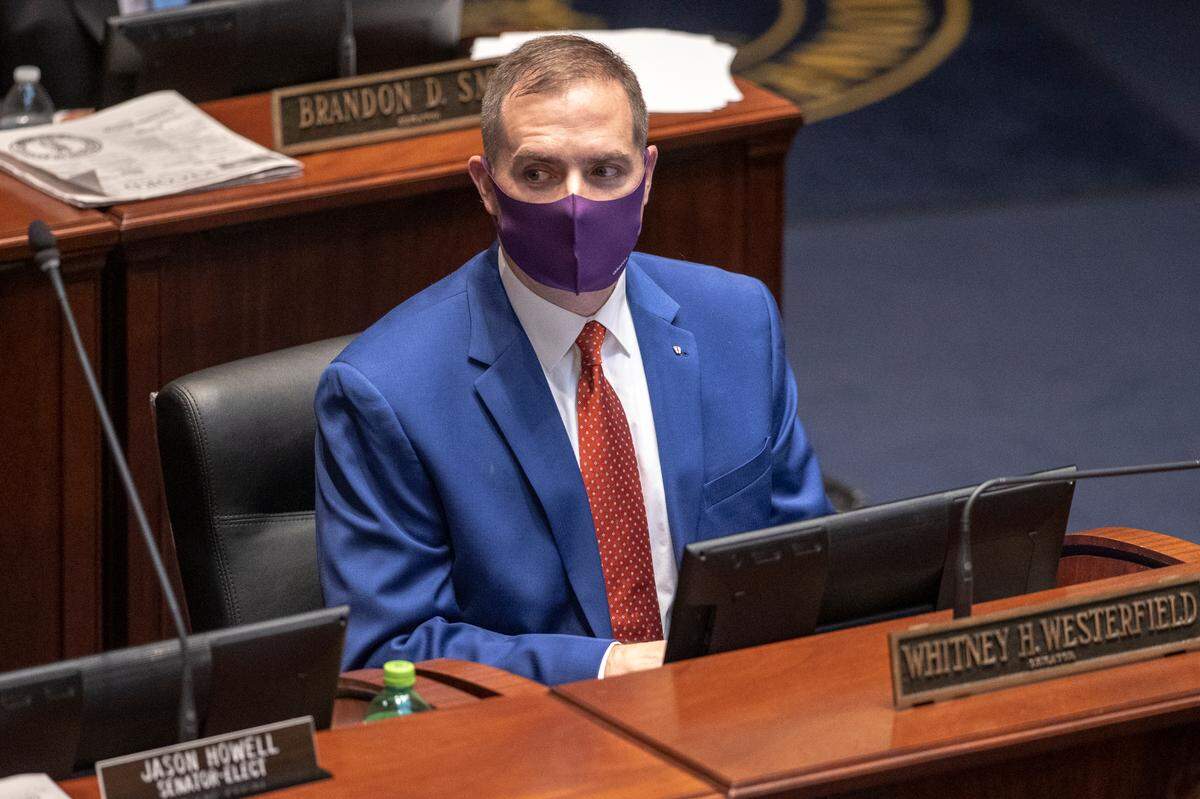
“The issue with criminal justice policy is that the solution that feels right is often not the one that objectively proves to be right,” Westerfield said. “It may feel right to us to be harsh and to punish someone who does something wrong. But objectively, that does not always prove to be the right solution in every case.”
Westerfield’s top priority this session was Senate Bill 36, which would end the automatic transfer of juvenile offenders in certain cases to circuit court, where they are tried as adults. Instead, judges would have to hold a hearing to determine, based on the evidence, whether each transfer is appropriate.
In Kentucky courts, black children are 60 percent of the juvenile offenders automatically sent to circuit courts for prosecution, although they comprise just 11 percent of the state’s child population, according to the Children’s Law Center in Covington.
“Transferring children to adult court causes lifelong and often devastating effects,” the Children’s Law Center said earlier this month in a statement supporting Westerfield’s bill. ”Children transferred to adult court are subject to all adult penalties, with the exception of the death penalty and life without parole.”
Westerfield’s actual bill got gummed up in the legislative process, but a friendly House colleague inserted the measure’s language into another bill that landed on the governor’s desk Tuesday.
As usual, some law-and-order lawmakers pushed back against the reform bills.
State Rep. John Blanton, R-Salyersville, told colleagues at a House Judiciary Committee hearing in February that his chief concern is public safety, and so a growing prison population does not necessarily bother him.
“Many of the things I see under the title ‘criminal justice reform,’ all I see us do is endanger the citizenry in an effort to lower the number of people we have incarcerated,” said Blanton, a retired Kentucky State Police officer. “People are incarcerated because they have committed crimes. Simply wiping crimes off the book doesn’t make us safer.”
What made it
Other than Westerfield’s juvenile offender measure, the three bills that made it to Beshear’s desk are:
▪ House Bill 126, which would raise the felony theft threshold in Kentucky for the first time since 2009, from $500 to $1,000. Thefts worth less than $1,000 would be a misdemeanor, although three or more such theft convictions in a five-year period could be enhanced to a Class D felony.
There are several thousand state prisoners in Kentucky serving time for Class D felony theft or fraud charges, so changing the valuation between misdemeanor and felony theft could have a big impact, according to a corrections impact statement attached to the bill.
Supporters said a new cell phone can cost about $500, and a theft on that level should not send someone to prison for up to five years and mark them as a convicted felon for the rest of their lives.
“Values of things have increased,” the bill’s sponsor, state Rep. C. Ed Massey, R-Hebron, told the House Judiciary Committee on Feb. 3. “We need to keep up with the valuation as values of things increase in our society.”
A 2017 report from the Pew Charitable Trusts found that most U.S. states have raised their felony theft thresholds since 2000, usually to somewhere between $1,000 and $2,500.
During that same period, property crime rates fell in most of those states, due to a variety of factors, including an aging population less prone to criminal behavior and better security technology, according to the report.
▪ House Bill 402, which would raise the amount of money owed for child support that qualifies as a felony, legally known as “flagrant nonsupport,” from $1,000 to $2,500. Initially, the bill would have raised that amount even higher, to $5,000, but opponents reached a compromise with the sponsors at $2,500.
▪ Senate Bill 84, which would prohibit Kentucky jails and prisons from placing inmates who either are pregnant or mothers of newborns in restrictive housing, administrative segregation or solitary confinement. It also sets rules for the care of inmates’ infants for 72 hours after birth.
The bill’s sponsor, state Sen. Julie Raque Adams, R-Louisville, told her colleagues that prisons and jails have failed to adapt to the fast-growing population of female inmates, and the fact that many of those inmates are pregnant.
What fell short
Other than Stivers’ no-knock warrants bill, which awaits a vote on the House floor when lawmakers return March 29, the other three pending reform bills are:
▪ House Bill 497, which would try to help newly released state inmates get a job. The bill would require the state Department of Corrections to help departing prisoners write a resume for job applications and provide them with various useful documents, including proof that they completed educational and vocational programs while they were behind bars and a driver’s license or personal identification card.
This bill awaits a final vote by the House to concur with changes made by the Senate.
▪ House Bill 148, which would ban the death penalty for Kentuckians with certain severe mental illnesses. After overwhelmingly passing the House on March 1, with no debate, the bill now appears stalled on the Senate floor. The Senate blocked a similar death penalty bill last year that was sponsored by one of its own members.
▪ House Bill 25, which would open the Kentucky Educational Excellence Scholarship program to students with felony convictions.
KEES funding is available to high school students and GED recipients, to help pay for college costs, based on their grades and test scores. But it’s not available to felons. According to the Kentucky League of Women Voters, more than 300,000 people in the state have been convicted of a felony, a disproportionate number of them Black men.
The House voted 96-to-2 to pass HB 25 last month, but it’s awaiting action on the Senate floor.