‘Set up for failure.’ KY youth worker claims pressure to water down incident report.
READ MORE
Juvenile Justice
State records substantiate at least 116 ‘special incidents’ with juvenile justice employees over the last three years.
Expand All
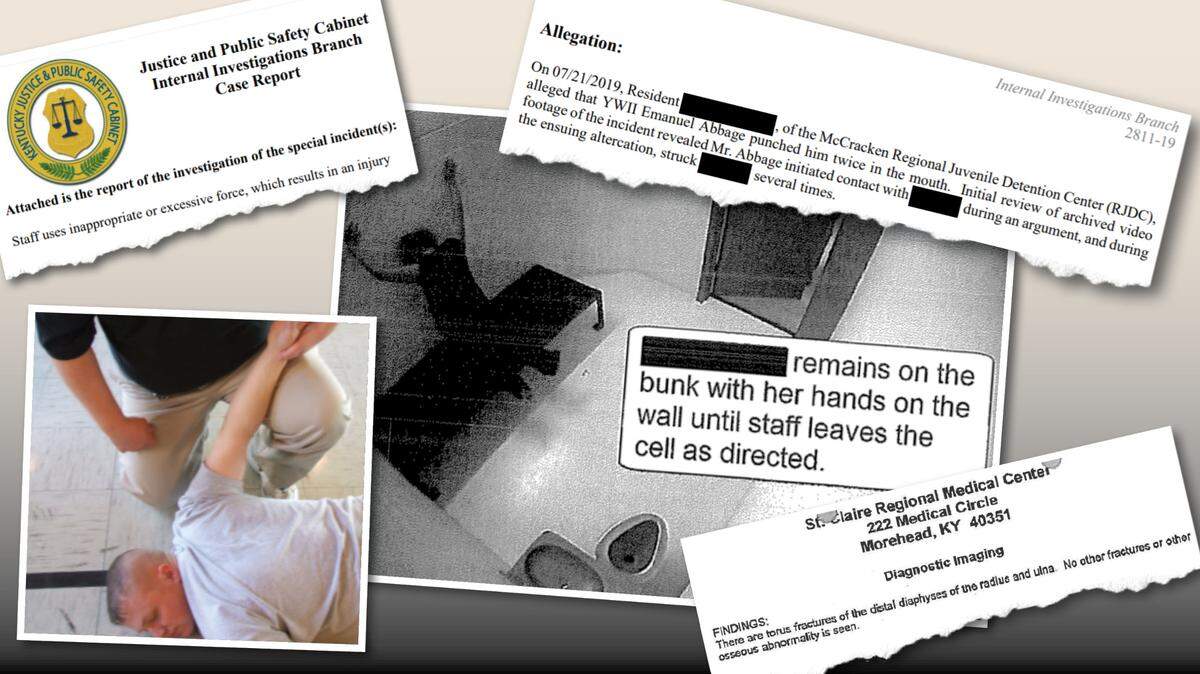
‘So many flaws.’ Broken bones, abuse and isolation inside Kentucky juvenile lockups.
‘He just lost it.’ A sample of abuse cases from KY juvenile detention centers.
‘Set up for failure.’ KY youth worker claims pressure to water down incident report.

The story of the KY Department of Juvenile Justice is a cycle of scandals & lawsuits
Youth worker Jezreel Bell said it was an accident when an adolescent boy fell and hurt his head on Sept. 24, 2020, inside the Warren Regional Juvenile Detention Center, ending up at the hospital for an examination.
The bigger problem is what Bell failed to mention afterward in his incident report: The leg-shackled boy didn’t just fall down, Bell shoved him to the floor during a restraint.
In a recent interview, Bell said his omitting that fact was the result of pressure from his superiors and a common tactic employed by the Kentucky Department of Juvenile Justice to avoid lawsuits.
“The way I was trained to write reports, they never wanted you to use direct words like ‘hit’ or ‘struck,’ or ‘push’ or ‘shove,’” Bell told the Herald-Leader on his last day on the job in early September. Bell quit after serving as a youth worker for more than two years. “You never ‘pushed somebody down,’ you ‘assisted them to the floor.’”
“They want you to make it sound as buttery as possible. They want you to make it sound like you used all the right Aikido moves, all the training moves. But truthfully, all the training that they teach you doesn’t do crap,” he said.
The Department of Juvenile Justice teaches its employees Aikido Control Training, which is supposed to be a nonviolent method that uses joint locks and circular movements to control someone instead of the kicks and punches used in other martial arts.
The department and its parent agency, the Kentucky Justice and Public Safety Cabinet, refused repeated interview requests from the Herald-Leader.
In a prepared statement, the department said: “DJJ leadership has not received any reports regarding the allegations of facilities or individuals being encouraged to be untruthful in the course of incident reports and investigations.”
“However, DJJ will further review the circumstances described in the information you presented and take appropriate action if any violations of policy are found,” the department said.
A boy hits his head
The incident happened at the Warren Regional Juvenile Detention Center, a maximum-security facility in downtown Bowling Green with 48 beds for youths awaiting trial.
The boy was 12 years old, but he was very aggressive, lashing out, Bell said.
“He had to be restrained three times that night,” Bell said.
During the episode in question, Bell and several of his colleagues spent 18 minutes struggling to get the boy under control, according to a report written later by the department’s Internal Investigations Branch. They cuffed his hands and chained his ankles together. Next, they locked him alone in a small room to calm down.
A few minutes later, though, they decided to go in after him. The boy had managed to free his hands, and he was pelting the small window and security camera with wads of toilet paper that he soaked in the toilet bowl. Bell and his colleagues went inside to take away the toilet paper roll.
During a brief struggle as Bell tried to exit the room, the boy clung to his shirt, according to a written summary of security video footage of the incident. Bell used his right hand to chop down three times on the boy’s left hand, finally breaking the grip.
Then Bell shoved the leg-shackled youth backward, away from him.
Unable to fully move his legs and feet to balance himself, the boy fell, hitting his head on the concrete floor with an audible “thud,” according to an internal investigators’ report written weeks later.
The boy vomited and cried. An ambulance took him to the hospital for treatment of a small injury on top of his head and examination for a possible concussion.
Bell told the Herald-Leader that he felt awful about the incident.
“It was not my intention to knock him down,” Bell said. “As much grief as he gave me, I was not trying to hurt him. I didn’t have any kind of vendetta against him. I mean, he was a 12-year-old kid.”
Leaving out a key fact
However, in his written account of the episode for the record later that day, Bell misreported the facts. He didn’t mention that he shoved the boy. He just said that during a restraint the boy tripped, fell and hit his head.
“Our report was accurate right up until the very end where I did not say the word ‘shove.’ But I should have. I really should have. Because that’s what happened,” Bell said. “That I regret. That I definitely regret.”
“Multiple interview statements” from staff likewise said that the boy tripped and fell, not that Bell shoved him down, internal investigators wrote in their own report later. The staff also failed to document the boy’s injuries by taking photographs, which is the customary procedure when a juvenile is hurt on the premises.
Bell told the Herald-Leader that youth workers are pressured to omit reference to any actions in incident reports that could put the department in a legally vulnerable position.
“That’s why I wrote the report that way,” Bell said. “They want you to write it that way to avoid getting sued.”
“I felt pressured by my superiors, and I did it to make them happy,” Bell said. “But I take full responsibility for that. I shouldn’t have given into that. I screwed up there.”
The department opened an internal investigation after the boy called its hotline to report the incident. Once the investigators reviewed video footage and interviewed everyone involved, they concluded that Bell used excessive force and that his incident report omitted his active role in the boy’s injury.
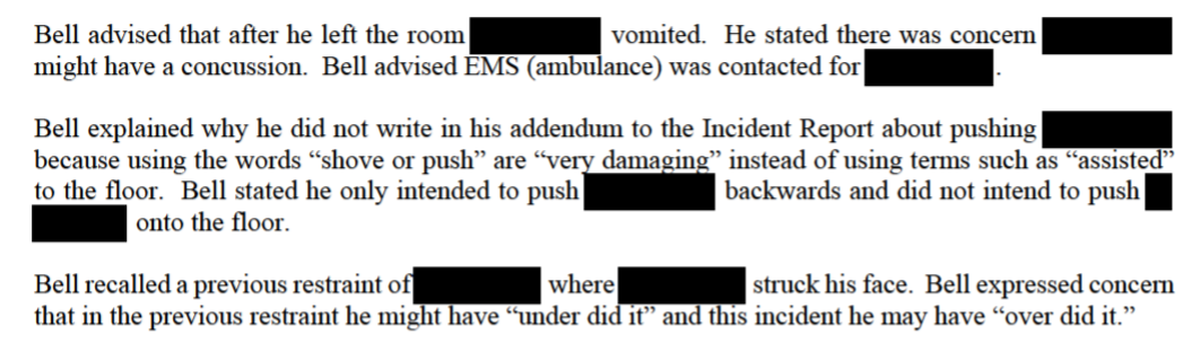
When confronted, Bell acknowledged to the investigators that he deliberately watered down his incident report.
“Bell explained why he did not write in ... the incident report about pushing (the boy), because using the words ‘shove or push’ are ‘very damaging’ instead of using terms such as ‘assisted to the floor,’” investigator Daniel Sparks wrote.
However, there didn’t appear to be any consequences as a result of his actions.
Bell said he was not punished. He said he never even learned how the investigation ended and never saw the completed investigative report until the Herald-Leader recently provided him with a copy.
A Kentucky State Police detective also investigated the incident for possible criminal wrongdoing, according to police records. After reviewing the video footage, where the youth appeared to be “verbally and physically non-compliant,” the detective wrote that he chose to not open a case.
‘Set up for failure’
Bell quit his job a year later, in September, after two years and four months as a youth worker. By the end, he felt burned out. The juvenile detention facilities are understaffed and provide inadequate training and support, which creates hazards for everyone, he said.
“It just felt like it was getting more unsafe and more unsafe and more unsafe,” Bell said.
The 1-to-14 staff-to-youth ratio that existed when he was hired was risky enough, he said. During daytime hours, regulations call for a 1-to-8 ratio. But the numbers just kept getting worse, he said. It was common to have only two youth workers on the floor with a youth worker supervisor monitoring events and opening the doors, he said.
“If you have to have a restraint, then, you’re screwed if you’ve got two people on the floor. You can have a 17-year-old and he’s 250 pounds and we’ve got a 5-foot-4 female and a guy (on staff) — all of a sudden there’s no Aikido that’s going to work, there’s no way you’re going to hold him down. And that’s not safe for anyone,” he said.
Bell said youth workers seldom find Aikido to be useful during the chaos of real-life confrontations, where they can be out-muscled and outnumbered. The best restraints are those where four or five employees share the duty of each grabbing a limb and safely escorting an angry juvenile to an isolated room to calm down, he said.
“Realistically, if someone is throwing punches at you and you’ve only managed to get a cuff on one of their hands, Aikido goes out the window 15 seconds in,” Bell said. “It’s a joke.”
However, he said, “If there are enough other staff, I’m like, ‘OK, I don’t necessarily have to worry about them punching me, kicking me, biting me, spitting on me, I don’t have to worry about the whole person. I just need to hang onto their arm until we can get them secured.”
In a prepared statement, the Department of Juvenile Justice said it’s aware that its facilities need more staff.
“Maintaining adequate staffing levels has been an ongoing concern in juvenile justice facilities across the nation for years, and Kentucky is no exception. The COVID-19 pandemic has presented further challenges relating to staffing,” the department said.
“One of Commissioner (Vicki) Reed’s first priorities is addressing staffing issues by exploring creative ways to recruit and retain staff. DJJ values the people who take care of the at-risk youth of the commonwealth and want to ensure the department has the most experienced and skilled staff available to treat them accordingly,” it said.
While he regrets the boy’s injury a year ago, Bell said, he was grateful to leave the Department of Juvenile Justice without having caused or suffered something worse or having been suspended from the job or fired.
Staying any longer felt like pushing his luck, he said.
“They told me when I got hired that at some point in your career, you’re going to end up talking to the Internal Investigations Branch. It is just inevitable that you’re going to get into trouble eventually,” he said. “I felt like we were set up for failure.”
This story was originally published September 22, 2021 at 10:39 AM.