‘We don’t have to choose.’ Beshear urges lawmakers to think big with next state budget
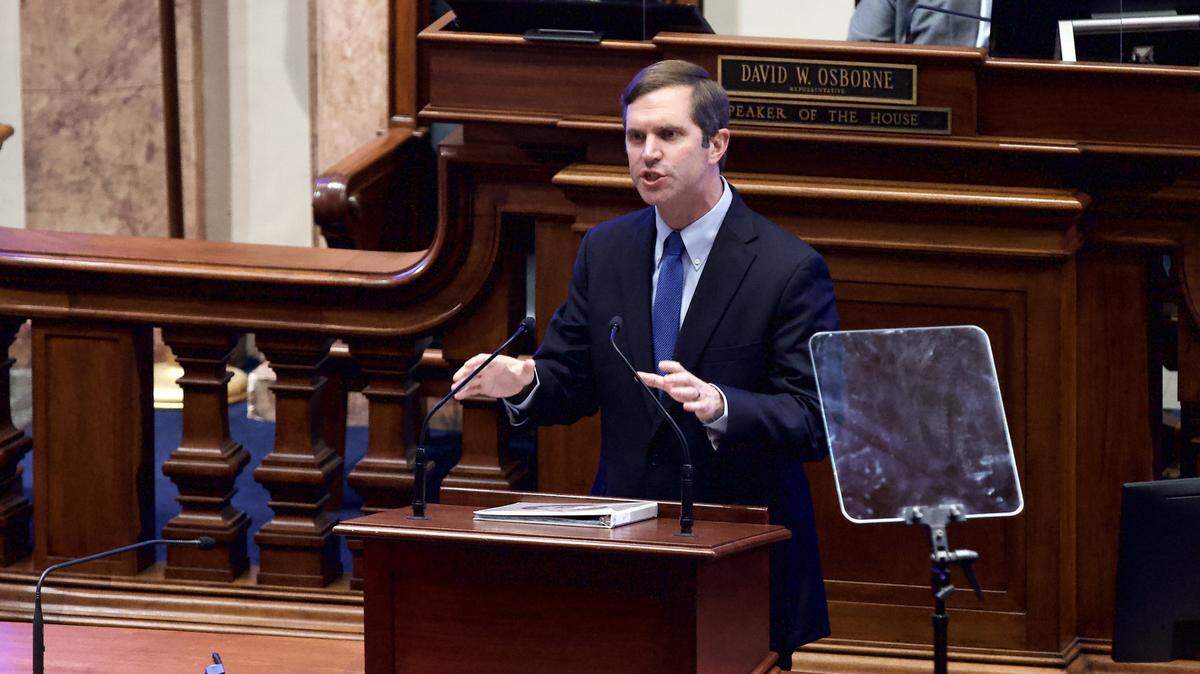
Democratic Gov. Andy Beshear on Thursday urged the General Assembly to think big as it writes Kentucky’s next two-year budget, with state revenues in unusually good shape.
Beshear’s spending recommendations included pay raises for state workers and school employees, enough funding for universal preschool for 4-year-olds, hiring 350 more social workers, making the full contributions into the pension funds for state workers and educators and using $750 million to pay down the state’s nearly $27 billion public pension debt.
“Right now, we don’t have to choose,” Beshear said in his televised speech to House and Senate members.
“We are able to be fiscally responsible while making record investments in our people and in our future. The investments that we make now will benefit many generations to come and forever change our commonwealth,” he said.
The governor’s budget address was anti-climactic this year, coming a week after House Republican leaders took the unprecedented step of filing their own budget bill without waiting to see his executive branch spending recommendations. Irritated by the House cutting ahead in line, Beshear unveiled different portions of his budget proposal at news conferences every day this week.
Beshear, 44, is running for re-election next year in a state now dominated by Republican politicians. That includes a legislature with veto-proof GOP super-majorities that gets to write the state budget however it wishes.
But some features in Beshear’s budget, such as pay raises for public workers and massive pension funding, have parallels in the House budget, thanks to the large sums of money available. Others, such as universal preschool, are not reflected in the House plan.
State economists last month estimated that Kentucky could collect enough revenue for a $14 billion General Fund in Fiscal Year 2023 and a $14.6 billion General Fund in Fiscal Year 2024, with several billion more available in surplus state revenue and federal aid from a COVID-19 pandemic stimulus package and an infrastructure bill.
Among other items, Beshear told lawmakers he would:
▪ Give a 5 percent pay raise to all state employees on May 1, and spend $42 million over the next two years to absorb the costs of an increase in their health insurance premiums. The House budget includes a 6 percent pay raise for state premiums, which Beshear said he supports. Beshear would target separate pay increases for Kentucky State Police and the departments of Corrections and Juvenile Justice, which are having severe staffing problems.
▪ Increase the state’s SEEK funding for school districts by 16.9 percent. This would raise the per-pupil funding level from the current $4,000 to $4,300 in fiscal year 2023 and $4,500 in fiscal year 2024, he said. It also would fully fund school districts’ student transportation costs, provide universal preschool and all-day kindergarten for all school districts. This would be a more generous level of state funding than the House budget offers for school districts.
▪ Provide enough money for a minimum 5 percent pay raise for all school personnel, “in addition to the regular rank-and-step salary schedule increases for certified staff.”
▪ Include $60 million in bond money for the Bucks for Brains research support program at the state’s universities, to be matched with private donations
▪ Provide $400 million to “front-line heroes,” which include nurses and health department workers, among others.
▪ Pay $36 million through fiscal year 2024 to “transform” 60 local Kentucky local health departments.
▪ Secure $250 million from the General Fund for major transportation projects, specifically, progress on the Brent Spence companion bridge in Northern Kentucky, the Interstate 69 bridge in Henderson and completion of the Mountain Parkway expansion in Eastern Kentucky. These would be one-time funds meant to qualify the state for federal grants, Beshear said.
▪ Allocate $200 million to boost high-speed Internet service around the state, on top of the $300 million in federal American Rescue Plan Act funds that were dedicated for this purpose in 2021.
▪ Spend nearly $17 million over the next two years to restore the positions of 90 unemployment insurance employees who were cut from regional career service centers around the state prior to the COVID-19 pandemic in 2020.
Republican legislative leaders, in a press conference held just after the address, didn’t offer specific critiques of the governor’s proposal because they had yet to see the budget document released late Thursday night after the address.
House Speaker David Osborne, R-Prospect, and Senate President Robert Stivers, R-Manchester, said that lawmakers should be cautious about spending because what they call an ‘artificial’ bump in revenues due to the recent influx of federal relief funds.
“Everybody wants to talk about how great this economy is,” Stivers said. “We’re still very low on workforce participation rate. It is an economy that has been created by infusion of federal dollars... we need to be very careful, very thoughtful, very methodical in what we do.”
Osborne said that conversations in the coming days would take place with State Budget Director John Hicks, but didn’t know if the governor would be involved in those discussions.
The Republicans’ budget bill, House Bill 1, could be passed out of the House as early as next week, Osborne said.
This story was originally published January 13, 2022 at 9:16 PM.