
Last days of the mountain Democrats? Red wave in Eastern Ky. becomes increasingly local.
READ MORE
What happened to the mountain Democrats?
Expand All
In February 2021, Harlan County Judge-Executive Dan Mosley posted a 9-minute video to Facebook.
The former broadcaster for Hazard’s WYMT announced in a crisp, TV-trained voice that he was leaving the Democratic Party and becoming a Republican. It was, on paper, an odd thing to do at a time when all the other elected officials in the county except one member of the county Fiscal Court were Democrats.
Mosley listed all the qualms he had with perceived shortcomings of Democrats being discussed nationally and in coal country hubs like Harlan.
“It’s shifted from a party for the men and women who want to work and get a leg up, just like my parents did, to a party for people who don’t want to work,” Mosley said in the video. He named several other perceived offenses largely committed or proposed by national Democrats: defunding law enforcement, “open borders” immigration policy, environmental regulation that had hurt coal, and justifying looting during the national Black Lives Matter movement.
National Democrats would take issue with most of those characterizations, and most have little to do with the local issues that Mosley deals with – roads, parks, grant applications, and similar tasks.
Yet, Mosley’s video made waves in the county of 30,000. 15,000 people viewed it. 335 shared it.
And every single partisan elected official followed suit: county attorney, jailer, sheriff, property value administrator, the four Democratic magistrates. All of them changed their registration to Republican.
“I didn’t know everybody was gonna go do that. I had no idea,” Mosley said. “But I had different officials come to me the day after I did it and said, ‘Look, you’ve said everything I’ve felt for five years, and I’m going too. I’m switching.”
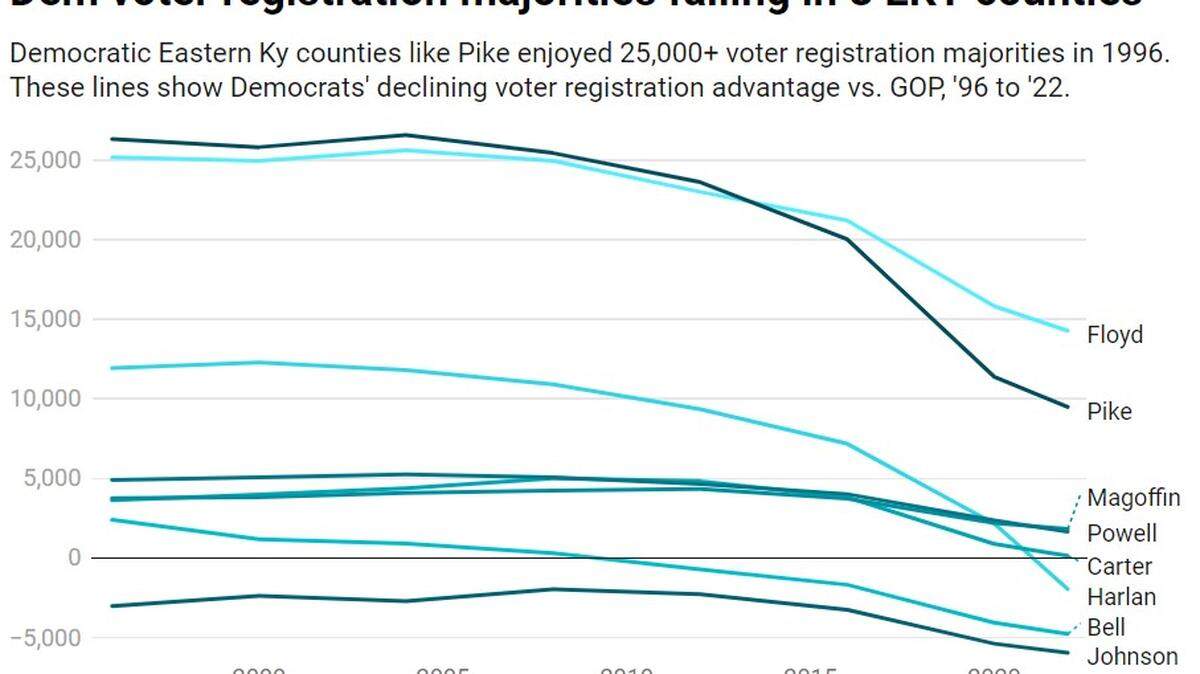
A raft of citizens followed suit. In February when Mosley switched, Democrats in Harlan County outnumbered Republicans by 3,000. In less than a year and a half, Republicans flipped it, and now outpace Democrats by 2,000. The Democrats didn’t field a challenger this Fall for Mosley’s next four-year term, either.
In many ways, Harlan is representative of Eastern Kentucky and Appalachia as a whole. It sired the classic coal miners’ union documentary “Harlan County, USA,” and the most recent prominent coal-labor dustup, where Blackjewel miners blocked a coal train to protest withheld pay. The hit detective TV series “Justified” was set there. The county population topped out around 75,000 in 1940 and is now just a third of that total.
And it’s politically representative. In 2000, the last time the county voted Democratic for president, Democrats had a 16,857 to 4,566 voter-registration advantage. Now registered Republicans outnumber Democrats by almost 2,000.
The politics of coal, culminating in Donald Trump’s 2016 race against Hillary Clinton, and a Democratic Party often seen as out of touch helped spur the trend.
It’s also nationwide and statewide. Democrats are losing ground all over rural America. In Western Kentucky – the other half of Democrats’ ‘barbell’-like control over the state – what used to be considered the party’s ‘Rock of Gibraltar’ has largely disintegrated.
The Republican party in Eastern and Western Kentucky is developing a stranglehold over elections for offices in Washington, Frankfort and the local county seats.
In 2010, counties within the Eastern Coal Field region of the state had 13 Democrats and six Republicans representing them in the House. 12 years later, Eastern Kentucky Republicans hold a 17 to 2 advantage in that chamber, and are 7 to 1 in the Senate. That leaves only 3 Democrats in the region in Sen. Robin Webb, D-Grayson; and Reps. Angie Hatton and Ashley Tackett Laferty of Whitesburg and Prestonsburg.
Registration very often in Kentucky does not align with voter behavior, but Republicans are heralding the fact that the state is on its way to become majority-GOP, and Appalachian counties are a part of that trend.
Trump took at least 3-to-1 margins in every single Eastern Kentucky county except Rowan and Boyd, where he won by at least 20 percentage points.
For many on both sides of the aisle, it remains an open question as to whether the region will continue to burn even brighter red – from federal elections all the way down to local – or if there’s some way that Democrats can tamp down the flame. Is what happened in Mosley’s county the exception, or a window into the future of every heritage Democratic pocket of the mountains?
What happened to mountain Democrats?
Mosley thinks that every Eastern Kentucky county will eventually join Harlan in becoming majority-Republican.
That view isn’t shared by all in the region, though – even fellow Republicans.
Bell County Judge-Executive Albey Brock, a Republican who’s held office for several years, is equally dissatisfied with Democrats. But he thinks that there will always be some measure of mountain Democrats.
“There’s not much distance between mountain Democrats and mountain Republicans,” Brock said. “... In those Democratic counties, you still have that deep-rooted union element that still exists among a lot of mountain Democrats.”
Bill Weinberg, a Knott County Democrat who ran for attorney general in the ‘80s and whose wife got beat by Mitch McConnell in the 2002 U.S. Senate general election, said that he thought some counties would remain in the party. In Knott County, Weinberg pointed out that Judge-Executive Jeff Dobson switched from Democrat to Republican like Mosley, but the other county elected officials have remained Democrats.
Brock said that he knew of several people who left the party over what he said was the party’s “lurch left” to support transgender people, Trump’s presence on the ticket and policies harmful to the coal industry.
At a recent meeting of the Powell County Democratic Party’s executive board, Brinton Epperson said that the party’s platform isn’t the problem – it’s that both sides have focused on socially conservative wedge issues too much.
“We’ve allowed the Republicans to make the narrative. I mean, we don’t have problems with the Democratic National Committee as far as their actual viewpoints go. The only problem I have with them is that they take the bait constantly,” Epperson said. “The Republicans are setting the narrative for what the debate is about when the Democrats should be talking about what Democrats really believe in.”
Part of that understanding in the region – as Brock put it, the sour reputation of the national party “trickling down” to state and local officials – has been fostered by effective political messaging.
In 2016, the year the Kentucky House flipped, a super PAC formed to support Sen. Mitch McConnell then led by McConnell ally and political strategist Scott Jennings ran ads aggressively attempting to pair rural Democrats with Hillary Clinton and former president Barack Obama.
A Western Kentucky Coal Field Democrat was attacked in his bid to unseat Republican energy committee chair Jim Gooch with a “Hillary Clinton birthday card,” which played a message urging voters to “ruin Hillary’s birthday” by voting “against every Clinton Democrat running.” The card played a clip of a now-infamous Clinton speech made during her campaign in which she said “we’re gonna put a lot of coal miners and coal companies out of business.”
One ad features clips from a speech of former house speaker Greg Stumbo praising Obama and Clinton. Another titled “Hillary & Hatton,” bashes the vocally pro-life Whitesburg Democrat Angie Hatton for taking “money from the same liberals trying to elect Hillary Clinton.”
“We are increasingly getting these political ads that are so nationalized. They’re not local issues at all,” Hatton said. “(This cycle), they’re going to be about immigration, the Black Lives Matter protests, the US Supreme Court decision on abortion. All of those things are very purposely ingrained into people’s minds – that all Democrats are identical – but there are various shades of blue, and my shade of blue is purple.”
‘The party has given up’
Ernie Yanarella, former political science department chair at the University of Kentucky who also taught Appalachian Studies classes, said that the old saying “all politics is local” applies less and less to the region given the hold that messaging related to Clinton and Trump has taken.
A contributor to some Democratic campaigns, Yanarella worries that the Democrats have nobody or no discernible organization outside of Gov. Andy Beshear that can distinguish the party from its national counterpart’s reputation. Beshear beat the unpopular former GOP governor Matt Bevin by a slim margin in 2019.
“(The party) has one identifiable anchor, and that of course is Andy Beshear. It has a number of satellites that are still rooted in history and influence. However, no one seems to have a sense of direction for the party itself.”
Tom Sexton co-founded a popular leftist podcast called “Trillbillies Workers Party” in Whitesburg, the southeastern tip of the state. He says much of the shift described by Yanarella can be attributed to the decline of local media – a well-documented trend across America – so voters take their cues only from national sources constantly berating national Democrats or Republicans without speaking to the issues.
“The sort of death of local politics, and by extension local journalism, has created this atmosphere where nobody is paying attention to local policy or anything,” Sexton said. “It’s just like, ‘I’m going to take my rhetorical cues from what’s going on the national level,’ whereas before there was a lot more color to those local races. Who was going to do what for people in the community was a lot more pertinent.”
Tres Watson, a seasoned conservative political operative who previously served as spokesman for the Republican Party of Kentucky, agreed that “as local media fades away,” voters are more often bombarded with messages about how radical prominent national members of either party are.
“I remember running for city council in Whitesburg and people asking me back then, ‘are you an Obama or Romney man?’ Like, what’s that got to do with this,” Sexton said.
Another factor is the loss of Democratic interest in some places like Eastern Kentucky, either real or perceived.
Anna Whites is a Frankfort-based attorney who frequently represents Kentucky Democratic politicians, and holds informal calls and training sessions for Democrats in the state.
“My own opinion is that the party has given up on anywhere beyond Lexington, Louisville, and maybe Owensboro or Frankfort,” Whites said. “... It’s a failure to try. It’s much easier to just give up and sit around with your friends than it is to drive to Paintsville and try to talk to people.”
Northeast Kentucky native Sen. Robin Webb, D-Grayson, is one of the most conservative Democrats serving in Frankfort. She said that in her experience state Democrats don’t reach out to people like her.
“I don’t ask the party for anything and they don’t ask me for any advice; and I rarely get the feeling that they’re trying to engage people like me,” Webb said. “That’s demographics and I get it. We disagree on a lot of issues. They bypass me and that suits me just fine.”
Jonathan Shell, current GOP candidate for Commissioner of Agriculture, went across the state actively recruiting House candidates when he was a state representative in the mid-2010s. He even visited some rural districts that had sent Democrats to Frankfort for ages. Whites said that she believes the Democrats don’t have an equivalent to Shell, someone running around the state on behalf of the party trying to rile up Democrats to run for office in Frankfort.
Kentucky Democratic Party Executive Director Sebastian Kitchen, in a statement responding to Whites’ and others criticisms, was quick to point out that much of Eastern Kentucky continues to send Democrats to elected office.
“Eastern Kentuckians continue to elect Democrats at all levels – to lead their counties, to represent them in the General Assembly and helping to elect Andy Beshear as their governor – because they know Democrats are creating more opportunities with good-paying jobs, expanding access to health care, supporting public schools and investing tens of millions of dollars in infrastructure including high-speed internet and completing the expansion of the Mountain Parkway,” Kitchen wrote.
He also criticized Republicans around their initiatives to cut jobless benefits for Kentuckians with House Bill 4, a measure almost uniformly opposed by mountain legislators both Democrat and Republican.
Rep. John Blanton, R-Salyersville, was often the loudest voice in the chamber against the bill. Even with unanimous Democrat opposition in line with most of the House Mountain Caucus, House Bill 4 passed the House easily with a majority of the GOP’s 75-member caucus’ support. A similar story was seen in the passage of House Bill 9, the bill that created a public funding mechanism for charter schools.
“While Democrats are fighting for families in Eastern Kentucky, Frankfort Republicans have turned their backs on Kentuckians by slashing assistance to workers and families and by siphoning money from public schools into charter schools operated by for-profit companies,” Kitchen wrote.
The role of coal
“Friends of Coal,” is perhaps one of the most recognizable pieces of branding in Kentucky.
And a major part of Republicans’ winning strategy in Eastern Kentucky is reliant on coal.
Coal used to be, from a labor-centric perspective, an animating force for Democrats in Eastern Kentucky. To be a Democrat in Eastern Kentucky was and to some extent is to be pro-coal laborer; now the more prevalent attitude is to be pro-coal industry, said longtime state political commentator and director of Institute for Rural Journalism and Community Issues Al Cross.
“There was always that feeling that Democrats looked out for the interests of working people, like coal miners. Well, then Obama came along and declared war on coal – and it really was a war on coal – and the Republicans completely turned that around,” Cross said. “You had people who used to despise coal operators being on the same side as coal operators, defending their mutual interests.”
Alan Maimon, former Eastern Kentucky reporter for the Courier-Journal and author of the nonfiction book “Twilight in Hazard,” wrote that the narrative got turned around in part due to a conscious Friends of Coal-led effort to suggest that “people needed to make a zero-sum choice between being friends of coal or enemies of coal.”
Cross pointed to a poll conducted across two years – in 2007, just before the Great Recession and Obama’s first term, and 2011.
In 2007, only 17% of survey respondents in traditionally Democratic Harlan and Letcher Counties said they thought “conservation/environmental rules/zoning laws” were a bad thing for the community. In 2011, 33% responded affirmatively
Only 37% of the same respondents in 2007 thought “resources should be used to create jobs rather than conserved.” 52% answered affirmatively in 2011.
But being a Republican in the mountains doesn’t mean you always take the side of coal companies over workers. Mosley, for instance, was a vocal supporter of the Blackjewel miners.
Former coal miner Sen. Robin Webb, D-Grayson, said national Democrats “demonizing” coal led to a worse fate for members of her party in Eastern Kentucky.
“The reason I registered as a Democrat was for working people. As a coal miner, I certainly recognize the benefit of unions, and worker protection,” Webb said “… I think (coal) certainly was a tipping point in elections, and some of the demonization of fossil fuels, which we’ve relied on here for so long. I think the resentment is high.”
That resentment has often been parlayed into Republican electoral successes, even in places the culture of supporting coal has extended far and wide.
Epperson said that some politicians have tried to score votes in Powell County by bringing up coal. Problem is, he said, Powell County’s economy has never been based around coal, and there might not have ever been a mine there.
‘Why are you even a Democrat?’
If any Democratic state senator outside of Lexington or Louisville was going to survive reelection in 2020, it would have been Johnny Ray Turner.
Turner had served for 20 years, and was facing his first general election challenge in his new district, which at 83% of registered voters was technically the most Democratic district in Kentucky.
But the perfect storm came, and its name was quite familiar.
Sen. Johnnie L. Turner, R-Harlan, who once held a House seat had the good fortune of nearly sharing a name with the longtime lawmaker and being on the top of the ticker.
“I’ve always had the thought that politics is about timing. Johnnie Turner from Harlan picked the right time with Trump on the ballot and with the same name with the first position on the ballot. There were a lot of things stacked against me,” Johnny Ray Turner said.
Might there be a way for conservative Democrats to signal to voters that they are, indeed, as conservative as their electorate so that conservatives who are registered as Democrats might think twice? Greg Stumbo has one idea.
Stumbo, a Prestonsburg politician whose star rose when he became Attorney General in 2004 and later house speaker in 2009, thinks that the state party should create an official designation for Democrats to mark themselves as ‘not those kind of Democrats.’
“There needs to be a branch of the Democratic Party in Kentucky, maybe an official branch within the party itself, where you can be a Democrat, but you’re not like the Washington Democrats. You’re not like (U.S. House Speaker) Nancy Pelosi’s Democrats,” Stumbo said.
The idea there would be that a designation like that could bring people still registered as Democrats ‘back home’ to the party of their heritage, feeling more comfortable voting for someone they know shares their views on abortion, religion and gun control.
Not everyone thinks it’s a worthwhile venture.
“I think it’s stupid,” Sexton said. “Whatever you gain from being conciliatory on the culture war issues like abortion, gay marriage, gun rights or whatever, I think you lose in perception of you not ‘being tough’ on it. When given the choice between the full-flavored or diet, (voters) are going to choose the full flavor. It’s all so disingenuous because I think every one of these people has a public and a private position… It’s kinda like, ‘just be a Republican. Why are you even a Democrat?’”
Cassie Chambers Armstrong, a Louisville Metro Councilwoman who wrote a family autobiography titled “Hill Women” about growing up in Berea, said that the party is already a big tent.
“I worry that that sort of thing only puts our differences front and center and causes people to segment a little bit more based on those perceived differences,” Armstrong, who used to be the state party’s vice chair, said. “I think what we should be trying to do is all come together and figure out how we build the coalition necessary to push change forward.”
She said more pertinent issues for the party and its candidates are the need to build a stronger and more coherent party infrastructure in places like where she grew up and fighting back against a “toxic” political discourse that’s only gotten more so via social media.
But Stumbo would point to ‘prototypes’ of Democrats who would fit the mold of his idea for a new branch of the party – namely former house minority leader and Elliott Countian Rocky Adkins.
“Rocky gave us the prototype of how to run in rural Kentucky. Rocky was a conservative, pro-life, pro-gun candidate. Well, once you get over that, then what are you for? Decent jobs, competitive wages, decent living, public education – all of those things, we (Democrats) are traditionally for.”
Adkins carried a majority of Kentucky’s 120 counties, including most all of his native Eastern Kentucky, and only lost to Beshear by 24,000 votes, or six percentage points in a 2019 gubernatorial contest. But Beshear drummed him in major population centers, particularly Louisville where Adkins only got 10% of the vote and Beshear beat him by 37,000 votes.
Not made available by press time for an interview, Adkins confirmed to the Northern Kentucky Tribune this month that he is interested in running for commissioner of agriculture in 2023.
Regardless of whether Stumbo’s idea would be helpful, most seem to agree that Democrats need to do a better job of recruiting and implementing the basics of retail politics.
Hatton, who serves as House minority Whip, said that she already reflects her constituents’ values.
This past session, the Whitesburg lawmaker voted with Republicans on bills that further restricted abortion and banned transgender girls from participating in girls sports. She also led criticisms from the left on Republican-led efforts such as funding charter schools, cutting jobless benefits and adding requirements for people looking to retain their eligibility for public assistance.
The Pike County portion of Hatton’s district was completely shifted when Republicans drew new House maps, ditching Pikeville for the more rural stretches of the county along the Virginia and West Virginia border. Hatton said that Trump won her new district by about 80 percentage points in 2016 and 2020.
Her opponent, Jacob Justice, is a dentist with a familiar last name in Pike County politics.
Hatton said that it’s possible that her days in the House are numbered. But, given her name recognition, the fact that she’s the only member of House leadership from the region, and that she’s got a strong relationship with Gov. Beshear, she said she’ll drive a hard bargain.
“They may well beat me. They may have redistricted me into an area that’s going to be impossible for even a very good Democrat to win, but they’re gonna have to spend a ton of money to do it,” Hatton said.
“I’m gonna make them chase me all over these hills. I’m gonna zig and zag and bob and weave; and if they do run me down they’ll have spent a fortune by the time they get it.”
This story was originally published June 30, 2022 at 11:19 AM.