Pronouns, bathrooms, trans health care: See all the anti-LGBTQ measures approved in KY.
READ MORE
Wrap-up on the 2023 legislative session
Take a look at what the Kentucky General Assembly passed, or didn’t pass, in 2023.
Expand All

What did the Kentucky legislature pass so far? A rundown of key bills, big and small.
Pronouns, bathrooms, trans health care: See all the anti-LGBTQ measures approved in KY.

Medical marijuana, sports betting & drag ban: What could still pass the ’23 KY legislature

Five bills on abortion were filed in the 2023 KY legislature. None of them got a hearing.

Lawmakers approved big changes to KY juvenile justice system. Here’s what they did.
Gender-affirming health care for transgender youth in Kentucky will likely soon be banned, following passage of a newly-packaged Republican omnibus bill on Thursday.
Less than a day after the Senate voted to significantly scale back a very similar sweeping proposal that some in the Senate GOP said went too far because it left trans kids with no affirming health care options, the measure in question was revived in its original form and stitched into another bill at the eleventh hour.
The new version of Senate Bill 150 was introduced in committee Thursday mid-day and quickly pushed through both chambers later in the day. It passed with near-unanimous Republican support in both the House and Senate, and now goes to Gov. Andy Beshear’s desk. Even if Beshear vetoes the bill, Republicans have the votes to override it if their near-unanimous support holds.
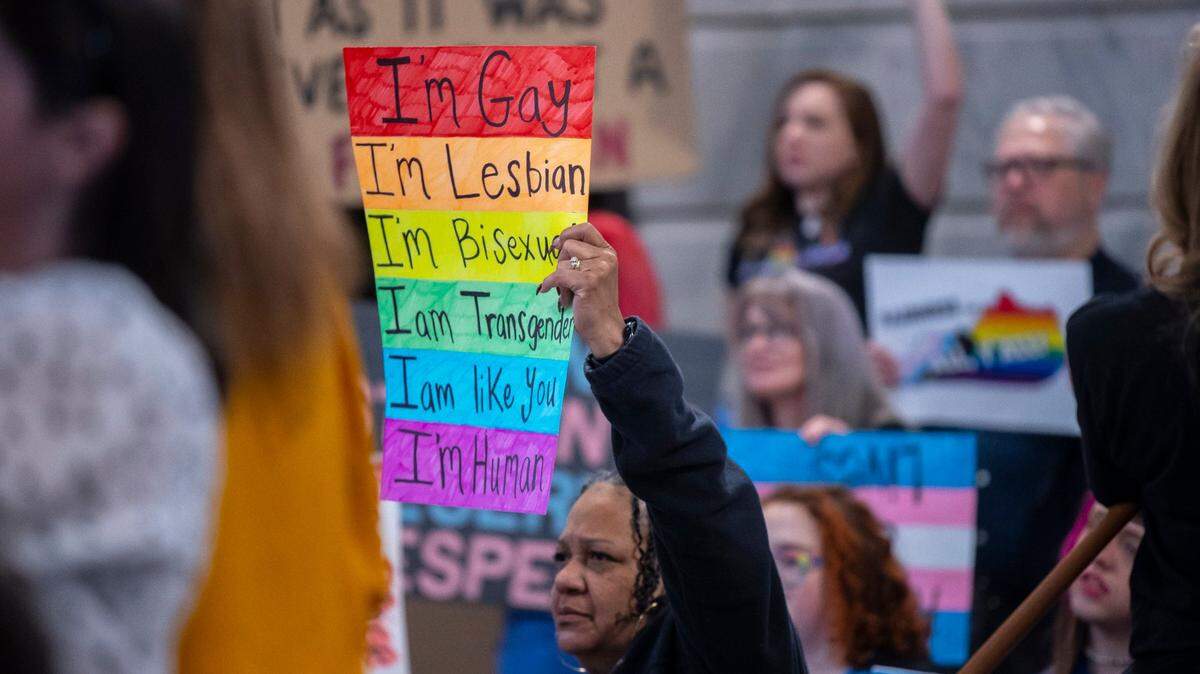
Passage of this bill typifies a legislative session marked by a raft of anti-LGBTQ bills from Republicans determined to combat a culture they say is pushing a “woke” agenda.
Senate Bill 150, in its original form, was far more narrow than its final product. It prohibited schools from requiring or recommending teachers use a transgender student’s preferred pronouns, and required schools to notify parents when curriculum related to human sexuality was going to be taught.
But bill sponsor Sen. Max Wise, R-Campbellsville, didn’t seems to mind all the additions to his bill. He and House Speaker Pro Tem David Meade, R-Stanford, introduced an amended version of the bill in a House Education Committee Thursday morning that would become the final form of SB 150. Perhaps most notably, it enacts a complete ban on all gender-affirming health care for youth in Kentucky with gender dysphoria. Medical providers in Kentucky have repeatedly warned lawmakers of the harm such a ban will cause to an already marginalized population.
The repackaged gender-affirming care ban, formerly filed as House Bill 470, outlaws the standard of care treatment for this population by banning gender reassignment surgery, the prescription of puberty blockers and hormones, and inpatient and outpatient gender-affirming hospital services for anyone under age 18.
Wise’s new bill also includes much of House Bill 177 from Rep. Shane Baker, R-Somerset, limiting K-12 instruction on sexual and gender identity.
Here’s what the final version of Senate Bill 150 includes:
- A ban on all gender-affirming health care for trans kids and teenagers in Kentucky. That care includes genital and non-genital reassignment surgery, hormone therapy, and any drugs that would “delay or stop normal puberty.” The bill, unlike previous versions, does not include any restrictions on mental health or counseling services that promote gender transition.
- In the vein of gender-affirming surgery, the law explicitly bars doctors from “removing any healthy or non-diseased body part or tissue” if the purpose is to “validate” or “alter” a minor’s perception of themselves that is “inconsistent with (their biological) sex.”
- A risked loss of license to doctors who violate the law. Patients who believe they are within their right to sue a doctor for violating the law would have until their 30th birthday to do so.
- For trans youth in Kentucky who are currently taking hormones or puberty blockers, their provider either needs to “immediately terminate” that treatment, unless they think doing so “would cause harm” to their patient. In that case, a health care provider is required to begin tapering that dosage.
- A ban on “any child, regardless of grade level” receiving presentation or instruction “studying or exploring gender identity, gender expression, or sexual orientation.” That provision mirrors language introduced by Rep. Baker in House Bill 177.
- A ban on transgender students using the bathroom that corresponds with their gender identity.Transgender students whose parent or legal guardian provides written consent “shall be provided with the best available accommodation” as long as it does not include allowing transgender students using the bathroom that corresponds with their gender identity.
- A ban on any child in fifth grade or below from receiving “any instruction through curriculum or programs on human sexuality or sexually transmitted diseases.” That provision mirrors language introduced in House Bill 177.
- A requirement that schools develop policies to “notify a parent in advance and obtain the parent’s written consent” before a child in sixth grade or above is taught about human sexuality or STDs.
- The contents of a “bathroom bill” that protects students “privacy rights.” Aimed at trans students, it requires that students only use school restrooms and locker rooms that correspond with their biological sex, single-stall restrooms, . Allowing otherwise creates “significant potential for disruption” and “unsafe conditions.” There’s also a requirement that schools develop a bathroom policy that protects students’ “privacy rights” as outlined in a section that condemns allowing transgender students to use a bathroom that corresponds with their gender identity.
A prohibition on schools requiring or recommending via policies that teachers use a trans student’s preferred pronouns. And requirements that schools to notify parents about curriculum related to “human sexuality, contraception, or family planning.” Likewise, schools would have to notify parents of their right to “withhold consent or decline” their child participate in that curriculum.
School districts in Kentucky do not generally mandate school personnel use specific pronouns for students, but they have issued guidance on best practices. The Kentucky Department of Education in September distributed in an information sheet titled, “Considerations for Using Student Preferred Names.” In it, KDE says it is “best practice” to, as a general rule, “recognize students using the name that most closely aligns with their identity.”
The bill’s banning of “any instruction” on sexuality and sexually transmitted diseases in elementary school is not dissimilar from the Florida law derided by some as the ‘Don’t Say Gay’ law. That law barred discussion on “sexual orientation or gender identity” in Kindergarten through third grade.
SB 150 goes much further than the Florida law, banning any instruction “on human sexuality” until sixth grade. A ban on “studying or exploring gender identity, gender expression, or sexual orientation” extends to all grades.
This story was originally published March 17, 2023 at 9:47 AM.