Why KY’s Amendment 2 overwhelmingly failed. Now, will GOP lawmakers change strategy?
It was during a contentious exchange over the bill that would eventually put Amendment 2 on the ballot that a Louisville Democrat offered her prediction of voters’ reaction to the measure come November.
“They will say no,” Rep. Josie Raymond said on the House floor in March.
“The voters of Kentucky know the value of our public schools, and the people they employ, and what they bring to our communities,” she said. “They know that this push to use public money on private schools is happening after years of work to defund and delegitimize our public schools. They will say no. This one’s another loser.”
Raymond added a final jab: “It will be so embarrassing for you all.”
Seven months later, Raymond’s prediction proved prophetic.
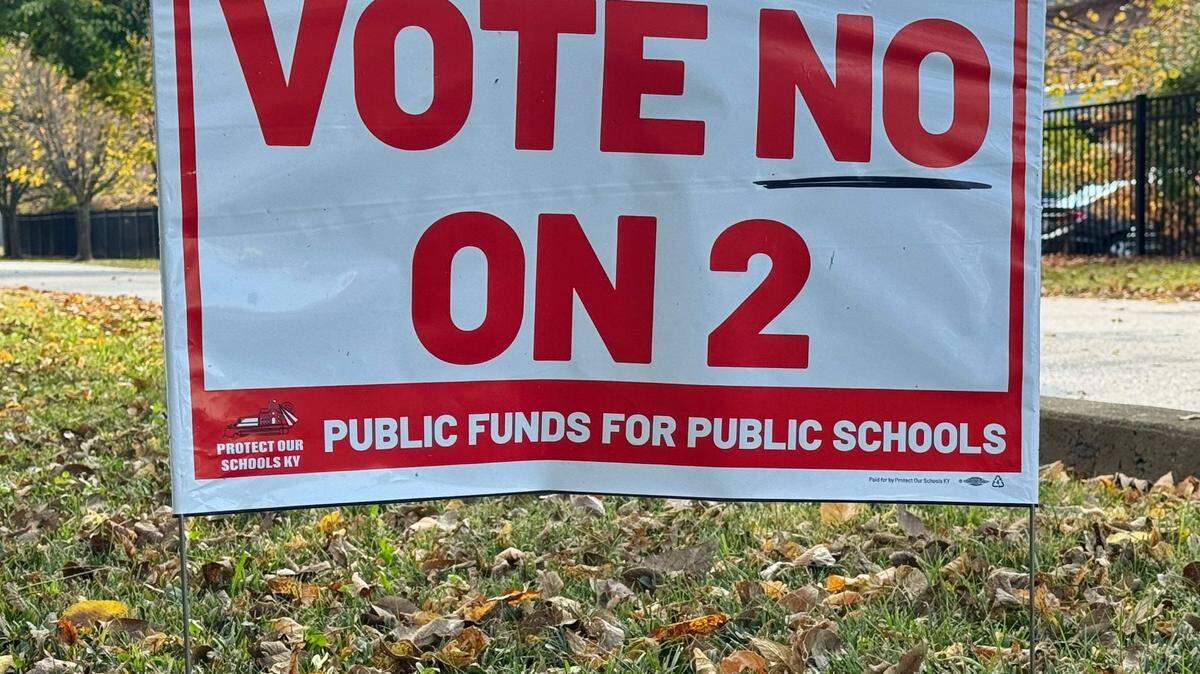
On Nov. 5, Kentucky voters overwhelmingly defeated Amendment 2, which asked permission to change the state constitution in a way that would allow the legislature to spend tax dollars outside the public school system on private, religious and charter schools.
The measure failed in all 120 counties by double-digits, except one — the margin of defeat in McCreary County was 6% — and statewide by a vote of 65% to 35%, according to unofficial election results.
Though the reason for its failure is multi-tiered, it comes down to two primary points, teachers, lawmakers, and education advocates interviewed for this story said:
- The proposal represented the opposite of what public school educators and their allies have been asking for for years, which is more funding.
- The political messaging from supporters about why Amendment 2 was necessary was cloudy and indecisive.
Senate President Robert Stivers acknowledged the sweeping defeat Wednesday morning.
“The public has spoken, so we’re going to look at other pathways,” he said, “to see how we can help those poorly performing school districts. And I think everybody is for that. You want accountability and good performance in public education.”
Stivers said Amendment 2 was meant to assist districts like Louisville’s Jefferson County Public Schools, “one of the worst performing systems, if not the worst performing,” he said.
It was, he added, “to focus on the poorest and the most needy, like the West End (of Louisville) and give them a different economic trajectory.”
But anti-public school messaging from some Republicans who championed the ballot question (including Kentucky’s junior US senator, Rand Paul), coupled with well-funded political action committees distributing campaign mailers favoring Amendment 2, put forth a narrative that highlighted public schools’ shortcomings by trumpeting low test scores and criticizing school libraries for carrying salacious reading material.
Other pro-Amendment 2 political mailers contained false or misleading information, including that passage of the amendment would bring “teacher pay raises.”
Another played into the conservative narrative that public schools are venues for indoctrination, accusing public schools of allowing the “radical left” to “to control your kids.”
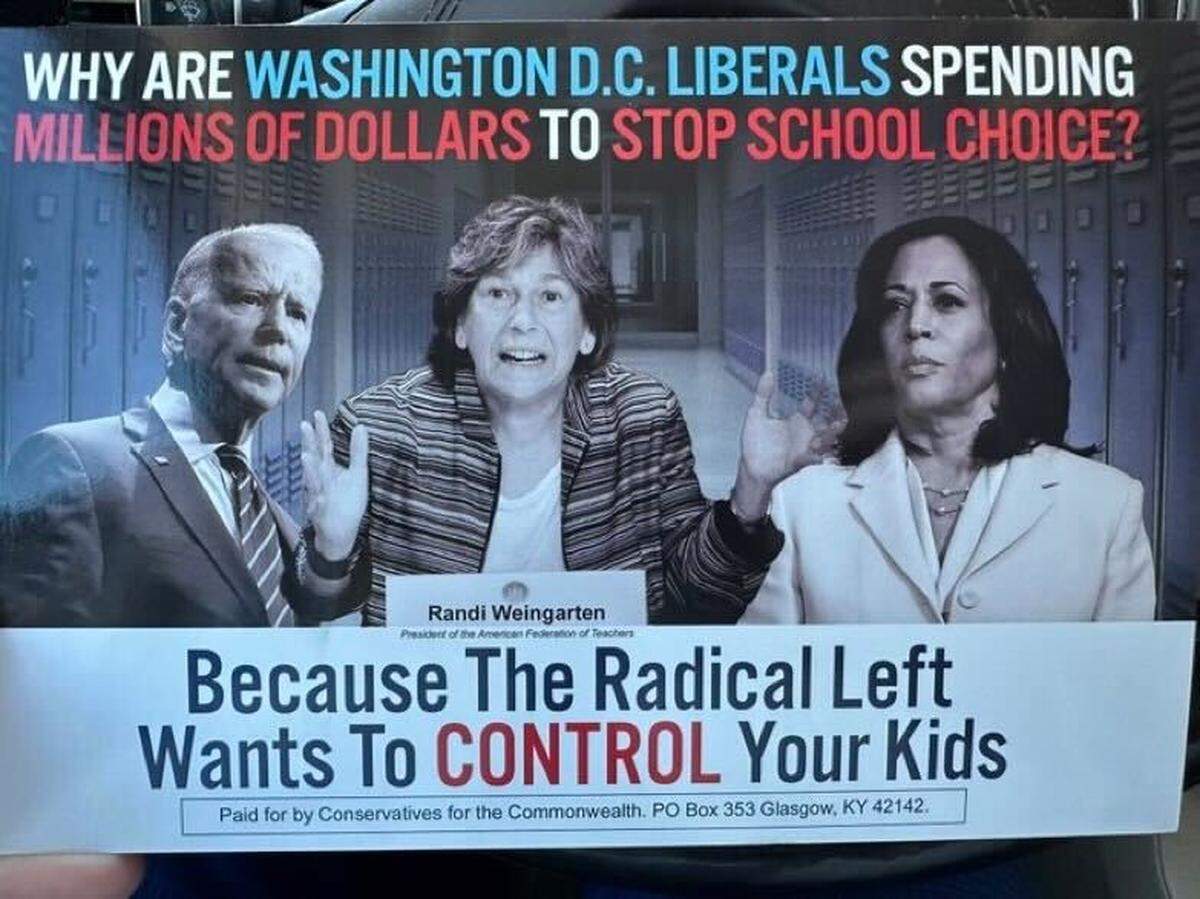
In short, Amendment 2 was presented by proponents as a needed remedy because public schools are failing Kentucky’s kids.
The Family Foundation, a conservative Christian lobbying group, vowed to keep fighting for “greater educational opportunities” because Kentucky’s “one-size-fits-all education system is simply failing many students and families,” in a Nov. 6 statement.
Executive Director David Walls said the solution is “increased freedom and choice” in order to “protect children from the harmful ideologies that have overtaken many public schools and harmed their effectiveness.”
Stivers’ post-election characterization of the intention behind Amendment 2, then, felt slightly off, said Abby Piper, education advocate and political consultant in Lexington.
“It’s a little disingenuous to say, ‘We’re doing this for failing schools,’ when we haven’t funded our public schools, even adjusted for inflation at 2008 levels, much less considering all the other unfunded mandates that have been passed,” she said.
“I do think the vast majority of our Republican caucus care deeply about the success of our young people. They understand the very serious economic implications of an under-educated public,” Piper said.
But amending the state constitution to pave the way for school voucher programs, for example, “is one of those things Kentuckians never really asked for.”
What led to Amendment 2’s downfall?
Republican Rep. Savannah Maddox, whose Northern Kentucky district includes Gallatin, Grant and part of Boone and Kenton counties, said voter “uncertainty” contributed to Amendment 2’s demise.
“Any time you have an issue of this magnitude, whether you’re an opponent or proponent, the most crucial task you have at hand is to define the issue,” she said Thursday. “Opponents of Amendment 2 managed to define this long before proponents had an opportunity to make their arguments.”
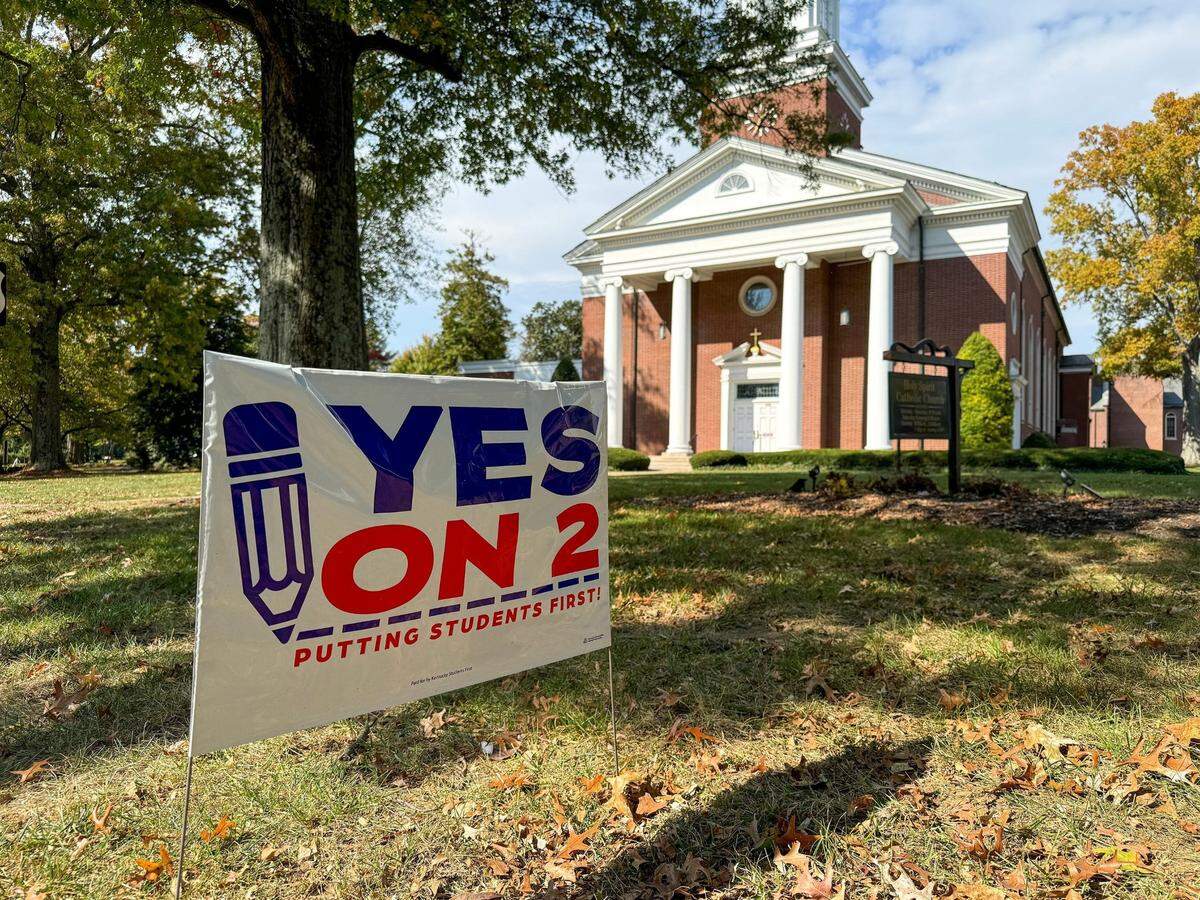
Opponents were quick to tie the question to school vouchers, saying changing the constitution would pave the way for lawmakers to create such programs in Kentucky.
Vouchers are a tax-funded means parents can send their kids to their chosen school, including private, religious or charter schools. Those funds are typically a combination of donations and money that would have otherwise gone to public schools.
Opponents’ characterization was informed by recent GOP strategies on the subject. But both attempts — the 2021 Education Opportunity Account Act and 2022’s charter school funding bill — were struck down by the courts as unconstitutional.
The only recourse for lawmakers was to change the wording of the constitution, which is how voters got Amendment 2.
The explicit question put to voters, however, did not mention vouchers, charter schools or tax credits in exchange for paying private school fees.
“It is not a voucher bill,” Senate Majority Floor Leader Damon Thayer said Oct. 28 on KET’s Kentucky Tonight.
Thayer, who did not respond to an interview request for this story, was refuting Lexington Democratic Sen. Reggie Thomas, who called Amendment 2 a “voucher amendment.”
Thayer accused Thomas of “absolutely muddying the waters and not telling the truth about Amendment 2.”
“It just would allow the legislature to deal with issues of school choice,” he added. “No one has even talked about a voucher bill in Kentucky.”
But that was the rub for proponents of Amendment 2, Maddox said: “People didn’t know what it was going to do.”
That was an issue for people on both sides of the amendment.
Bobby Hazelwood, who has a child enrolled at a private Christian school in Lexington, supports the idea of a statewide voucher program. As a self-described “right of center” voter, his interest piqued with Amendment 2.
But as Election Day neared and he increasingly heard defenses like Thayer’s in political mailers and from other Republicans, Hazelwood started to think supporters of the measure were trying to hide the ball.
“When you tell me ‘school choice,’ and that you want money to follow the students, but you say no vouchers, that doesn’t compute to me,” he told the Herald-Leader. “Somebody like me, who should be a vote in the bag, was really turned off.”
If the point is to “expand educational opportunities,” doesn’t that reasonably include vouchers? And if it doesn’t, he wondered, then “what are we getting at?”
Because that question went ultimately unanswered, “that right there was the problem,” Maddox said, “and that strategy proved to be disastrous.”
“You had opponents of Amendment 2 tying it to school vouchers and saying it’s going to take away funding for public education,” she said. “A proponent would say, ‘Well that’s not the case, because the amendment doesn’t mention vouchers.’
“But a thinking voter is going to read further into that and say, ‘Well, you can’t tell me what it does, either.’”
Sen. Whitney Westerfield, R-Fruit Hill, agreed, saying the “unknowns” were the amendment’s downfall.
“Opponent groups were able to point to this possibility or that possibility,” and because pro-Amendment 2 messaging wasn’t clear or cohesive, “proponents of the amendment also couldn’t say, that’s not going to happen,” he said.
Teachers simply don’t believe Frankfort
Amendment 2 didn’t happen in a vacuum. It was proposed against a backdrop of years of perceived hostility from Frankfort and particularly GOP lawmakers, some contend.
“It’s because of the history. Since 2018, there have been attacks on public education. I think the issue with Amendment 2, specifically, is because of that buildup,” said Noraa Ransey, a first-grade elementary teacher at North Calloway Elementary School in Murray.
She cited former Gov. Matt Bevin’s 2018 pension reform bill — also referred to as the “sewer bill,” because lawmakers converted a sewage treatment bill into a pension bill in the final days of session that year. Lawmakers rushed it through the approval process with no public review and limited chance for debate.
It rankled teachers statewide, many of whom descended on Frankfort to protest and held “sick-outs” in their districts.
Though it was eventually struck down in court, it included deep cuts for new, current and retired employees, and would’ve put all new teacher hires on a less generous hybrid pension plan, requiring them to work longer before becoming eligible for retirement.
Against this backdrop, compounded by years since of not fully funding education and stagnant teacher pay, “I can’t trust my legislators, because they have consistently voted against public education,” Ransey said.
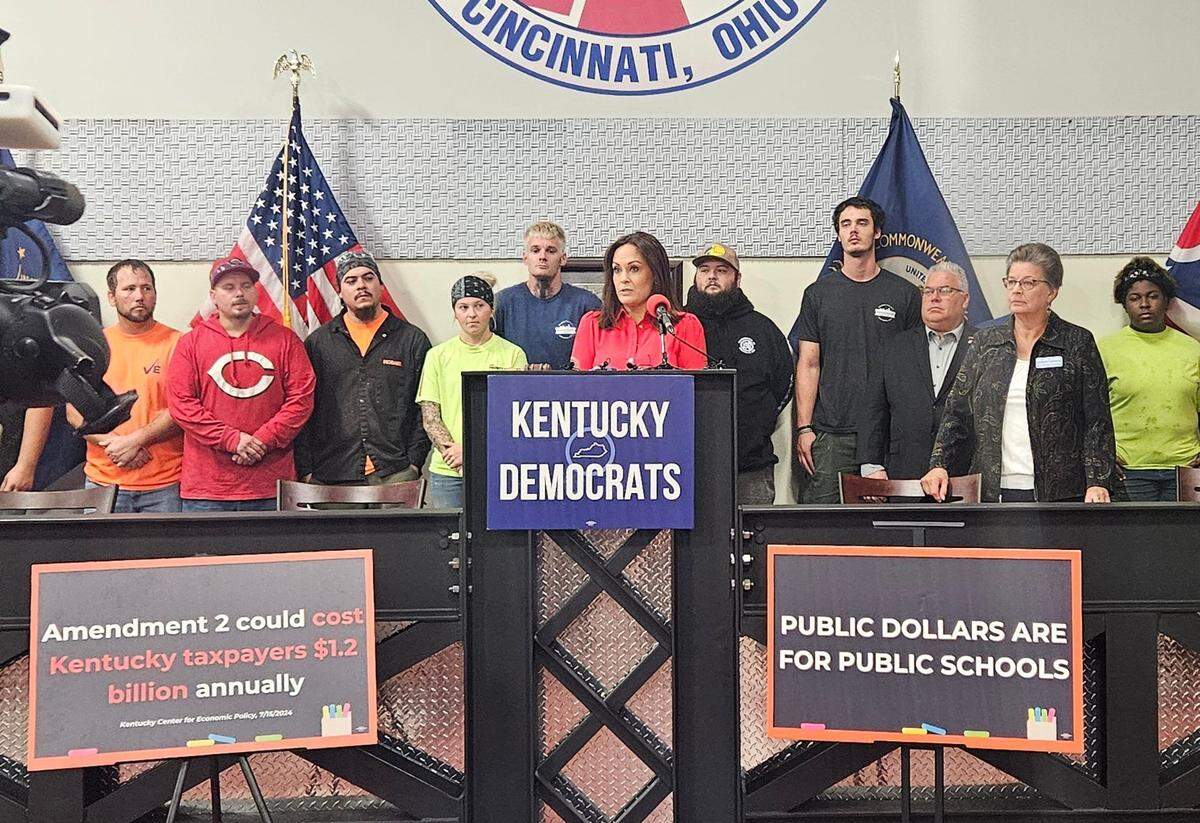
Lt. Gov. Jacqueline Coleman, who was still working as an educator in 2018, said many teachers have not come back from feeling shortchanged by the state.
“It is all related,” she said. “Teachers feel, I think the word I would use is, disrespected. They just want to make sure they have the space to do the job they have been educated and trained to do.”
That’s true for Ransey, a teacher of 20 years who also relied on the public school system to meet basic needs beyond her education as a child. At her Calloway County school, one in four students are food insecure, she said.
“A lot of the work I do is just making sure education is equitable, and everybody, no matter who you are or what your ZIP code is, has fair and equal access to things,” she said.
Amendment 2, which Ransey viewed as first and foremost a threat to her students’ access to resources, felt like an overreach by politicians in Frankfort, “who have consistently not made the best choices for us,” she said.
More than 300 miles east, the situation is similar, said Tiffany Combs, an instructional coach for the Perry County School District.
“Public school educators are already asked to do more with less every year,” Combs said in May. They are “more than just an education for most students. It’s a lifeline, just like it was for me.”
Because this reality is not new in Kentucky, it seemed misguided for Republicans to prioritize a “school choice” amendment that would lead to more money being siphoned away from those districts, Ransey and Combs said.
“The biggest thing (Amendment 2’s defeat) shows everybody — especially those that were pushing for it — is Kentucky really cares about its public schools,” Combs said Thursday.
“Now, it’s time for Frankfort to start seeing that.”
This story was originally published November 11, 2024 at 4:00 AM.