A new rule will make nursing homes hire more staff to improve care. Kentucky opposes it.

Kentucky is challenging a new federal rule that will require better staffing at nursing homes despite the state’s own evidence that better staffing is needed to protect the vulnerable people who live in those facilities.
Inside Lyndon Woods Care & Rehabilitation, a Louisville nursing home, elderly residents without proper supervision punched, kicked and slapped each other; repeatedly fell to the floor; lay in their own urine and feces, their pleas for help unanswered; and suffered serious injuries, including bedsores and broken bones, some fatal.
These were the findings of Kentucky state health inspectors who, over five visits in 2023, cited Lyndon Woods with 72 health and safety deficiencies and levied $650,448 in fines.
The biggest problem, inspectors said: Lyndon Woods didn’t employ enough staff to care for the 120 people living there. Overwhelmed care workers complained that they couldn’t change everyone’s soiled briefs or get them out of bed each day, inspectors said.
A nursing assistant said she and a colleague were responsible for 60 residents.
One employee protested that “not having enough aides scheduled to work was very dangerous for the residents and did not provide them with the care they needed and deserved,” inspectors wrote in a March 16, 2023, report.
Another employee told inspectors that “she worked when there was critical staffing shortages in the building, and management staff would just sit in their office and not come and help.”
Brent Moss is a Houston attorney who has defended nursing homes as a corporate lawyer and prosecuted them as senior Medicaid fraud counsel in the Arkansas attorney general’s office. He’s suing Lyndon Woods for the estate of Wayne E. Moore, an 81-year-old Shelbyville man who died Feb. 15, 2023, after a six-month stay at the facility where his medical needs were neglected because of under-staffing, according to the lawsuit.
“The nursing homes that I’ve dealt with over my career, if the experience is a bad one, it’s always tied to staffing,” Moss told the Herald-Leader recently.
“Where you have problems providing enough staff, you’re going to have problems with your quality of care and you’re putting people at risk,” Moss said.
Lyndon Woods and its owner, Journey Healthcare of Noblesville, Ind., did not respond to calls seeking comment.
Requiring more care daily
On April 22, the U.S. Centers for Medicare and Medicaid Services, or CMS, said it’s addressing “the dangers of inadequate staffing in nursing homes” with a new rule that establishes minimum staffing standards. (Nursing homes rely on billions of federal dollars from Medicare and Medicaid, so when CMS talks, they have to listen.)
CMS is a federal agency within the US Department of Health and Human Services.
Starting in May 2026, CMS will require nursing homes to provide an overall 3.48 hours of direct care per resident every day. More specifically, it will mandate at least 0.55 hours of care per day from registered nurses and 2.45 hours from nursing assistants.
A registered nurse will need to be on site at all times to provide skilled care as needed.

Limited exemptions will be allowed for nursing homes that make good-faith efforts to hire staff but still fall short because of demonstrable workforce shortages in their area. The federal government has committed $75 million in tuition and scholarships to train more skilled-care staff in order to help nursing homes comply.
An analysis by KFF, a nonprofit health policy research, polling and news organization, estimates the rule’s annual cost at $4.3 billion, or a 2 percent increase in expenses for the national nursing home industry.
Kentucky sides with industry
The nursing home industry is fighting back with legal challenges against CMS, calling the rule an unreasonable financial burden when there’s already a shortage of health-care workers.
And it has powerful allies: Kentucky and 19 other states joined industry groups in one of their lawsuits asking a judge to block the rule on the argument that CMS overstepped its regulatory authority. Their case was filed Oct. 8 in federal district court in Iowa. A similar challenge is pending in federal district court in Texas.
In his portion of the Iowa suit, Kentucky Attorney General Russell Coleman said most of his state’s nursing homes — 211 out of 269 — don’t meet the minimum staffing standards. They will need to hire an additional 185 registered nurses and 1,336 nursing assistants to comply with the impending rule, Coleman argued.
Kentucky law only requires nursing homes to provide “a sufficient number of personnel on duty at all times to meet the total need of residents,” Coleman said. It does not specify numbers for hourly care or on-duty employees.
CMS’ rule is “an existential threat to the nursing home industry, as many nursing homes that are already struggling will have no choice but to go out of business,” the suit states. “Instead of addressing the legitimate challenges nursing homes face, the defendants put forward a heavy-handed mandate through its final rule.”
Coleman’s office did not respond to requests for comment about his participation in the lawsuit.
Trump might oppose rule
It’s not clear the federal government will allow the minimum staffing standards to proceed in 2026 under the Trump administration.
Donald Trump, reelected president in November, has tapped television celebrity Dr. Mehmet Oz as his choice to lead CMS. During his first term as president, Trump repealed a number of pro-consumer nursing home regulations enacted by Democratic predecessor Barack Obama and reduced the fines levied on the facilities.
“Trump’s focus is largely on incentivizing at-home care and supporting family caregivers, albeit with a more hands-off regulatory approach and tax cuts, which raises worries about the quality of care,” Skilled Nursing News wrote in an analysis of Trump’s record on nursing homes published shortly before the Nov. 5 election.
Possibly offering a further clue, Trump’s previous CMS head, Seema Verma, was a staunch opponent of minimum staffing standards for nursing homes, calling them “government micromanagement” in a 2022 opinion piece that she wrote.
More staff, better care
Sherry Culp, Kentucky’s long-term care ombudsman, says her watchdog agency hears plenty from residents and their families unhappy about too few employees being on duty in Kentucky nursing homes.
In the past year, Culp said, the ombudsman’s office has fielded 222 complaints about failure to respond to residents’ requests for help through their bedside call-lights and 149 complaints about facilities being short-staffed generally.
Culp said other categories that relate to under-staffing include gross neglect (28 complaints in the past year), preventable injuries (30 complaints), symptoms left unattended (132 complaints) and lack of incontinence and hygiene care (140 complaints).
Although Kentucky has struggled with one of the nation’s largest backlogs of nursing home inspections since the COVID-19 pandemic, in the inspections that state officials have managed to make over the last five years, they have cited the specific deficiency of inadequate nursing or physician care at 21 facilities across the state.
Three of those nursing homes were cited repeatedly for that deficiency, including Lyndon Woods in Louisville.
But most kinds of serious deficiencies found at nursing homes can be traced back to inadequate staffing, said Toby Edelman, senior policy attorney with the Center for Medicare Advocacy in Washington, D.C.
“Everything comes back to staffing. Whether it’s pressure sores because nobody is moving the residents in their beds or broken bones from falls because nobody is assisting them, the research consistently shows that more staff means better care in a nursing home and less staff means worse care,” Edelman said.
Edelman said she can’t sympathize with facilities crying poverty at hiring time when research shows that so many corporations that own nursing home chains are “tunneling” profits back into their own pockets through real-estate and management subsidiaries that are allowed to siphon money from the operations through rents and fees.
“So, it’s troubling to see the states siding with the industry against minimum staffing requirements and making the industry’s arguments, ‘Oh, we can’t meet these standards! It will be too much of a burden!’ I think it’s pretty bogus,” Edelman said.
“If there’s no money in nursing homes, then why do these companies keep buying them?”
Competing for Kentucky nurses
Kentucky’s chief nursing home lobbying group, the Kentucky Association of Health Care Facilities, did not respond to requests for comment for this story.
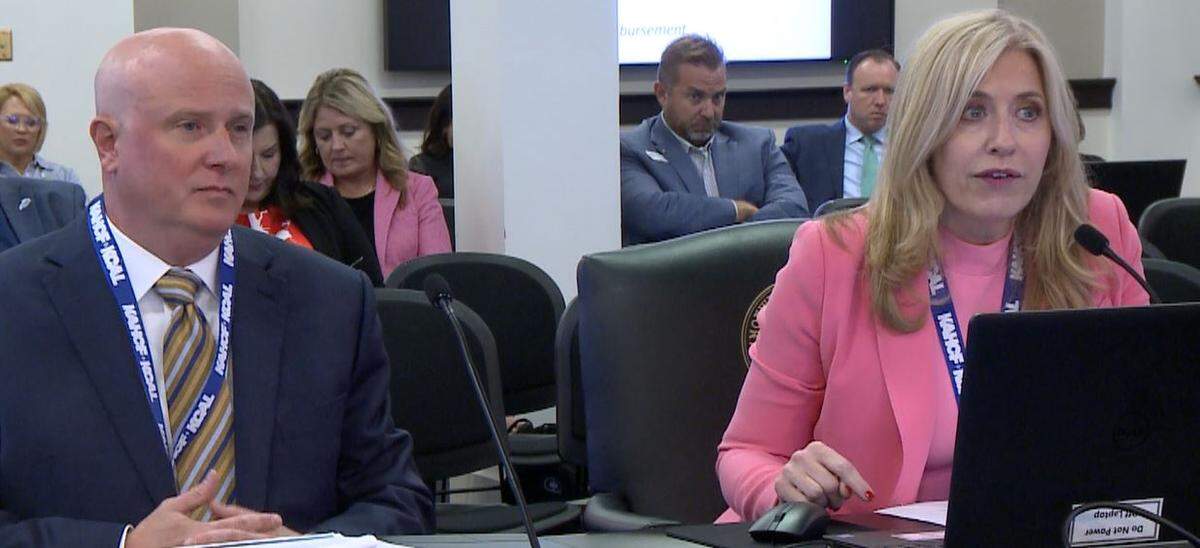
At a Sept. 25 state legislative hearing, officers with the organizaiton testified that minimum staffing standards pose the greatest threat their industry has seen since the pandemic sickened or killed thousands of people in their facilities.
Kentucky has too few registered nurses — a University of Kentucky study puts the number at 69,102 — so nursing homes must compete with hospitals and medical practices to hire from a limited supply, said Lisa Biddle-Puffer, vice president of quality and regulatory affairs with the health care facilities association.
According to the U.S. Bureau of Labor Statistics, hospitals hold the advantage because they offer more money. Hospitals pay registered nurses an average of $96,800 a year and nursing assistants an average of $40,670, compared to nursing homes, which on average pay $82,930 and $38,370, respectively, for the same jobs.
Given the noncompetitive wages and staff burnout, most nursing homes in the Kentucky Association of Health Care Facilities say they have employee shortages, according to survey results presented to the legislature’s Interim Joint Committee on Health Services.
Forty percent of Kentucky nursing homes that responded to the survey acknowledge they have “low-level staffing.”
“The timing of this is dreadful, to be honest,” Biddle-Puffer told the committee. “It really makes no sense right now to have staffing mandates at a time when we’re having the most changing demographics for the elders that we serve and the highest caregiver shortage.”
As a result of the new rule, Kentucky will see some nursing homes close or reduce the number of people they admit, warned Jeremy Bischoff, KAHCF vice president of reimbursement, in his own testimony.
To support his point, Bischoff presented the committee with a short list of nursing home closures in recent years. However, some on his list were shuttered when CMS terminated their federal payments because of serious health and safety violations, including Regis Woods in Louisville and Johnson Mathers Nursing Home in Carlisle.
The nursing home lobbyists got a sympathetic ear from lawmakers in Frankfort, where attempts to set minimum staffing standards in state law have gone nowhere in past legislative sessions.
“You folks are certainly a victim of everybody wanting the best health care that somebody else’s money can buy,” said the committee’s co-chairman, state Sen. Stephen Meredith, R-Leitchfield, a former hospital chief executive who said he started his career in the long-term care industry.
During the third quarter of 2024, around the time of the legislative hearing, the health care facilities organization gave $28,466 in campaign donations to state politicians, including $2,100 to Coleman, the attorney general; $5,000 each to the Republican House and Senate caucus committees; and $10,000 to committees run by the Republican Party of Kentucky, according to campaign-finance reports.
As of Aug. 31, the group reported spending more than $50,000 lobbying the legislature so far this year.