Exit Interview: Killian Timoney on lessons learned & what it means to be Republican today

Rep. Killian Timoney’s track record as a political moderate worked largely to his benefit during his two terms in office.
The Nicholasville Republican was first elected in 2020. Between then and now, as Republicans grew their supermajority in Frankfort, the currency of remaining bipartisan decreased in value, as did a need to vote moderate.
But Timoney, elected to represent a politically “purple” House District 45, was one of a few in the GOP to remain somewhat socially moderate, even as partisanship persisted.
Months before federal abortion protections were overturned in Roe v. Wade in 2022, Timoney voted with his party to pass House Bill 3, which banned abortions after 15 weeks and added more state agency red tape around the procedure — steps that opponents at the time said would effectively end abortion access in Kentucky.
That same session, Timoney voted against most members of his party on Senate Bill 83, the bill to ban transgender girls from competing on girls’ middle- and high-school sports teams, which remains in effect today.
Then came 2023’s Senate Bill 150.
The sweeping bill did lots of things, including restricting K-12 school teachings on sexuality and gender identity and prohibiting transgender students from using school restroom facilities that align with their gender identity.
Most notably, SB 150 made it illegal for Kentucky doctors to provide gender-affirming health care, like hormone therapy or puberty blockers, to transgender minors who’ve been clinically diagnosed as living with gender dysphoria. This aspect of the law, still in effect today, is currently being challenged in court. Widespread consensus among major medical associations is that laws hampering doctors from providing this type of care ultimately harms their patients, who are already marginalized and at risk of higher suicidal ideation.
Timoney, an educator in the Fayette County Public School system, had reservations. He was one of a handful of Republicans to ultimately vote against its passage.
“My role as a Christian is to ease people’s pain when I can, and to serve one another,” Timoney said in an interview with the Herald-Leader. “And if someone has tendencies that are suicidal, what types of supports am I putting around that person?”
He views this vote, and his “no” vote on the trans sports bill, as costing him his seat.
In May, when he faced a primary challenger, the growing Liberty Republican movement in Kentucky seized the opportunity. Thomas Jefferson, a self-described Liberty candidate who supported the bans on trans girls competing in girls’ K-12 sports and gender-affirming health care mounted an expensive campaign to unseat Timoney.
The Jessamine County Republican Party backed Jefferson, as did political action committees tied to the Liberty wing of the Kentucky GOP. Those PACs paid for political mailers that capitalized on how Timoney voted on those two bills. One mailer called him “Groomer Killian” and said he showed “the telltale signs of a predator.”
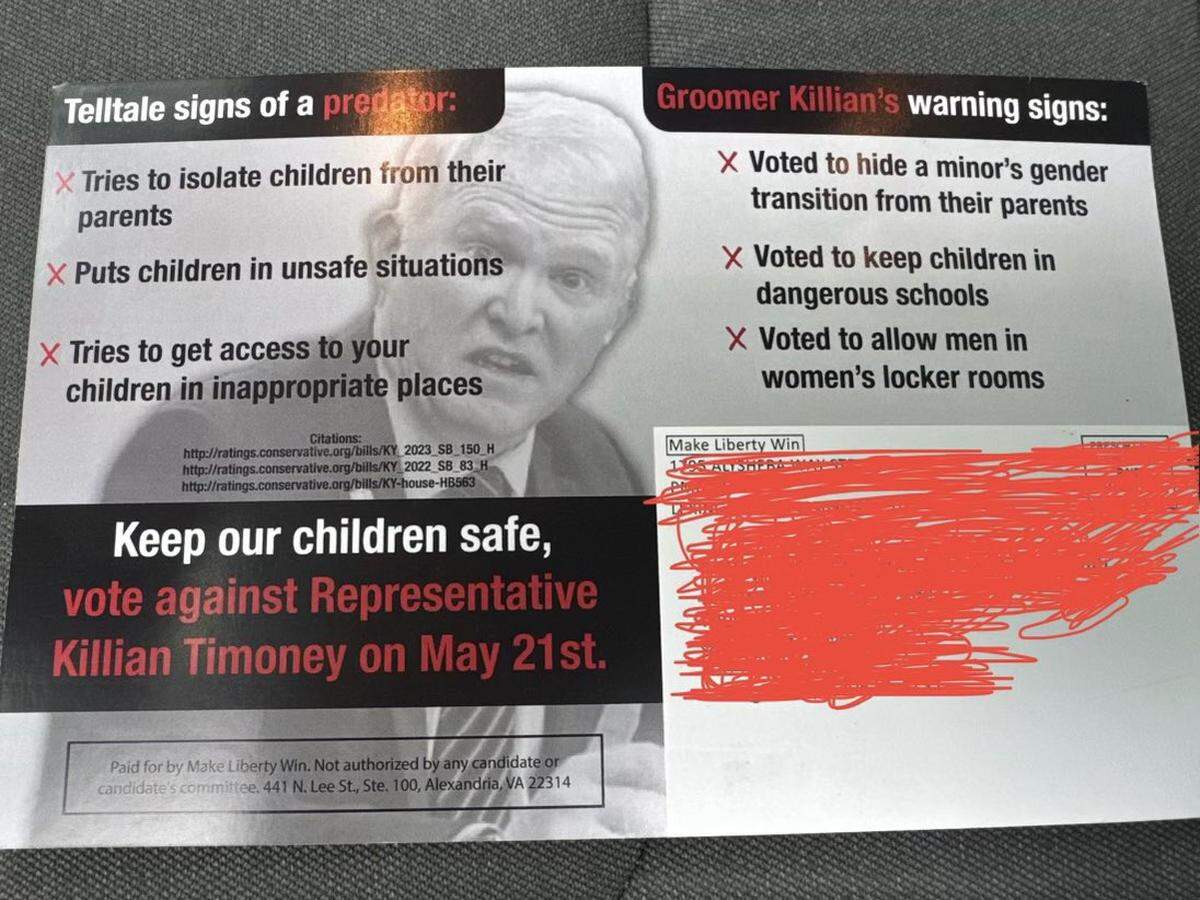
Timoney lost in a landslide to Jefferson, who won more more than 70% of the vote. In the November general election, Jefferson lost to Adam Moore, a moderate Democrat.
In a recent 90-minute conversation with the Herald-Leader, Timoney reflected on his time in Frankfort, his party’s future, the appeal of President-elect Donald Trump on Kentucky voters and the “lightning rod” social policy Republicans have passed in recent years.
Answers have been edited for space and clarity.
Herald-Leader: What do you glean from being beat by a more conservative Liberty candidate in the primary, who then was beat by a more moderate Democrat in the general election?
Killian Timoney: Contrary to the results in the primary, I feel like I had a pretty successful two terms in the General Assembly. I think despite the massive amount of negativity thrown at me during the primary, there were people aware of the work I’d done and they saw the 45th as well represented, overall.
People overlooked that, or I didn’t do a good enough job of relaying the work I was getting done.
I’m a small government, pro-capitalism, prosperity person. But at the same time, I brought an approach that doesn’t pit one group of people against another. I would rather explain to somebody who disagreed with a vote why I voted the way I did. Because understanding is much less volatile and vitriolic. It’s much less aggressive and abrasive, but it takes longer. And sadly, fireworks sell. And I think that’s an important part of where we are today.
I feel like the Liberty faction is doing a really good job of taking advantage of opportunities. What I mean by that is, in a presidential primary year, a moderate like me gets exposed, someone who’s taken a stance on lightning rod issues of the past two years, which is anything to do with trans kids.
Say I had voted for both of those bills, would you be talking to a lame duck representative? I don’t think so.
I don’t think you can underestimate the impact of the special interest groups, too. There were some that helped and some that hurt, and the hurt was much more effective. I do think the 45th District sent a message: Trump won. Barr won by a ton. Yet in my House race, it flipped. I think that sends a message that Liberty-style politics that Thomas Jefferson was a part of is not as embraced in the 45th as in other places.
Losing in the primary was just a casualty in that war. I took those stances for a reason, and I don’t regret them one bit.
H-L: You mention the momentum behind some Liberty candidates who supported those hot-button issues you opposed. What do you make of the rise of Liberty candidates in Kentucky?
KT: There’s the Liberty group, but I don’t know that they are pure libertarians. Because libertarians, do they want the government making decisions for anybody about anything? The answer is no. They are liberty, they want freedom from government control. How does that fit with abortion, or gender-affirming health care? What would a true libertarian say about the long arm of government reaching into a doctor’s office and telling parents and doctors what’s best for their kids?
My “no” vote on Senate Bill 150 had more to do with the government being in doctor’s offices.
I think what’s happening with the Liberty group in Kentucky is a blending of philosophy and ideology. Some of those other issues that are cornerstones for the Republican party, and they don’t necessarily align with what the textbook definition of a libertarian says.
H-L: Over the last three or four years in Frankfort, some of the most prioritized or talked-about policy from Republicans has been highly divisive and aimed at a marginalized group of people. As a member of the party who voted against some of these bills, what do you make of that policy direction?
KT: Why do you think that is? Do you think it’s distractionary? Why I’m asking that is, the No. 1 issue facing voters in the 45th District of Kentucky is the price of groceries.
We’ve got thousands of kids in foster care, and quite a few of them sleeping on floors in office buildings. It’s a statement of fact. We do not incentivize foster and adoption in Kentucky. There are kids graduating out of foster services.
Why are we attacking each other? I feel like (Republicans) need to prioritize what our issues are, and we also need to have a strong understanding about what’s important. As a representative, is it me flashing my values, is that what’s important? Or am I supposed to represent my district?
I think there are factions of the Republican party that latch on to those issues. And then you’ve got a very quiet group passing five and six bills a person. They are the ones you typically don’t see getting quoted in newspapers and press conferences.
I think a lot of people in the 45th, overall, just don’t want trans kids killing themselves — that is the issue. I’m going to get attacked by these special interest groups, saying I don’t care about trans girls playing in girls’ sports. What I care about is kids killing themselves, and what ever we have to do to stop that from happening.
Again, the purpose of government is to protect lives, liberty and the pursuit of happiness. My role as a Christian is to ease people’s pain when I can, to serve one another. If someone has tendencies that are suicidal, what types of supports am I putting around that person?
Am I signing legislation that, ultimately, all it will do is pour gasoline on a fire and make it a massive one? I’m going to try and keep people alive. I don’t care if they’re farmers, defense attorneys, veterans — all groups identified as having high suicide rates right now, with the highest of that group being trans kids.
You know, I’m a former track coach. I see the benefits of physical activity and competing in team sports, especially kids who are struggling with mental health. Let’s figure out a way where we can still be inclusive of people who are struggling with their identity. They should be encouraged to go into those sports, instead of saying, ‘Listen, you’re a sideshow anomaly, and we actually passed a law preventing you from participating.’
H-L: You mentioned how President-elect Trump won big in the 45th District, the same district that elected a moderate Democrat over the Liberty candidate that ousted you. If someone were to ask you what a normal Republican looks like, and whether Trump is a normal Republican, what would you say?
K-T: I think a normal Republican responded really well to Trump’s plan, because it deals with the price of eggs, bread and milk, and a 25% tariff on Mexico and Canada makes sense, because he wants American businesses to crank up and get rolling again. That’s like saying I endorse baseball and apple pie and the Fourth of July.
I think some people felt with Democratic vision, those things would get lost in the conversations about the future. Trump mentioned it in the beginning, which is why your typical Republican ended up coming back.
Stylistically, he’s definitely controversial. If he were a running back on a football team and scored a touchdown, you know his dance is going to be epic, and he’s going to stare at you as he walks off the field and tell your dad he birthed a loser. That’s what he’s going to do, and there are people there to watch him do that. But I think his message resounded with traditional Republicans. They at least want the perception Americans are working for America.
H-L: You said earlier that you don’t regret the votes that likely cost you your seat. But knowing what you know now, would you have done anything differently?
KT: (A fellow Republican) came up to me on the last day of session and said, ‘Killian, it’s critical you don’t allow them to identify who you are.’”
H-L: What does that mean?
KT: He didn’t want the Jessamine County Republican Party, the libertarians, to tell the story of who I was, because they’re not going to tell a good story. What I would’ve done differently is not waited so long to create a narrative about myself. (My opponents) at that point had already been knocking doors saying I wasn’t a real Christian because I didn’t stand for the ideologies of the Family Foundation.
I do want to say this about the Republican party: I was never encouraged to vote in any way. (Members of leadership) came up to me ahead of the trans sports bill and Senate Bill 150, knowing I was probably going to vote against them, and said, ‘This vote will hurt you in the primary, but you’ve got to vote your conscience.’ I’m getting emotional. I love those guys for that.
At the end of the day, I’m not some radical progressive. I’m just a person who cares about people, and I took some stances that cost me that seat.