
Anatomy of a $125 million deal: How speed and secrecy helped make a Northern KY project happen
In private calls and emails, it all sounded simple.
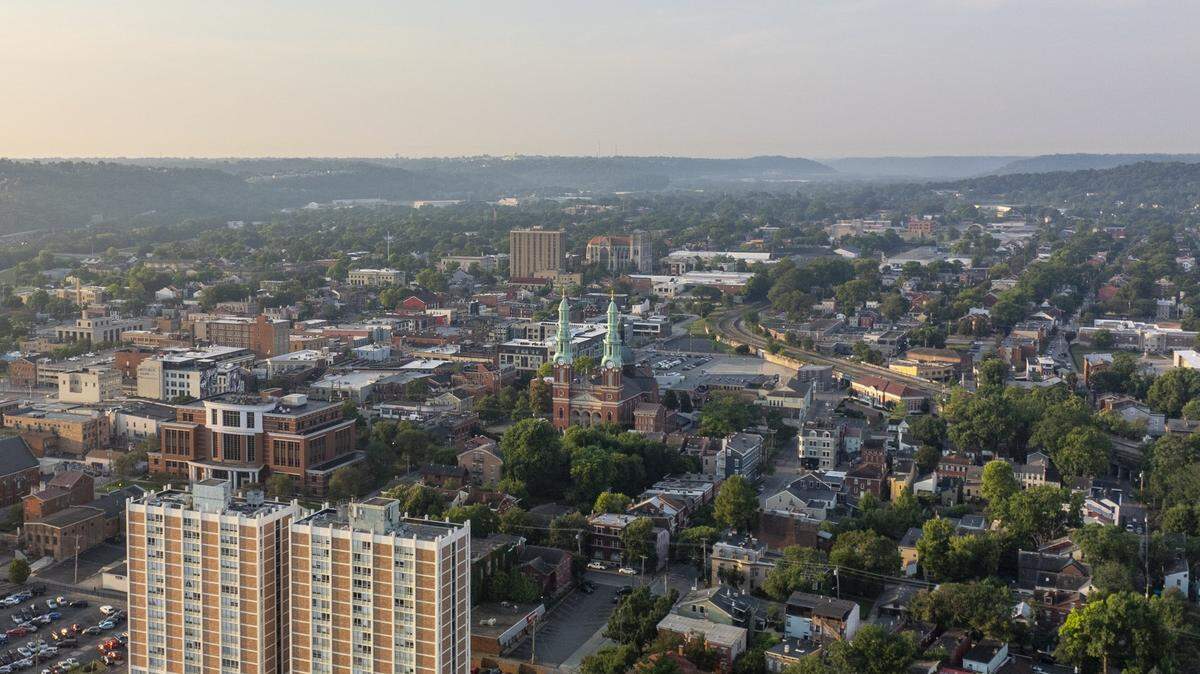
Create an education and innovation showpiece anchored by the relocation of law and medical school campuses at one of the most-coveted downtown development sites in the commonwealth. It would command a high-profile presence near the Ohio River, just a brief walk across the Roebling Suspension Bridge to the heart of downtown Cincinnati.
Redeveloping a slice of the massive 23-acre site abandoned four years ago by the Internal Revenue Service would inject new energy into downtown Covington. It also would give students access to an urban setting — closer to bars, restaurants, courthouses and potential jobs.
It also would rob Campbell County of two of its crown jewels: The Salmon P. Chase College of Law and the Northern Kentucky campus of the University of Kentucky College of Medicine would relocate six miles from Highland Heights to neighboring Kenton County.
The final cost to state taxpayers of this project would hit the $125 million mark. And for it to happen, speed and secrecy were essential.
It took less than a dozen weeks — 79 days to be precise — for the ambitious project to take shape, materialize and earn approval from legislators, a monthslong Herald-Leader investigation reveals.
The wheels began to turn Jan. 9, 2024, with an initial email from a Kenton County government staffer to a powerful Northern Kentucky Republican lawmaker, and the vision was announced March 13 at a legislative committee meeting.
It ended March 28, 2024, with the veto-proof passage of House Bill 1, the state’s massive one-time spending package.
The Herald-Leader’s review of how the deal happened also shows the $125 million package was conceived and essentially approved far from the glare of Frankfort and the state legislature.
There were no hearings. No public pronouncements. No discussions with those who might push back.
The top administrator of Highland Heights, Republican and Democratic members of Kentucky’s legislature that represent Campbell County, and even Covington’s mayor — none knew about the project until the week the funding plan was announced.
There is no indication laws were broken or ethical lines were crossed.
But an analysis of more than 1,100 pages of emails between Kentucky State Sen. Chris McDaniel, Kenton County Judge-Executive Kris Knochelman, as well as unelected bureaucrats in Kenton County government and the two universities, provides a revelatory look at how Kentucky’s most expensive local project in 2024 happened.
All without public input.
The funding for the mega-development was announced by McDaniel at a March committee meeting in Frankfort, just 15 days before the final deadline for veto-proof spending bills.
Taxpayers were not given a significant opportunity to weigh in on the massive proposal or ask a critical question to legislators:
Is this the best way to spend $125 million of our money?
Charlie Coleman, a former Campbell County commissioner who led a successful public effort to stop NKU’s Chase Law from making a similar move in 2015, was critical of how the deal came down in 2024. There wasn’t time to launch such a campaign against the project this time around, he said.
“The process is the problem,” Coleman said. “It shouldn’t have been a behind-closed-doors decision. The public, the taxpayers, didn’t really have an opportunity to weigh in. It was a done deal, and we were told the way this is going to be.”
Highland Heights officials also are peeved they were not consulted about the relocation of NKU’s law school.
City Administrator Michael Giffin told the Herald-Leader he and others were surprised by the deal. And there’s an even greater concern: The loss of as much as $100,000 in payroll tax dollars from NKU employees that will disappear when the school moves to Covington.
That’s a notable slice of the city’s overall $5 million budget, Giffin said.
“It was disappointing, and the city wasn’t necessarily aware that it was happening before it happened,” he said.
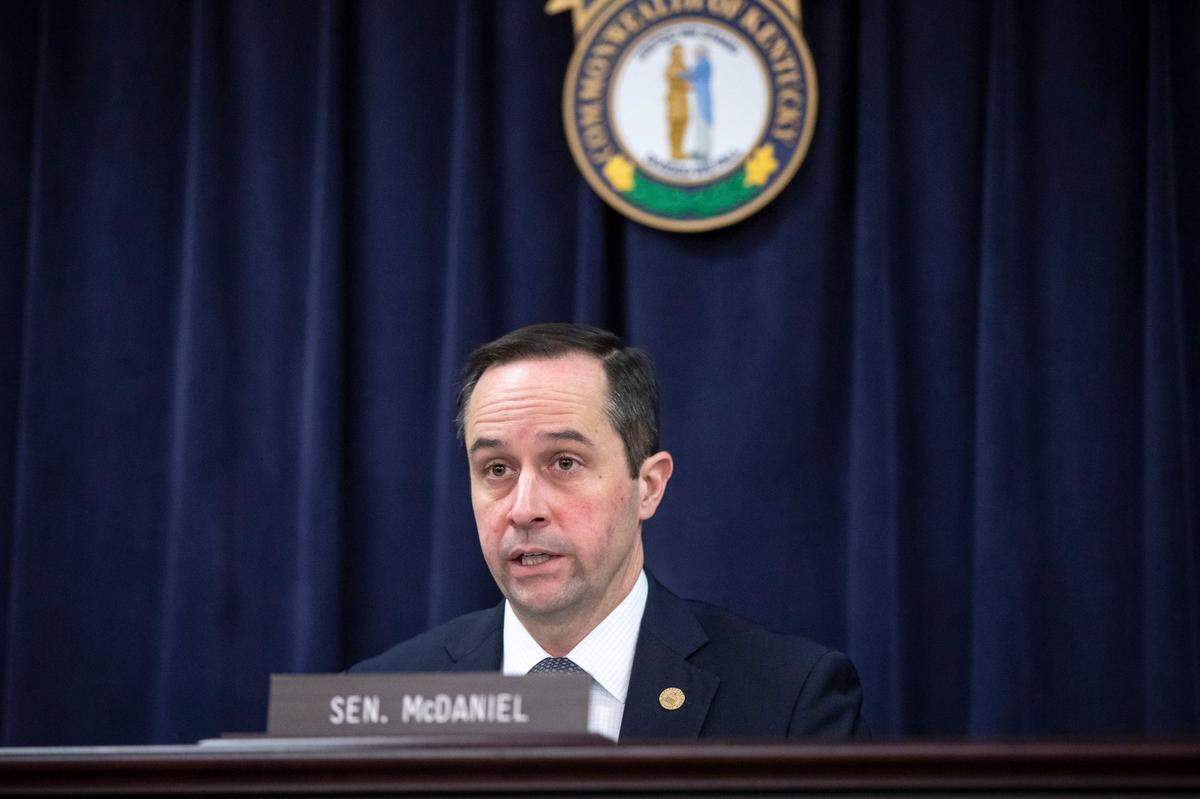
McDaniel, chairman of the state Senate’s powerful Appropriations & Revenue Committee, said the benefits to Northern Kentucky far outweigh any criticism.
The project will benefit both colleges, he said. There’s a growing appeal of urban areas for younger post-graduate students, and Covington and Cincinnati offer hospitals, biotech firms, law firms and courthouses within walking distance.
“You really have to look at this from the point of view of both of those schools as assets of the commonwealth,” McDaniel said.
“While there are local impacts, there are other interests, particularly those of recruiting and retaining high-quality students, that take precedence.”
The money to plan, design, and construct the facility goes to the Kenton County government in two installments: $10 million during the current fiscal year and $115 million in the next, which starts July 1, 2025.
The Northern Kentucky Riverport Authority, which will deploy the funds given to the county, has yet to purchase any land.
Even given McDaniel’s argument on improving NKU and UK’s presence in the growing Northern Kentucky region, some opponents and skeptics question moving existing state assets less than six miles as the crow flies at a price tag of $125 million.
That sum is the most state general fund money put toward a single, tangible project since the legislature pledged up to $250 million for the massive Ford BlueOval SK electric vehicle battery campus in Glendale, which is set to employ 5,000 people.
“The $250 million to BlueOval came with thousands of jobs and billions of dollars in investment. This, to my knowledge, does not offer any of those kinds of growth opportunities for our region,” said Rachel Roberts, a former Democratic legislator who represented Campbell County until this year.
“It simply seems to be taking a program from one county and moving it to a different county at a very steep cost.”
Ernesto Scorsone was a Democratic legislator representing Lexington for 23 years, from 1985 to 2008, before becoming a judge. He isn’t buying the justification for moving NKU’s Chase and the UK’s medical campus.
“You’re just relocating the same enterprise, so in terms of the state there is no economic development gain by doing this,” he said. “This is essentially a vanity project. The state, I think, could use this kind of money in a much better way. It’d be more valuable to shore up some of the problems.
“My God, look at the (state’s) juvenile justice system and what it needs. You know, $125 million would do a lot more to help improve that situation.”
From mockups to $125 million
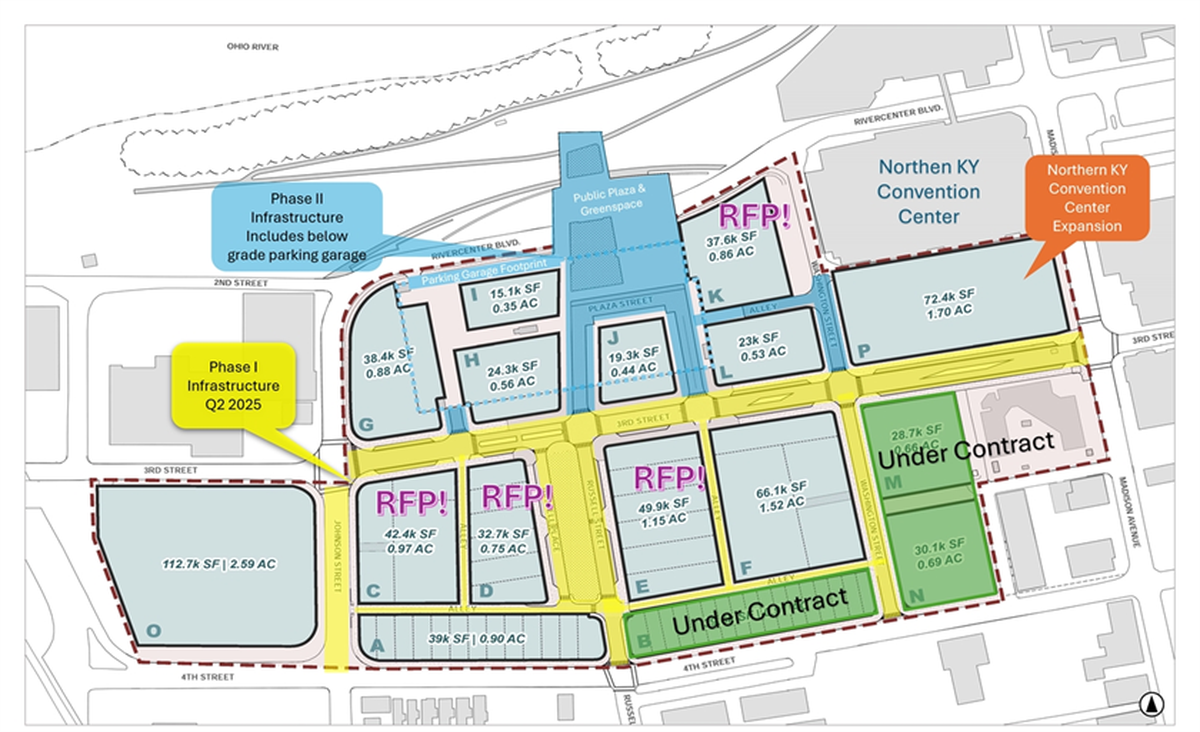
It starts with the Central Covington Riverfront area, known by officials and developers as CCR.
Formerly the site of a massive Internal Revenue Service office building, the 23-acre empty site sits on the edge of downtown Covington, right next to the Ohio River flood wall across from Paycor Stadium, home to the Cincinnati Bengals.
Covington bought the land in 2020 and tore down the vacant office in 2022.
Instead of selling the land to one developer in a single deal, the city has paved roads there, slicing it up to sell parcels to multiple developers. A city news release says the work aims to “replace what was once a fenced-off concrete island with a connected neighborhood,” a somewhat novel approach that’s garnered positive attention from urbanism enthusiasts.

During the project’s germination last year, Kenton County Director of External Affairs John Stanton took the operational driver’s seat, keeping both McDaniel and Knochelman apprised of developments, coordinating meetings and quietly ginning up interest in the idea with officials at both schools.
On Jan. 12, 2024, he emailed to NKU officials potential budget language for moving the law school to Covington, and he engaged with UK leaders around the same time.
“I’d like to develop a long-term strategy to help UK access the resources present in the Greater Cincinnati region,” Stanton emailed Holly Danneman, an associate dean at UK’s Northern Kentucky medical campus, on Jan. 14.
In that note, he shared a news story about an Indiana “innovation district” that brings together a medical school, biomedical startups and government.
Stanton followed up that day with another email to Danneman referring to funds recently granted to UK for biomedical innovation: “How do we make Covington an extension of UK’s campus?”
Danneman sent Stanton a list of pros and cons for moving UK’s Northern Kentucky satellite from Highland Heights to urban Covington on Jan. 28. She listed 10 positives, including “proximity to clinical partners” and “appealing to student demographics” among others.
The nine negatives were primarily logistical issues like access to facilities and parking.
By early February, McDaniel had held an informal meeting with UK President Eli Capilouto and other university officials about the project.
A Feb. 4 email from Stanton reviewed by the Herald-Leader said a “courtside” chat with Capilouto — UK men’s basketball had just hosted the University of Tennessee the day before — was productive. The president listened to the pitch and was “reserved, but expressing interest” about the idea.
On Feb. 17, Shad Sletto, a local real estate professional with the construction and development firm Al Neyer, mocked up a preliminary $230 million budget for the whole project. Like Knochelman, Stanton and McDaniel, Sletto is also involved with the Kenton County Republican party, serving on its executive committee.
McDaniel responded to the initial budget in an email: “I doubt my ability to get this kind of money but we’ll see where we can get.”
By Feb. 25, Sletto sent to the small group of Kenton County officials and McDaniel the first renderings of the project: Three interconnected towers overlooking the Ohio River.
The group started to work March 3 via email on a news release outlining the deal.
McDaniel announced the funding — then $150 million, though the final compromise budget landed on the $125 million total — March 13 during a meeting of the Senate Appropriations & Revenue Committee that he chairs.
The bill, which included one-time funding for projects all over the state, got 38-0 approval from the full Senate that day and the final version passed 35-1 and 86-10 on March 28.
The project was not in the House’s version of the bill unveiled Jan. 16, nor was it in Democratic Gov. Andy Beshear’s budget proposal released that month.
In September 2024, the county and the Northern Kentucky Riverport Authority — an economic development body through which the funds are being deployed — entered into a contract with a management firm on the project.
The county’s sights have thus far been set on a few parcels that total roughly three acres at the northwest corner of the Covington Central Riverfront site, along Johnson Street.
Language in House Bill 1, the one-time appropriations bill that granted the $125 million for the project, designates only that the money go to the county to construct a “Commonwealth Center for Biomedical Excellence in the City of Covington in partnership with Northern Kentucky University and the University of Kentucky.”
Kenton County officials have highlighted the area’s preexisting startup biomedical companies — such as Gravity Diagnostics or Bexion Pharmaceuticals — as ripe for partnerships.
There also is a possibility that UK will add a pharmacy school element to the new Covington project.
“While this current project focuses on the UK College of Medicine-Northern Kentucky Campus, we are continually evaluating other options and opportunities for growth to meet the commonwealth’s needs in the future,” UK spokesperson Jay Blanton wrote in a statement.
It’s unclear what will come of Nunn Hall, the current building housing NKU’s Chase Law on the university’s flagship Highland Heights campus. Remodeling work has been underway there and is not yet complete, thanks to more than $15 million in approved state projects over the course of the past two budget cycles.
“There are no finalized plans for the future of Nunn Hall yet,” NKU spokesperson Corey Best wrote in a statement to the Herald-Leader. “We will engage with campus partners to determine the best use for the space in alignment with the needs of the university and its community.”
Best added that a timeline for project completion has not been solidified and the school is “actively participating in planning conversations.”
A guarantee: This will benefit Northern Kentucky
Why did supporters of the $125 million deal provide little public notice until very late in the process?
Opponents say it may have something to do with the last time a similar idea was floated about 10 years ago.
At the time, public opposition helped sink the project.
In 2015, Knochelman sought to attract the law school to downtown Covington when Kenton County vacated its Court Street building. Many Campbell County folks sounded the alarm against it, and NKU eventually determined the move wasn’t feasible.
“It would have a negative effect on Highland Heights, and any pluses for them, would be a minus for us,” Coleman,a Campbell county commissioner representing the area, said at the time. He was one of the loudest opponents of the project, forming a bipartisan coalition of Campbell Countians against it.
Sen. Shelley Funke Frommeyer supports the project this year. The Alexandria Republican represents all of Campbell County, where a majority of her voters reside, as well as a small slice of downtown Covington, including the other side of the Covington Central Riverfront site.
She said she understood initial concerns from her Campbell County constituents upset about the loss, but added she was not involved in any aspect of the deal before it went public.
“Even in my regular conversations with NKU leadership, and their legislative liaison (lobbyist), they did not share with me their efforts around the distributed campus,” Frommeyer said.
Some speculate, she said, Campbell County residents were left out of the process because project leaders wanted to avoid public backlash.
“The postmortem from a number of others indicated that, with further input, (that) may have slogged it to ‘no action,’ and we didn’t want it getting slogged to no action,” Frommeyer said. “I can respect that attitude. These things can be very difficult with such a big move.”
How the deal unfolded in Kentucky’s Senate was sharply different than how funding requests were handled in the House, said Roberts, the former state representative from Campbell County who didn’t seek reelection in 2024. She’s rankled by how the Covington project played out.
House Appropriations & Revenue Chairman Jason Petrie “more or less asked you for a business plan” for new or special spending for your legislative district, Roberts said.
She added that Petrie, an Elkton Republican, insisted that she and others have data that justified any spending item request.
“On the House side of things, I can tell you that it seemed very robust, and like everyone was required to do a fair amount of legwork for the ‘ask’ they were making, especially if it was for new or out of the ordinary spending,” she said.
“So, to see this come so quickly from the Senate side — in a way that didn’t seem to have that same vetting with all of the local officials rowing the boat in the same direction asking for the same things, providing the same data set — that was interesting to me, for sure.”
Knochelman told the Herald-Leader in a mid-2024 interview that he prefers action to overlong deliberation or impact studies.
“I can guarantee (the project) is going to be positive. I’m not a real big study guy — it wastes a lot of time — but it’s going to be impactful to the region,” he said. “You could develop a study and spend a fortune on it; it’s going to tell you that it’s going to help Northern Kentucky.
“The stars are aligning, and in the end, Northern Kentucky wins.”
Frommeyer agreed, saying the project is “growth-oriented” and “has all the right reasoning.”
When asked about the timing and process, McDaniel stressed that the driving force behind the project was different than it was in 2015.
With a massive surplus in the current budget that legislators doled out in the one-time spending bill, the state had the money to spend and started from there.
That wasn’t the case in 2015.
“Last time, the nexus was the idea of, ‘Hey, we want to move the law school to Covington.’ This time, the nexus of the idea was, ‘We’re going to do one-time transformational projects in the commonwealth. What could some of those be?’” McDaniel said.
“It was just a very different starting place.”
The rules dictating transparency at the state and local levels also are different.
The legislature is not obligated to share its plans with the public until the day they get passed. Such was the case for the controversial “sewer bill” that attempted to change the state’s retirement system in 2018 and 2023’s Senate Bill 150, which banned gender-affirming care for minors.
Local governments generally have to provide space for public comment before passing a new ordinance.
Local governments are also subject to the Kentucky Open Records Act in a way that the Legislative branch is not.
A few years ago, the legislature moved to shield itself almost completely from requests filed under that act. Last year, some in the legislature considered a bill significantly curtailing the public’s access to local and state executive branch records, though that legislation was later scuttled.
Amye Bensenhaver, a former deputy attorney general for 25 years who co-founded the Kentucky Open Government Coalition, said the process behind the Covington project indicates planners wanted to avoid public debate before the money got into the budget.
“I’m just like, ‘Wait a minute, if you think there might be pushback, there may be a reason.’ There may be a problem with what you are proposing to do. That’s what that pushback is, and that’s what you need to listen to,” she said.
“It is one of those situations where they’re basically admitting that they do not have the best interest of their constituents at heart.”
How would Lexington react to losing UK’s law school?
McDaniel’s pitch for moving the law and medical campuses is fairly straightforward: He contends it improves the institutions, which are key assets for the state.
“When you stop and look at what other regions, what other universities are doing, this falls in line with what the cutting edge folks are doing: You’re going into an urban core. These (students) are not like undergrads on a campus. These are folks who are in a doctoral-level program. They’re in a different phase of life, and the things that they desire are different,” McDaniel said.
Covington is more diverse than Highland Heights and an easy walk to downtown Cincinnati. The nightlife, restaurants and, even more important, proximity to potential employers make it a better fit than Highland Heights, McDaniel said.
Currently, NKU Chase Law is ranked third of the three Kentucky law schools by US News and World Report. Ranked No. 150 in the nation, it’s just behind the University of Louisville’s law school, coming in at No. 136.
University of Kentucky’s J. David Rosenberg College of Law is ranked No. 61 in the country.
Coleman, the former Campbell County commissioner who led the charge against a similar effort a decade ago, told the Herald-Leader he still hates the idea because it steals high-profile assets from Campbell County.
“What do you think (UK President) Capilouto or the Lexington local officials would say if they took the law school or the medical school (from Lexington) and moved it to Jessamine County?” Coleman asked.
Coleman said the “power structure” in Northern Kentucky is made up of politicians and business executives who promote a regional outlook, sometimes to the detriment of a single county like Campbell.
“It’s a mystery to me that nobody has said anything — at least anybody with any political power. They’re all afraid of the power structure, I assume. I wonder: Where’s our county government? I haven’t heard a word from them opposing it.”
Campbell County Judge-Executive Steve Pendery has not responded to Herald-Leader requests for comment.
An open records request for county officials’ emails about the project yielded just one message in which Pendery forwarded a note sent to him the day that the funding went public.
The county claims a message it sent “expressing opinion to the General Assembly” about the campuses moving is exempt from public disclosure because it’s “preliminary.”
It’s also difficult to get legislators to weigh in on the McDaniel-led project.
The Northern Kentucky veteran legislator has chaired the Senate Appropriations & Revenue Committee for 10 years, making him one of Frankfort’s most powerful members of the legislature. He’s a consequential voice in the room when it comes time to approve funding for local projects requested by legislators.
McDaniel also is respected by members, lobbyists and activists on both sides of the aisle as an intelligent and effective operator in Frankfort.
Supporters of the project have cited, as a counterbalance to the loss of the law and medical schools, the state-backed relocation of the Kentucky State Police crime lab and the creation of a Northern Kentucky Medical Examiner’s Office under one roof at the former Highland Heights city building.
That was expected and discussed among county officials before appearing in the budget as a $21 million allocation, mostly paid via bond funds.
But Giffin, the Highland Heights city administrator, said the impact of those two moves is still a “net negative” on the city’s tax rolls.
Despite the importance of the project, only a couple of people made it a political issue for this year’s elections: McDaniel touted the allocation in a television advertisement.
Brandon Long, a Democrat who ran an unsuccessful campaign in the Campbell County-based House District 68, ran against the decision.
Long shares Coleman’s assessment, characterizing the regional groups’ work as a “concerted effort” to centralize Northern Kentucky’s identity and capital in downtown Covington, and to a lesser extent, downtown Newport.
“The priority is the ‘development up here,’ and creating a regional identity,” said Long, a Fort Thomas resident.
“Everybody just has to, for lack of a better word, submit to that. They’re just going to pat us on the head and say, ‘We’ll take care of you, Campbell County. Just trust us.’”
This story was originally published January 8, 2025 at 4:45 AM.