KY Senate approves bill to help coal industry by allowing pollution in more water sources
.jpg "Senate Bill 89, requested by the Kentucky Coal Association, would weaken the state’s water pollution laws.")
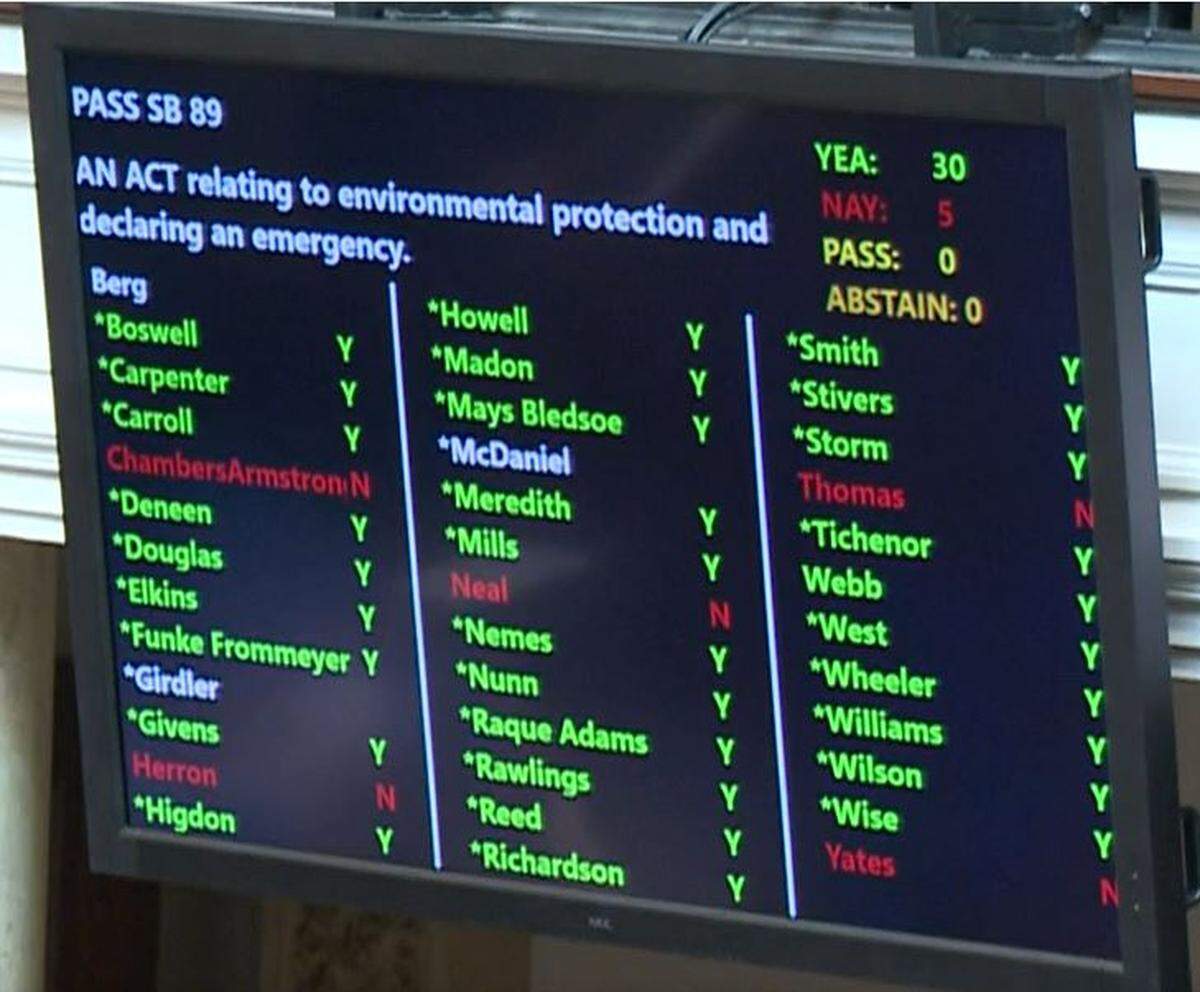
The Kentucky Senate on Friday voted 30-to-5 to pass a controversial bill that would benefit the coal industry by making it easier to pollute more water sources without getting in trouble with state environmental officials.
Senate Bill 89 now goes to the House.
The Kentucky Energy and Environment Cabinet has too much authority to interfere with coal mining while carrying out its regulatory mission of protecting water quality, said the bill’s sponsor, state Sen. Scott Madon, R-Pineville.
Madon blamed the cabinet, which includes the Division of Water, for “unwarranted governmental overreach” during a Senate floor speech Friday.

“Permitting delays that risk jobs, unnecessary red tape that reduces our competitiveness and out-of-control regulatory proposals that would impose over $100 billion in additional costs to the coal industry — one has to question if the cabinet even wants us to mine coal in Kentucky,” Madon said.
“It’s time to stop letting the red tape choke the progress and start letting common sense lead the way,” he said. “As I always say when I’m talking about coal, God put coal under our feet so we can use it. It’s one of our greatest natural resources. And it’s our job to push back on unelected bureaucrats that overstep and safeguard constituents from government overreach.”
The cabinet did not immediately respond Friday to a request for comment.
Earlier in the week, a cabinet spokeswoman said the agency was still reviewing the bill “and the many impacts it will have on the quality of Kentucky’s drinking water, the costs to individual communities and public water departments and the possible effects to public health and the environment.”
Definition of protected waters
Madon’s bill would would narrow the definition of protected “waters of the commonwealth” used by the Division of Water so it mirrors a 2023 U.S. Supreme Court decision that weakened the Environmental Protection Agency’s ability to enforce the federal Clean Water Act.
Currently, state environmental regulators are responsible for protecting “any and all rivers, streams, creeks, lakes, ponds, impounding reservoirs, springs, wells, marshes, and all other bodies of surface or underground water, natural or artificial.”
But on the federal level, the Supreme Court limited the definition of protected “navigable waters” to oceans, lakes, rivers, streams and wetlands that have a “continuous surface connection to those bodies.”
Other wetlands and groundwater that do not have surface connections to those bodies as well as temporary seasonal waterways created by rains and snow melt no longer are covered by the Clean Water Act.
Environmental groups like the Kentucky Resources Council warn that Madon’s bill likewise would strip state protection from groundwater and “ephemeral headwater streams,” the small, temporary streams that flow into larger streams, creeks and rivers after a rain or snow melt.
Polluting groundwater and ephemeral headwater streams is not only bad for the environment, the groups say, it risks contaminating drinking water sources for Kentuckians who rely on wells or downstream river water every time they turn on their faucets.
“I think they’re only worried about surface water, but this just totally throws out groundwater,” said hydrologist Chuck Davis, president of the Kentucky Ecological Restoration Association, in comments to the Herald-Leader on Friday.
“There are these little communities that rely exclusively on groundwater withdrawal for drinking water that are in the mountains near coal mines where (the Division of Water) still has regulatory authority to regulate groundwater pollution,” Davis said.
“If that goes away, you leave communities that rely on groundwater for drinking water just at a terrible place with no regulatory oversight from anybody. It’s awful to think about,” he said.
Critics’ testimony cut short
Critics of the bills who tried to testify against it Feb. 12 before the Senate Committee on Natural Resources and Energy were cut short by a procedural motion when impatient senators asked to approve it and adjourn. Madon, the sponsor, was joined at the witness table that day by two officials with the Kentucky Coal Association.
On Friday, a handful of Senate Democrats said they sympathized with Republican senators’ desire to protect the coal industry. But Madon’s bill is written so broadly that it would leave important water sources unprotected on the state level in Kentucky, including groundwater, they said.
State Sen. Keturah Herron, D-Louisville, cited the crisis of the contaminated municipal water supply in Flint, Mich., 10 years ago, which occurred after the city switched its intake lines to a badly polluted river.
Louisville has its own polluting industries concentrated in the Rubbertown neighborhood, Herron said. She asked Madon who would protect groundwater in Louisville if his bill becomes law and chemicals are spilled.
“I would assume that would be the Energy and Environment Cabinet, the one that does it now,” Madon replied.
“From my understanding, based on the change in the definition of groundwater, this legislation would not allow that,” Herron said. “I hope what your answer was just now is the correct answer. But it still gives me concern.”
Staff writer Austin Horn contributed to this report.
This story was originally published February 14, 2025 at 1:04 PM.