This Southern Baptist leader in KY is leading the church’s charge to overturn gay marriage
Since the Supreme Court legalized gay marriage in 2015, Andrew Walker of Louisville has devoted much of his adult life working to get it overturned.
That decade-long effort reached a milestone in June at the Southern Baptist Convention’s annual meeting, where one of the largest evangelical bodies in the country voted to codify its position against gay marriage and transgender rights.
As head of the SBC’s resolution committee, Walker, an associate professor of Christian ethics and public theology at the Southern Baptist Theological Seminary in Louisville, was the architect of the resolution, titled “On Restoring Moral Clarity through God’s Design for Gender, Marriage and the Family.”
It pointedly calls on the Supreme Court to overturn Obergefell v. Hodges, the landmark case that legalized same-sex marriage a decade ago.
That decision, and other policies affirming gay and trans people’s rights, “deny the biological reality of male and female are legal fictions, undermine the truth of God’s design and lead to social confusion and injustice,” and “defy God’s design for marriage and family,” the resolution reads.
Nearly 11,000 “messengers,” or members of Southern Baptist churches across the country, attended the June conference in Dallas. Contrasted against the divisive vote in 2023, when members only narrowly rejected a formal ban on churches with women pastors after fraught debate, passage of Walker’s resolution, which wades into some of the most barbed culture war issues, passed easily and with little fanfare.
Walker wasn’t surprised by this.
“I can understand why this might be audacious from the perspective of the secular media,” he said. “The majority of Americans affirm same-sex marriage, so why would you risk name and reputation to say something that would be perceived as backwards by American standards today?
“But internally within the SBC, this is not remotely controversial.”
Walker, who is also associate dean of theology at the SBC’s flagship seminary, described the approval of the resolution as one component of an ongoing process to reclaim marriage, legally and morally, as exclusively between a man and a woman.
“This resolution is just one pillar or prong in a multi-faceted strategy to basically remind society that it may think it can abscond with God’s moral laws,” he said, “but God’s moral laws, as I understand them, will find a way of vindicating themselves over time.”
‘A rebellion against God’s design’
Walker’s brick-by-brick approach is modeled after conservatives’ successful decades-long pursuit that eventually toppled Roe v. Wade in 2022, which had preserved abortion access for nearly 50 years.
On the heels of the Supreme Court’s June 18 decision upholding ban on transgender-affirming medical care, opponents of gay marriage see overturning Obergefell as an increasingly achievable goal.
Southern Baptists are some of the most vocal opponents.
Even though its membership continues its steady decline nationwide, Southern Baptists remain the largest Protestant denomination in the country and arguably the most powerful religious group shaping American policy.
But to those on the outside looking in, especially in more progressive religious denominations, the SBC continues to further isolate itself.
“I appreciate the effort to try and portray this as something that is not hostile,” said Chris Caldwell, interim pastor at Highland Baptist in Louisville, of the resolution. “But the gay and trans people that I know and love would find it very difficult to accept that argument.”
Highland officially left the Southern Baptist Convention in the early 2000s over what Caldwell described as “irreconcilable” theological differences. For instance, Highland has been led from the pulpit by female ministers, openly welcomes LGBTQ members and staff, and performs same-sex marriage ceremonies — all tenets formally opposed by the SBC.
Caldwell said this latest resolution aligns with the stereotype that Southern Baptists constitute “a religion more known by what it’s against.”
“I serve a church now, and have served churches through the years, that prefer to be known by what they’re for,” he said.
Increasingly, the SBC has thrown its weight behind issues that are or have become politically conservative flash points.
Albert Mohler, the longtime head of the Southern Baptist Theological Seminary, said in 2014 that the legalization of gay marriage portended a bleak reality for Christians.
“Christians who affirm the biblical understanding of marriage as the union of a man and woman must now recognize that we can no longer count upon the government and its laws to reflect that understanding,” Mohler wrote.
Mohler’s perspective has remained unchanged, but the cultural context for expressing it has grown more hospitable, in part because of the “onslaught of the sexual revolution,” Walker said.
This year’s resolution calling for gay marriage to be overturned also condemns the “normalization of transgender ideology, especially the participation of biological males in girls’ sports and medical transition of minors.”
That normalization “represents a rebellion against God’s design for male and female, inflicts unjust harm on children and women, employs coercive language control, and undermines fairness, safety and truth,” according to the resolution.
Walker’s resolution calls on lawmakers to “pass laws that reflect the truth of creation and natural law – about marriage, sex, human life, and family — and to oppose any law that denies or undermines that God has made plain through nature and scripture.”
While SBC’s vote regarding gay marriage and trans rights may serve primarily a symbolic and principled purpose, it does reflect moral arguments the Supreme Court has shown it’s willing to uphold.
Just a few days after Southern Baptists convened in Dallas, the high court ruled June 18 that a Tennessee ban on gender-affirming care for trans youth is constitutional. This ruling also means a similar ban in Kentucky can remain in place.
The Ethics and Religious Liberty Commission, the influential public policy arm of the Southern Baptist Convention, filed an amicus brief in that case in support of Tennessee’s ban, because it upholds “fundamental truths that Southern Baptists hold dear.”
Tennessee Attorney General Jonathan Skrmetti, who argued in favor of Tennessee’s ban before the Supreme Court, spoke on a panel at this year’s SBC meeting about how he believes it was God’s will that he defend Tennessee’s ban.
In the lead up to this year’s annual convention, ERLC President Brent Leatherwood wrote, in “marriage and family across the nation, we have seen a rise in the pro-LGBTQ agenda, which has infiltrated all aspects of public life,” which is why, “our team has been advocating against this harmful ideology across the board.”
Walker, too, sees himself as working in line with biblical ministry.
Jesus “doesn’t just look at people who are experiencing these hurts and difficulties and say, ‘Hey, you do you, man. Live your truth,’” Walker said. “He identifies with their suffering, names their sin, but then he shows mercy, love and gentleness.
“Social conservatives, Christians like myself, we understand that this is a very long-term cultural conversation,” he added. “The purpose of this resolution is the ultimate horizon for the design of marriage and family, but then at the more penultimate horizon or social horizon is, we need to keep the argument alive.”
Citing nationwide polls that still show a majority of Americans support legalized gay marriage, Walker said he’s aware “there is virtually no political will at this point in time to overturn Obergefell.”
A 2023-2024 Pew Research Center poll found 59% of religious adults say homosexuality should be accepted by society, helped by the fact that the number of LGBTQ couples who are married and living together has also continued to steadily increase.
Walker and others who share in his belief system also point to a recent Gallup poll published in May that shows support for gay marriage has stagnated across the board and diminished considerably among Republicans.
Republican support of gay marriage peaked at 55% in 2021 and 2022, but that has gradually dropped to 41%, the poll found. Conversely, support among Democrats has risen to 88%, a record high. That 47-point gap is the “largest since Gallup first began tracking this measure 29 years ago,” Gallup said.
To Walker, “there’s no doubt there’s momentum on the side of social conservatives” at this time.
“I am not saying that America is on the cusp of a social conservative renaissance,” he said. “But I am saying there is more openness to my worldview than I have perceived there ever has been since I’ve been an adult.”
Walker knows he’s playing the long game. And in Kentucky, he’s not alone in helping to mobilize that coalition.
‘Court created a problem only it can fix’
Kim Davis, the former Rowan County clerk who denied marriage licenses to gay couples after their unions were legalized, is working to get her case before the Supreme Court with the goal of overturning Obergefell.
Davis was sued in 2015 by gay couples in Rowan County, who argued that her actions violated their constitutional right to marry. Davis refused to grant them marriage licenses, claiming that doing so would violate her religious belief that marriage is exclusively reserved for heterosexual couples.
“My conscience will not allow me,” she told a federal judge in 2015.
After repeated losses — she’s been ordered by a jury and a judge to pay hundreds of thousands of dollars in damages to a gay couple who sued her —Davis is appealing yet again, in hopes that she can vanquish the law she violated in the first place.
Though legal experts have told the Herald-Leader Davis’ case is too procedurally flawed to move the needle on Obergefell, her attorneys are charging ahead, buoyed by the Supreme Court’s decisions this term, including their ruling upholding state bans on gender-affirming health care for trans youth.
“It is not a matter of IF but WHEN the court will overrule Obergefell. The Kim Davis case will be the catalyst,” Davis’ attorney Mat Staver said in an email. Staver founded the conservative Christian legal group Liberty Counsel, based in Orlando, that is representing Davis.
He plans to file Davis’ appeal before the end of July, in hopes of getting it on the court’s calendar in 2026.
Staver is hopeful not just because the court’s conservative majority has grown since 2020, but because of something Justice Clarence Thomas wrote when justices declined to hear Davis’ case five years ago.
Her case “provides a stark reminder of the consequences of Obergefell. By choosing to privilege a novel constitutional right over the religious liberty interests explicitly protected in the First Amendment, and by doing so undemocratically, the court has created a problem that only it can fix,” Thomas wrote. “Until then, Obergefell will continue to have ruinous consequences for religious liberty.”
To Staver, this “leaves the door open.”
The issue he argued in Davis’ case in 2020 was qualified immunity, or whether Davis, as a public official, had immunity to exercise her religious liberty in place of carrying out her duties to provide marriage licenses as elected county clerk.
Davis was briefly jailed for contempt for refusing to issue marriage licenses, even after a judge ordered her to do so. That punishment amounts to a violation of her religious liberties, Staver has argued.
Davis “was entitled to a reasonable accommodation for her sincere religious convictions under the First Amendment and Kentucky’s Religious Freedom Restoration Act,” her lawyers wrote in a 73-page brief last July. “The government’s refusal to timely grant such an accommodation impermissibly infringed her religious exercise.”
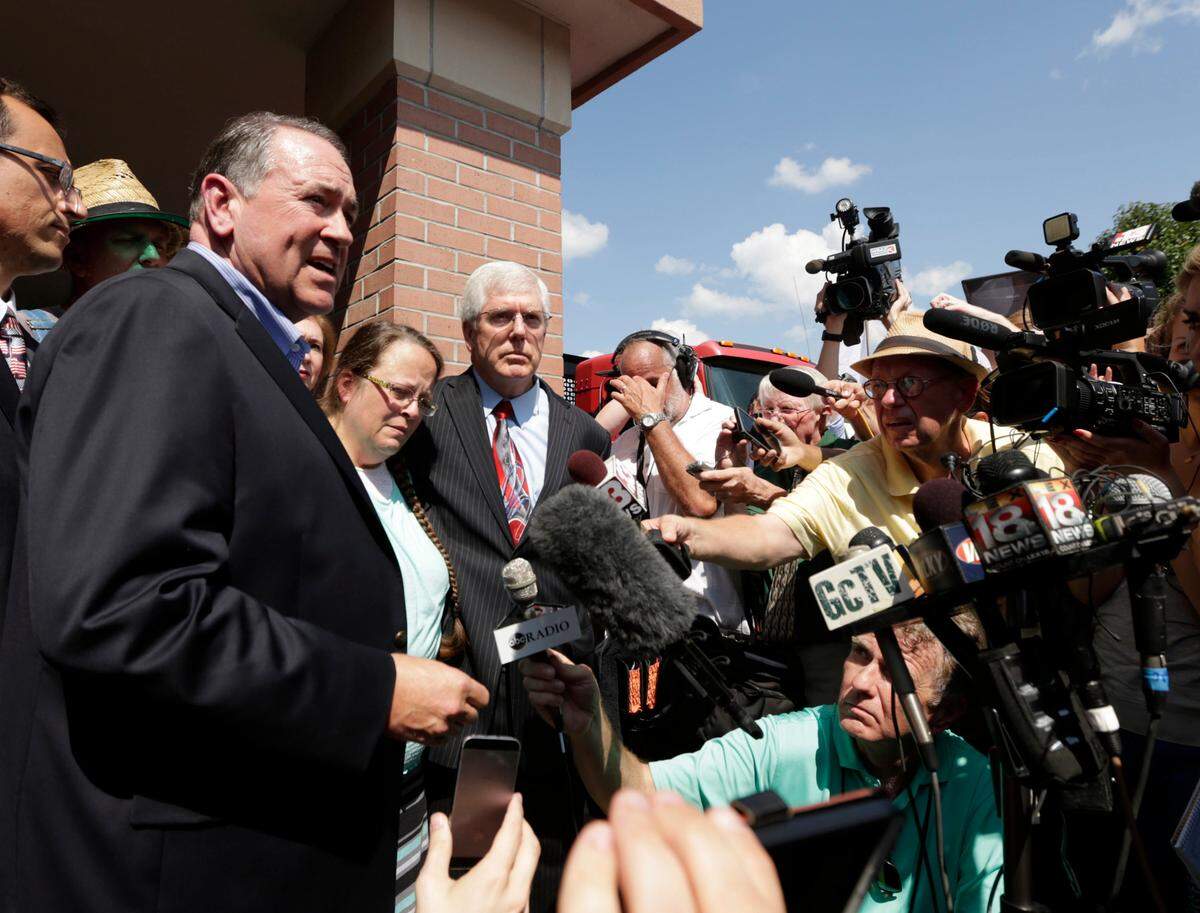
Today, the issue at hand in her case is more pointedly a defense of the “First Amendment Free Exercise Clause,” since Staver believes Davis to be the “first victim of Obergefell,” because she was jailed for six days and has been ordered to pay hundreds of thousands of dollars in damages.
This pursuit is supported by others in Kentucky, where the General Assembly maintains a Republican supermajority.
“The ultimate solution to the Obergefell decision is the same as that for Roe v. Wade: a court willing to revisit and reverse its own deeply-flawed and anti-democratic rulings,” Kentucky Family Foundation’s Senior Policy Analyst Martin Cothran wrote in a June 25 op-ed.
An influential conservative Christian lobbying group, the Family Foundation has lobbied in favor of nearly all hot-button policies to pass out of the Kentucky legislature in recent years, including efforts to restrict and ban abortion, and bills limiting the rights of trans youth and adults to access health care and play sports that align with their gender identity.
When Obergefell was decided, Walker was working as a lobbyist for the Family Foundation.
Reversing Obergefell “would, of course, require someone to challenge the decision,” Cothran wrote. “But with an increasingly conservative electorate recoiling from the insanity of the gender revolutionaries, such an effort is not unimaginable.”
‘It’s not a brokenness’
Reflecting on the resolution, Walker said his intention is rooted in compassion and care, not political vitriol or moral brow-beating.
He referenced Matthew 12:20 and the description of Jesus’ servant in need.
“A bruised reed he will not break, and a smoldering wick he will not snuff, until he has brought justice through to victory,” it reads.
“The imagery is, Jesus does not bruise those who are delicate and gentle. I mean this fervently: I have no contempt at all for individuals who experience gender-identity conflict. I want to be as mercifully kind and gentle as much as I possibly can,” Walker said.
To him, passing a resolution projecting this moral worldview, one that requires a major course-correction and would ideally lead to the nullification of hundreds of thousands of gay marriages nationwide because they contravene “God’s moral laws” is compassionate and in line with Jesus’ teachings.
“Regardless of where culture goes, if you believe marriage is actually not redefinable, then we’re called to witness to the truth about what marriage is,” Walker said.
“This is not so much, ‘let’s pick on homosexuals.’ We actually need to speak the truth about what marriage is, because we think this is actually embedded in our understanding of human flourishing and the common good.”
But what does human flourishing look like?
To Rev. Sally Evans, an ordained minister in Louisville who is raising two children with her wife, to whom she’s been married since 2013, it looks like reflecting God’s love to her family and onto the diverse world around her.
To Walker’s point about healthy marriages leading to flourishing societies, Evans said she’s not in disagreement.
But imposing a worldview in the name of God’s moral order in hopes of denying family’s like hers legal standing is a subversion of her understanding of God and the collective well-being of others.
Being gay “is not an addiction I can’t get over; it’s not a brokenness,” Evans said. Characterizing the SBC’s effort as an act of compassion feels like a “profound minimization” of her and so many other LGBTQ people’s individual journeys toward self-actualization, she said.
At the end of the day, Evans’ marriage isn’t much different than her straight brother’s marriage.
“There is so much more alike than different in our unions,” she said.
“We both reflect kindness and compassion and hope and a deep sense of unconditional love, whether that’s to our kids or to our neighbors. We both have the potential to reflect God’s love equally,” Evans said. “That’s why I think God blesses it.”
This story was originally published July 10, 2025 at 5:00 AM.