
Q&A: Sen. Mitch McConnell on his legacy, Gov. Beshear, 2026, Israel and more
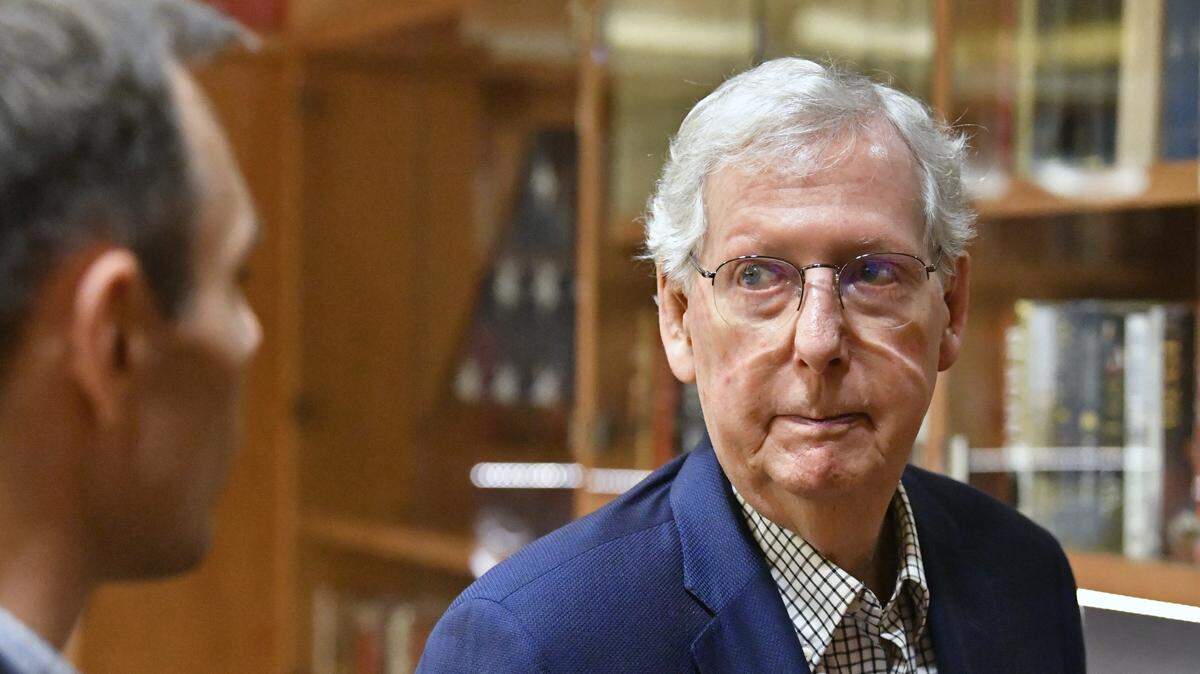
Sen. Mitch McConnell has a message he’d like to get across.
At the outset of a recent interview with the Herald-Leader, McConnell made a point to ask: What greater measure of popularity is there than elections?
“These suggestions about who’s popular and who isn’t irritate the hell out of me, because when you get into the leadership position, you get beat up,” McConnell said. “So, how do you judge popularity? Seven victories in Kentucky, nine victories in the (Senate Republican) conference.”
Since stunning the political world with his 1984 win over incumbent Democrat Walter “Dee” Huddleston to gain office, McConnell has indeed won all of his elections in Kentucky by comfortable margins, and his colleagues in the Senate granted him a record-breaking 18 years as party leader.
So, why does popularity matter for an already legendary 83-year-old Senator entering his final act, not seeking reelection in 2026?
It’s become a central message of one of the many prominent Republicans seeking to replace him. Lexington tech entrepreneur Nate Morris has built his GOP Senate campaign around being anti-McConnell, ending his many television ads with the tagline “I’m a Trump guy, not a McConnell boy.”
Part of that gambit is that McConnell’s electoral victories matter less than what the surveys say: that McConnell is unpopular with a majority of Kentuckians. According to one from Morning Consult, McConnell has the lowest approval rating among constituents of any of the 100 U.S. senators.
Despite his riff on electoral results working as something of a retort to Morris, McConnell did not want to offer any direct thoughts on the race or offer an opinion on whether he hoped Morris would lose.
“I’m not going to get into the Senate race,” McConnell said.
The race to replace him was one of many topics McConnell covered in an extensive Aug. 29 conversation with the Herald-Leader. He offered thoughts on Kentucky Gov. Andy Beshear, the mid-decade redistricting push, President Donald Trump and what he believes Kentuckians should remember about his service to the state.
The big three he mentioned: a tobacco industry buyout engineered in the mid-2000s, the $1.6 billion in federal funding for a toll-free Brent Spence Bridge in Northern Kentucky, and the massive effort to deconstruct a chemical weapons storage facility in Richmond.
The interview took place at the McConnell-Chao Archives at the University of Louisville, a museum-like addition to the expanding McConnell Center. Just past the archives is a still-growing library replete with most of the hundreds of books McConnell has read during his time in office.
The last four books he said he’s read: Two on George C. Marshall, architect of America’s first big foray into foreign aid, the Marshall Plan; “America First,” a history of FDR’s struggle against isolationism leading up to World War II; and “Founding Partisans,” which is described as “a revelatory history of the shocking emergence of vicious political division at the birth of the United States.”
After some searching, archivists at the center were able to track down just four works of fiction in the volume of several hundred books. The last one McConnell read was “Nemesis,” by Phillip Roth, which focuses on the Polio epidemic that was raging around the time of McConnell’s birth. McConnell had Polio as a child and still deals with its lingering effects today.
An Aug. 29 story covered some of the topics mentioned in the Herald-Leader’s interview with McConnell, particularly his views on the Trump administration. This Q&A includes those topics, plus most of the remainder of the 40-plus-minute interview, lightly edited for length and clarity.
Herald-Leader: I’d imagine you probably have just a little more free time now that you’re not Senate GOP leader. How do you spend your free or leisure time?
Mitch McConnell: Well, I still have plenty to do, but it’s more narrow and more focused. You know, when you’re in a leader job, you’re involved in everybody’s life — their personal problems, their political ambitions and trying to make everybody look good, and tough decisions, taking the heat.
I’m not doing that anymore. I thought the best thing for me to do the last two years was to focus on what I thought was the most important thing I might have an impact on, and that’s defense and foreign policy. I think this is the most dangerous period since before World War Two. There’s certain similarities right now to the ‘30s. Herbert Hoover signed the Smoot-Hawley tariff bill in 1930, widely believed by historians and economists to have taken the depression worldwide. Those who were totally anxious to stay out of all of what was going on in Europe were called “America First.” Sound familiar?
So what do we have today? North Korea, China, Russia, Iran and Iran’s proxies. They’re very different kinds of countries, but they have one thing in common: They hate us. So, when you talk about preparedness, we’re not prepared like we should be… with regard to Ukraine, what we need to do is avoid the headline at the end of the war, ‘Russia wins, America loses.’ It has huge worldwide implications, and for those who are concerned about the money, I think it’s important to remember that about half of the money was spent in this country, including in Kentucky, (with) 38 states modernizing our own industrial bases. We’ve sent older weapons to Ukraine.
H-L: I think most everybody in Kentucky knows who you are, but I’m curious, when you think about your legacy in Kentucky – not, say, blocking a Supreme Court nomination, not anything DC-centric – what do you want Kentuckians to think about?
MM: The tobacco buyout (of 2004), I think, had a huge impact on our state… You didn’t have to be too smart to figure out tobacco was heading in the wrong direction. There used to be a lobby group in Washington called the Tobacco Institute. The last time I went to meet with them, no one was smoking. So I suggested, I think it was ‘97 or ‘98, a buyout.
All the people in the tobacco world went berserk. There was a poll taken of Kentucky tobacco growers, and they were overwhelmingly against it. Jim Bunning was running for the U.S. Senate at the same time, and I said, “Jim, you’ve got to be against this.” But two years later, they all came into my office and said, “You know, that might be a good idea.”
So then the question was, how do you convince people that paying people not to grow tobacco is a good use of public funds? That’s a pretty tough vote. So what I did was craft a bill that did just that, paid for by tobacco itself. That didn’t get it done in terms of the vote, so it was still going to be a voting problem. So I was the (Senate GOP) whip at that point, and I asked the leader to put me on an “unrelated bills conference” and dropped it in. That’s how we passed it.
The second issue I would mention, much more recently, is the Brent Spence Bridge (companion bridge to connect Kentucky to Ohio). Many times in legislative work, multiple people do it. But the reason I mention this is because I had the most to do with the tobacco buyout and passing it, and on the Brent Spence Bridge.
I’m not getting up every day during the Biden years thinking, “What can I do with Joe Biden?” But I helped develop a bipartisan group that stripped out of this massive amount of money that Biden wanted us to vote for — which was a mistake — and we stripped out the transportation part. What it did was solve the 20-year problem of not being willing to allocate that much money out of the (state) transportation fund for one project when you’ve got 138 people who have transportation issues.
We built it without tolls. You can ask (Senate President) Robert Stivers and (House Speaker) David Osborne: It solved an impossible situation for them, because they had members from up there who obviously couldn’t afford it. And then in private conversations, everybody understood that without tolls it wouldn’t be done. One other thing: on that same deal, the state got $4 or $5 billion over the next four years for other road projects.
The chemical weapons depot (in Richmond), you talk about a long game. From the beginning to the end, that was almost my entire career. My job every year was to come up with the money that we needed to continue to move along.
H-L: You’ve obviously seen in the news the talk of mid-decade redistricting. What do you think about the idea of splitting up Kentucky’s 3rd Congressional District to favor Republicans and have a 6-0 map? Do you think that’s a good idea or a bad idea?
MM: I don’t have any on-the-record comment.
H-L: You’ve sort of indirectly addressed some of what we’re hearing from Nate Morris on the campaign trail. Do you want to directly address any of his comments that he’s made in his campaign now?
MM: No, but I think what I told you right at the beginning relates to that subject.
H-L: Do you at least hope that he loses?
MM: I’m not going to get into the Senate race.

H-L: It’s no secret that you and (U.S. senate candidate and former attorney general) Daniel Cameron have very close professional ties, and at least were very close at one point. Is that no longer the case?
MM: No, that’s not no longer the case. Look, it’s pretty hard to find somebody in Kentucky politics that I don’t have some involvement with, either helping them get elected or solving local problems. I mean, if you’re searching for somebody in Kentucky that I haven’t been trying to help or be involved with in one way or another, (it’ll be a) pretty long search.
H-L: President Trump wants U.S. Rep. Thomas Massie gone. Do you agree with President Trump that Thomas Massie should be primaried?
MM: Look, my own view about the leader job, whether you’re the president or the leader of one of the parties, is the Ronald Reagan quote that I thought made the most sense. He had what he called the 11th commandment: Do not speak ill of another Republican. So that’s the way I’ve tried to conduct my career.
H-L: In another interview, you raised the possibility of Kentucky Gov. Andy Beshear running for Senate. Do you think he will run for Senate? Do you have any reason to believe that?
MM: Let’s just put it this way: I don’t believe just because he says it that he’s not going to run for the Senate. He’s a gifted politician, he won in a red state, and I know Chuck Schumer well enough to know that he’s probably beating the door down. And so, what the governor will have to decide: Is he more likely to get to be president, a pretty long shot for anybody, or to win a Senate seat where he’s shown he’s competitive? So I think we’re going to have to pay attention to Kentucky right up until the filing deadline, and I think who is chosen makes a big difference.
H-L: Do you think Beshear has any realistic shot at getting the nomination and even becoming president, or do you think it’s dead in the water?
MM: Do you think you do?
H-L: Well, I know I don’t.
MM: The point I’m making is that’s a really long shot thing. Seems to me that you’d have to be pretty darn confident to think that starting from nowhere, you’re going to be president of the United States.
H-L: We saw recently in the news that President Trump fired the Centers for Disease Control and Prevention director amid pressure from Health and Human Services Secretary Robert F Kennedy Jr. over vaccine policy. I’m wondering if you share in some of the criticisms of that choice, given that you voted against Mr. Kennedy for Secretary.
MM: No.
H-L: I wanted to ask you about some of the projects in state capitalism, I guess you could call it, that we’ve seen — the U.S.’ “golden share” in Nippon steel, the share in Intel that the administration just acquired. It may seem a little anathema to free market capitalism, a long-held value of yours and most Republicans. What do you make of that?
MM: I think it’s a terrible idea. It’s industrial policy, (and) the government’s picking winners and losers. I don’t think we ought to go down that path at all.
H-L: You’ve called the situation in Gaza “mixed.” Obviously, you’re a supporter of our relationship with Israel. I’m wondering, what about the situation now leads you to conclude that the situation is mixed? What don’t you like about what you’re seeing right now?
MM: Well, first of all, I don’t think it’s our business to tell the Israelis how to run the war any more than I think it’s our business to tell the Ukrainians how to run their war. They’re both allies.
Having said that, Israel clearly is taking a bath on the coverage, and they know it. It’s a uniquely difficult problem. It’s hard to figure out how to solve it. You may not remember this, but you know how Hamas got in control? There was an election. So we were naive enough to think if you just had an election, everything would be alright. We tried that in Egypt, and the Muslim Brotherhood won. So I’m reluctant to tell the Israelis how they ought to do this. It’s a very challenging situation.
They know, obviously, the downside of conducting this contest. For myself, I’m not going to walk away from Israel. I think it’s an incredible story of how it was created and how it exists in a very bad neighborhood. I want to give President Trump some credit: In his first term, the agreement called the Abraham Accords, which included the UAE and a few other Arab countries, came into existence.
I actually took some of my members on a trip a couple of years ago, and the UAE was one of the stops, in addition to Saudi Arabia, and I met the Israeli ambassador to UAE, and he said business was booming, and also it was clear that wouldn’t have happened unless Saudi Arabia signed off on it.
Which leads me to what may have been the reason for Hamas’ attack in the first place: the growing feeling that Israel and Saudi Arabia were going to (McConnell raises two connected fingers). I talked to the Crown Prince when we were in Riyadh, and there’s a lot of communication between them and Israel now — not officially diplomatic relations, but (it’s) growing.
The Crown Prince wants to change Saudi Arabia and is making progress on a lot of things. You know, you can’t dictate their system. If you only had friends with those who had elections, you wouldn’t have as many friends as we do. We don’t have a better friend than Jordan, for example. It’s not exactly a democratic government.
H-L: Do you think America is a better place today than it was around 10, 11 years ago, when Trump came down the golden escalator and announced he was running for president?
MM: You know, I’m not sure enough time has passed to start evaluating who made a difference and who didn’t. I thought a good bit about that myself, just in terms of whether I thought I made a difference. And I think, as you’re already aware, at the federal level it would be the courts.
H-L: Do you think that going forward, the party should continue to be in the mold of President Trump?
MM: That’s up to the voters, But I am disappointed by the decision of (Iowa Sen.) Joni Ernst not to run again, (North Carolina Sen.) Thom Tillis to not to run again, (Tennessee Sen.) Marsha Blackburn has said she’s going to run for governor.
There are two kinds of people I’ve run into in politics: Those who want to make a point, and it’s pretty easy to do because all you have to do is criticize another member of your party, or those who want to make a difference. Fortunately, I’ve been surrounded, mostly, by people who wanted to make a difference — for their state, in a close election or federal policy.
As I go toward the endzone of my career, I would like everybody to be able to say, “You know, I actually had an impact in a positive way on the country.”
H-L: In February 2021, you said, “loony lies and conspiracy theories are cancer for the Republican Party in our country,” in reference to Congresswoman Marjorie Taylor Greene. Four years later, do you think the lies and conspiracy theories have stopped, or are they still cancerous to the party and the country?
MM: In other words, do I object to making stuff up? Yeah.
H-L: I‘m curious what your future actually looks like. You’ve talked about it a little bit. You’ve said you won’t be a lobbyist, which is often the profession of people who leave. What does it look like?
MM: Well, I can’t be a lawyer, either (laughs). I don’t know how to be a lawyer. My wife doesn’t want me home for lunch, I can tell you that.
H-L: Nonprofit boards? Company boards?
MM: I was 42 when I got there. I’ll be 84 when I leave. If you add on the seven years as county judge here, it’s almost half a century. Some would argue that’s a good reason for term limits. You know what my answer to that always is? We have them now — they’re called elections.
I’ve obviously begun to think about it. I think I’ll hang around the place where we, you and I, are right now more than I have been able to in the past. I’m pretty proud of what we’ve built here.
The thing that started first was the (McConnell) Scholarship program, which I raised the money for to try to attract the best and brightest kids we could get to go here, rather than to up east, where they frequently never come back.
We’ve had 275 graduates. Most of them are in Kentucky or are coming back to Kentucky. Some of them are in politics — Michael Adams, Daniel Cameron and Scott Jennings. But (also) dentists, doctors and business people. One staffer of mine, going abroad, ran into one of them in the foreign service in Vietnam. So they’ve gone into all kinds of different areas. But what I’m really happy about is they’re probably either here now or headed back, which is what it was all about in the beginning.
H-L: Anything else you’d like to add?
(Staffer suggests he talk about state Republican growth from his first election to present)
MM: I’ve tried to help move us from where we were when I got elected. We had not won a statewide race in 16 years, and I didn’t win by a landslide. We had several breakthrough moments. The ‘94 Republican sweep gave us the two House seats. Then, the breakthrough in the state Senate. Dan Seum actually made his decision (to become a Republican, tipping the Senate to a GOP majority) in my living room here with David Williams and me sitting by him.
So I tried to participate in making it better, and I think it has. I’m not trying to take all the credit for that, but I’ve tried to help. We flipped the state Senate and kept it, got it better and better. But then there’s the state House. I had a meeting with a bunch of House Republicans after the 2014 election, and we had a number of districts where we had no candidate at all. Then, shall I say, there was a lack of candidate quality where we did have them. So (chief of staff) Terry (Carmack) and (Commissioner of Agriculture) Jonathan Shell and I got involved in going around, courting candidates. I tried to participate in upping the quality and making sure we had somebody running who was electable.
So, election night 2016, I had three things on my hope list. Number one was the state House to flip. Jeff Hoover called early in the evening and said, ‘We got it done. Checked that off.’
I still wanted to be the majority leader, because that’s a lot better than being the minority leader, and about 11 p.m., we checked that off.
It never occurred to me that Donald Trump would actually get elected. When he did, we had the Supreme Court vacancy sitting there, and an opportunity to change the court system with quality strict constructionists for a long time.
This story was originally published September 2, 2025 at 5:00 AM.