
McConnell to KY biz leaders: I’m focusing on national defense the next two years
AI-generated summary reviewed by our newsroom.
- McConnell will spend final term chairing Defense Appropriations to shape DOD budget.
- His legacy centers on pro-business judicial appointments and Senate leadership roles.
- McConnell criticized tariffs, urged negotiation to resolve trade, Gaza and budget feuds.
In one of Mitch McConnell’s first campaigns for public office, Kentucky’s longest-serving senator said his team vowed to host neighborhood coffee meetings around Louisville and Jefferson County.
“No one came,” he said Oct. 14 in Louisville to a full room of the state’s business leaders who chuckled with the senator.
“So, it’s certainly safe to say I never envisioned a crowd like this.”
During the Kentucky Chamber of Commerce’s 79th Annual Dinner honoring McConnell Tuesday evening, several state leaders lauded the senator’s legacy that’s spanned more than four decades and has included installing pro-business judges and lifting Kentucky through policy and negotiation.
“I remember reading about some of the great political figures of our time ... and I always wondered, ‘What were they like?’ I wondered what they thought, I wondered how they overcame the obstacles they were presented,” said Kentucky Speaker of the House David Osborne.
“... I know that 100 years from now, there’s going to be history books written (and people will wonder the same things). And the fact of the matter is, we get to know because we are living that history book.”
Focus of remaining time in Congress
In the remaining part of his final term, McConnell said he plans to make an impact from the helm of the Defense Appropriations Subcommittee.
“I’m going to spend my last two years doing whatever I can to try to encourage us to take a different direction than the flat line of spending,” McConnell said. “This is a serious challenge, the biggest challenge in the world, and so what I decided ... to do was take up the Defense Appropriations Subcommittee.”
The subcommittee is responsible for reviewing policies that give money to the country’s military and its intelligence agencies, directly determining the budget for the Department of Defense. After McConnell stepped down as the Senate’s GOP leader, he became the subcommittee’s chair in January 2025.
“I thought the most important thing going on in the world right now is the threat we face in defense and foreign policy,” McConnell said. “... I want to give the president a shout-out for the involvement in the Gaza solution hopefully, but I don’t think the tariff war makes any sense.”
Since President Donald Trump began imposing his sweeping trade and tariff agenda in February, McConnell has continued to say added costs from taxes on imported goods are shouldered by American consumers and the policies aren’t helping the longevity of the country’s trade negotiations and relationship with allies.
The president’s recent trip to Israel and Egypt was the final push for a ceasefire agreement and exchange for hostages in the Gaza Strip where war has taken hold as a result of unresolved land conflict.
Optimistic for a conclusion in the Middle East, McConnell also has pushed for giving strong military and financial aid to Ukraine as it also fights a war with Russia over land the senator has said is critical to defending democracy.
“I can guarantee Ronald Reagan would roll over in his grave if he knew that we were reluctant to give the Ukrainians what they need to shoot Russia,” McConnell said.
Wading through government shutdowns
McConnell said the job of party leader is always to shepherd success while taking blows and arrows. The job is also about negotiation, a task not always as easy as it sounds, he said.
On Oct. 1, for the first time in nearly seven years, the U.S. government shut down when Republicans and Democrats failed to agree on an appropriations budget.
“Take what’s going on now with the government shutdown. We’ve been through a few of those over the years and in the end, five people will solve the problem: the four leaders in Congress and the president,” McConnell said.
“Over 18 years, I was in a number of those situations and ... looking at the current situation, I’m kind of glad John Thune is doing it.”
A judicial legacy
Introductory remarks from Kentucky Chamber President and CEO Ashli Watts and U.S. Chamber of Commerce President and CEO Suzanne Clark were made to resounding applause as both women said carrying on McConnell’s pro-business legacy and knowing the system to do it is of the utmost importance.
Among many career-defining moments, there’s likely none are as consequential as McConnell’s move to block Democratic President Barack Obama from filling a Supreme Court vacancy with Merrick Garland in 2016.
In the following four years during Trump’s first presidency, McConnell ushered in Neil Gorsuch, Brett Kavanaugh and Amy Coney Barrett to the bench, along with making hundreds of lower-court appointments.
Those three justices are conservative leaning and tend to agree with McConnell’s motivation to limit regulation, often seen as a pro-business interest. In 2024, the Supreme Court instructed courts to use independent judgment in rulings instead of deferring to a federal agency’s rules which was long customary to interpret vague parts of laws and regulations.
“I thought judges were our No. 1 (focus) because they last longer (than legislation),” McConnell said. “The great division among judges in recent years has been whether they ought to be the umpire or be in the game, and I was always of the umpire (opinion) ... I hope (they’re) only calling the balls and strikes.”
Seeing the parties shift
McConnell, who first took congressional office in 1985, said he’s seen the party in power shift a number of times, but nothing resembles the changing political landscape like the evolution of Fancy Farm, the annual West Kentucky political rally and barbecue tradition.
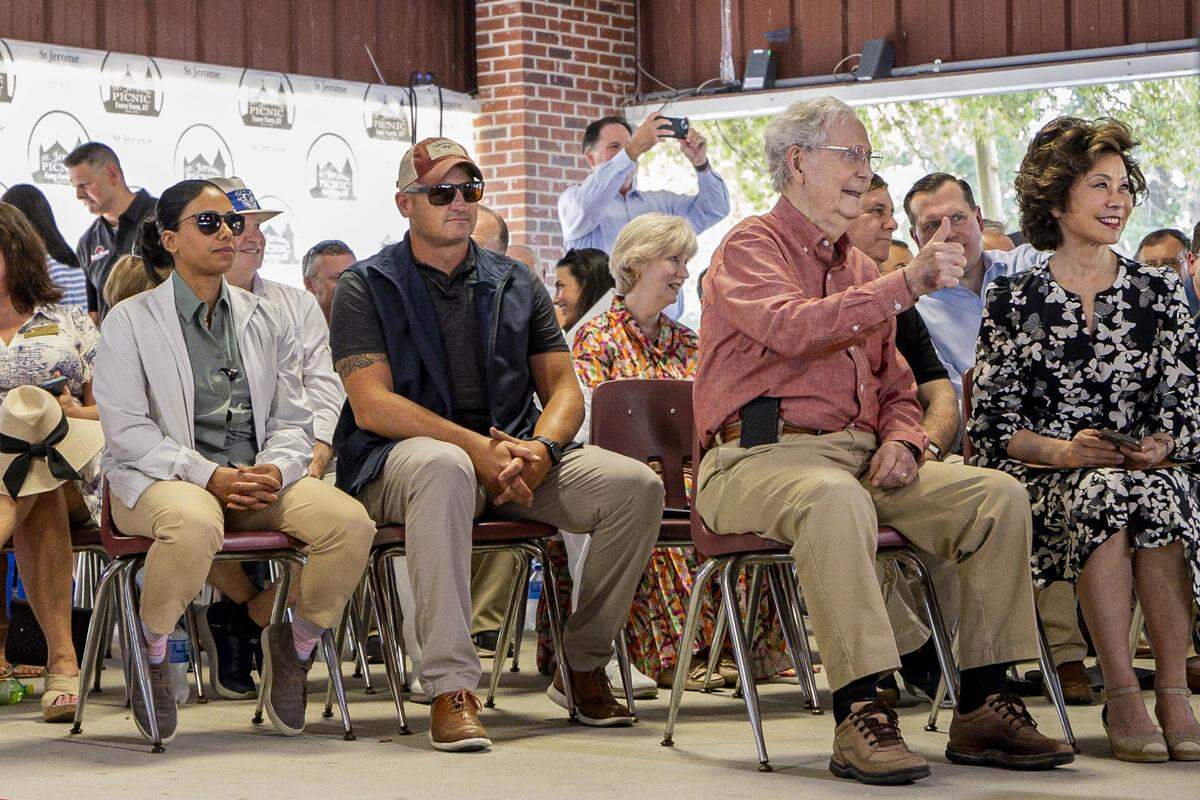
When he first started attending and politicians were divided on stage by party, McConnell said on the Republican side, it was him and a couple of county chairmen. On the Democratic side, there were numerous governors, state officials, local officials, making the porch they were sitting on almost lean to the left.
“This year when I went down there ... the most prominent Democrat they could find was the mayor of Mayfield,” McConnell said.
“It has been fascinating to watch the evolution from the state, which was almost always Democratic. And today, you can’t find a Democrat with a flashlight.”
.JPG)