Seniors left to rot in bed suffered severe injuries in KY nursing home, records say
AI-generated summary reviewed by our newsroom.
- State inspection found pressure sores led to serious injury and death.
- Survey cited falsified records and routine neglect, including missed skin checks.
- Families filed 11 lawsuits accusing Salyersville nursing home of neglect, wrongful death.
Editor’s note: This story contains graphic images and descriptions of injuries that some readers may find upsetting.
Kentuckians have rotted in their beds inside Salyersville Nursing and Rehabilitation Center, a low-rated Magoffin County nursing home owned by a consortium of New York investors, according to lawsuits and a deeply critical state inspection last year that led to $447,485 in fines.
Documents describe how residents were allowed to suffer agonizing, gruesome pressure sores that decayed their flesh and led to infection and death.
At least 11 lawsuits filed by different families against the 142-bed nursing home since 2021 have alleged that pathway of harm for their loved ones — pressure sores, infections and death — although other injuries and illnesses sometimes were cited, too, such as malnutrition and unexplained broken bones.
A May 17, 2025, inspection by a survey team from the Office of Inspector General at the Kentucky Cabinet for Health and Family Services also criticized the nursing home for allowing residents to suffer from pressure sores that led to serious injury and death.
Residents were neglected in their beds as a matter of routine, inspectors said, with clinical records falsified by staff to make it wrongly appear that care plans were being followed.
The inspection came after a four-year gap in which the state failed to conduct its legally required annual review of the nursing home’s quality of care. Kentucky has struggled with one of the nation’s biggest backlogs in nursing home inspections since the COVID-19 pandemic, although state officials say they’ve worked hard to get back on schedule.
The state’s much-delayed inspection resulted in 14 deficiencies being issued, 10 of them for the highest levels of violation, known as “immediate jeopardy.” The Salyersville nursing home is currently rated as a one-star facility, or “much below average,” by the U.S. Centers for Medicare and Medicaid Services.
The plight of one woman — 81-year-old Ruth Smith Castle Reed — was cited in both the state’s inspection last year and a wrongful death lawsuit that her family filed on March 25, 2026.

Reed, a retired cook for the Johnson County Public Schools, lived at Salyersville Nursing and Rehabilitation Center for one month, from Oct. 4, 2024, through Nov. 3, 2024. Still fully in possession of her wits, she was supposed to recover there from surgery for a broken back following a fall at her home, where she lived independently.
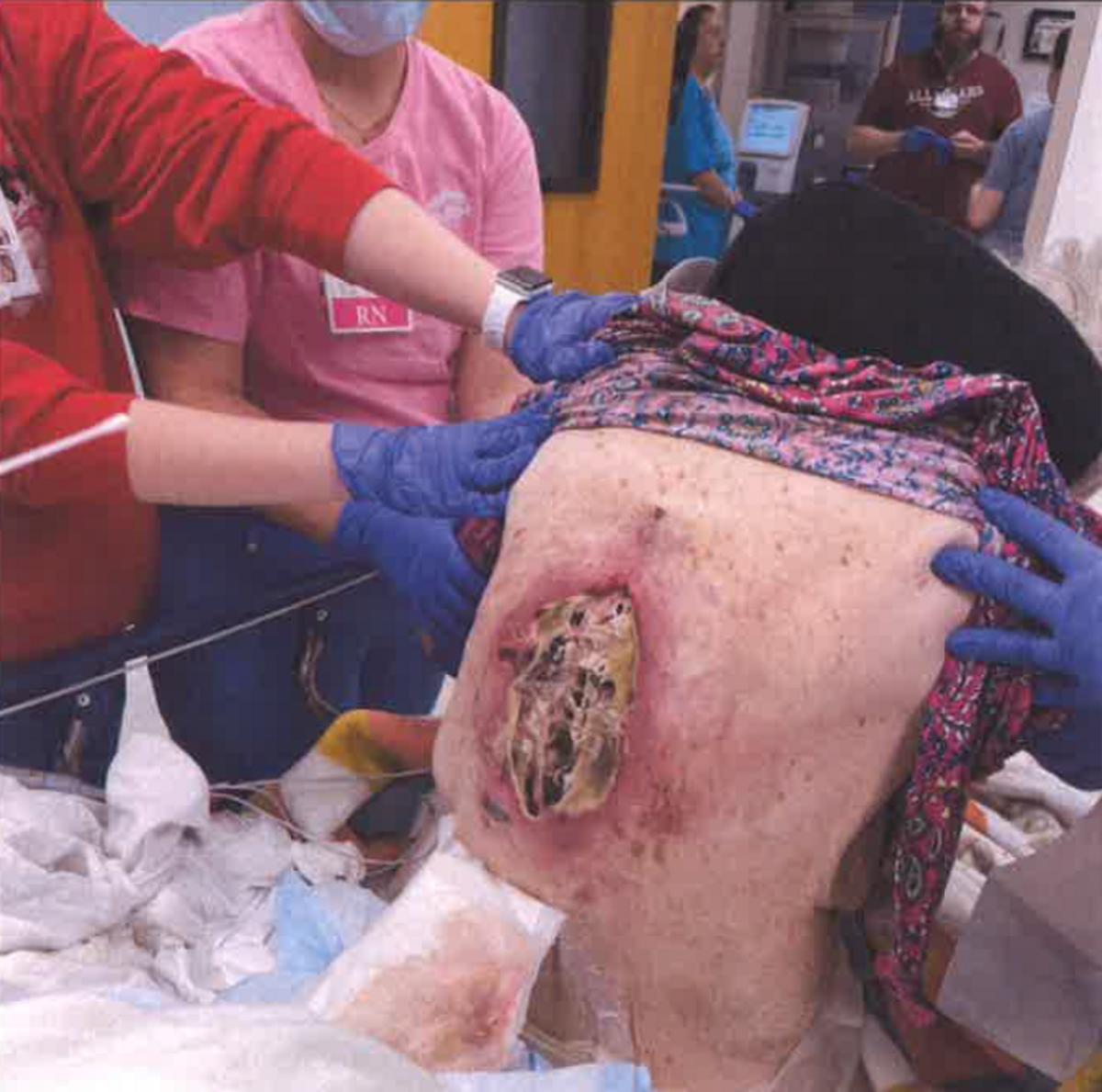
Instead, she died in hospice on Nov. 22, 2024, of acute kidney failure and sepsis, her body’s overwhelming response to infection. In her final days, she had a gaping hole in her back the size of a dinner plate.
What is Frankfort doing?
In Frankfort, Attorney General Russell Coleman oversees an Office of Medicaid Fraud and Abuse Control that is supposed to protect nursing home residents from abuse, neglect and exploitation. But Coleman’s spokespeople did not respond to questions about what the attorney general has done about nursing homes in recent years.
Although the Salyersville nursing home has taken steps to get back into compliance with quality of care standards, the state health cabinet’s Office of Inspector General is recommending to the federal government that it be designated a Special Focus Facility, said cabinet spokeswoman Elizabeth Fisher.
Special Focus Facility nursing homes have a pattern of serious, persistent problems. As a result, they face more frequent inspections and tougher penalties until they either improve and graduate from the program or lose their eligibility to collect Medicaid and Medicare payments, effectively closing their doors.
However, the Centers for Medicare and Medicaid Services only lets small states like Kentucky have one facility in the SFF program at a time, Fisher said.
For the past 17 months, that’s been Lyndon Crossing in Louisville. Three other Kentucky nursing homes are listed as SFF candidates alongside the one in Salyersville, making the competition tough for that single slot.
And a report issued last year from the Office of Inspector General for the U.S. Department of Health and Human Services concluded that the SFF program doesn’t do much good, anyway.
“Between 2013 and 2022, nearly two-thirds of the nursing homes that were in the SFF program improved enough to graduate but soon afterward showed the type of quality problems that put them in the SFF program in the first place,” the inspector general wrote.
The most recent Kentucky graduate from the SFF program, Madison Health And Rehabilitation Center in Richmond, was accused in a lawsuit this month by a former payroll and human resources worker of falsifying time cards to conceal a lack of nursing staff.
‘It looked so bad’
Because of the meager medical care the Salyersville nursing home provided, the skin on Reed’s back disintegrated into a gory, inflamed crater that oozed foul-smelling green liquid and revealed her vertebrae, according to the state’s inspection, her family’s suit and a photo her family included with its litigation.
A registered nurse at the nursing home told state inspectors that Reed’s pressure sore “was the worst wound she had ever seen, and stated, ‘It looked so bad,’” inspectors wrote in their report.
“That’s why the visual is so horrific,” said Laraclay Parker, one of the attorneys for Reed’s family.
“The wound is described as gangrenous and foul-smelling,” Parker said. “So, you know, we think about the pain, but there’s also the horror of being able to smell something like that coming out of your body and not being able to turn around and physically see it.”
The Herald-Leader’s phone calls to the nursing home’s administrator in Salyersville and its Louisville attorney, seeking comment for this story, were not returned.
In court filings, the nursing home denies any liability for injuries or deaths suffered under its roof.
In its response to the suit filed by Reed’s family, it steers blame back at the dead woman herself, saying “the claimed damages and injuries, if any, were the proximate result of Ruth Reed’s intentional and/or negligent acts or omissions and/or failure to follow medical advice.”
In a separate lawsuit, Parker’s firm also represents the previous administrator of the Salyersville nursing home, Joshua Calhoun, and its former longtime medical director, Dr. Charles Hardin.
The men sued the facility on May 19, alleging they were fired last year for protesting the scant funding and staffing provided to the nursing home by its owners and the decision to move admission screenings for new residents from the facility to the owners’ offices in New York.
Until that policy switch, the men allege, it was Hardin, a local doctor, who decided which residents the nursing home was capable of admitting and caring for.
However, the Centers for Medicare and Medicaid Services — which provides most of the revenue for nursing homes in the United States — pays more generously for “high-acuity” residents with complex and demanding medical needs, Parker said.
As a result, she said, the New York owners wanted to pack the Salyersville nursing home with high-acuity residents, regardless of whether they employed enough staff on site to care for them.
“The game in nursing home care is to try to admit the most complex patients you possibly can while keeping your staffing as low as possible, because that’s where the (profit) margins are,” Parker said. “But that is also a recipe for disaster, and it’s against the Medicare regulations.”
‘No excuse’ for pressure sores
Pressure sores result from a human body resting in one position for too long.
When people move around, tiny capillaries supply oxygenated blood to their skin and the subcutaneous tissue right below the skin, keeping it healthy.
But if they lie in bed all day without moving, capillaries along the rear of the body — the scalp, back, buttocks, heels — can be compressed by their weight, cutting off blood supply and leading to tissue death, or necrosis.
It doesn’t take long for necrosis to open a crater into the body, sometimes called a bedsore or pressure ulcer. Thin mattresses without much padding can make it worse. So can an old, frail body that also doesn’t have much padding. With skin breached, infections easily follow, particularly when people are left in their own feces and urine, as is too often the case in nursing homes.
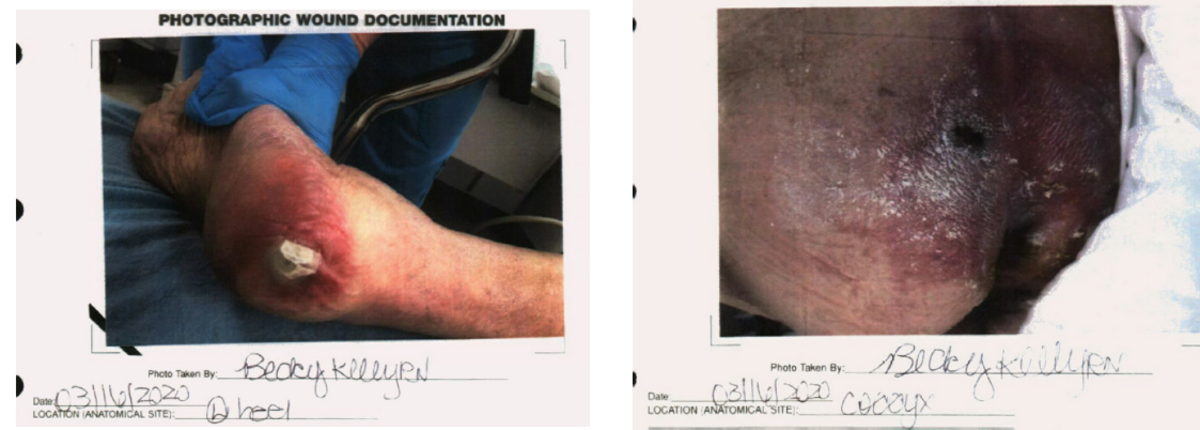
It’s long been understood that pressure sores reveal neglect in healthcare. They occur when patients aren’t repositioned in their beds or wheelchairs and their skin isn’t regularly checked for signs of wear.
“If he has a bedsore, it’s generally not the fault of the disease, but of the nursing,” Florence Nightingale, the founder of modern nursing, wrote in 1859.
When you see a nursing home with many pressure sores, you’ve likely identified a facility that doesn’t have enough attentive staff on duty, said Toby Edelman, a national expert on nursing home care quality and senior policy attorney with the nonprofit Center for Medicare Advocacy in Washington, D.C.
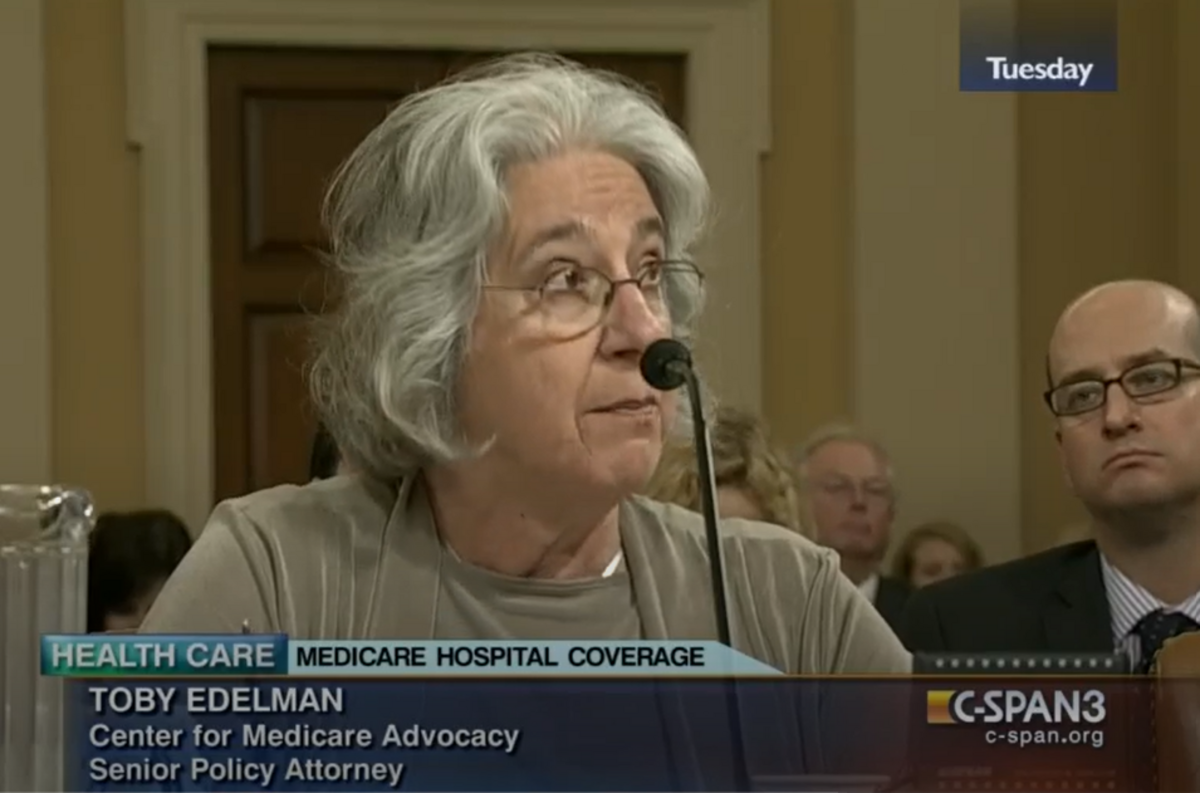
“Basically, they are completely avoidable with appropriate nursing care,” Edelman said.
“If you do what you’re supposed to — reposition them, monitor them, make sure people have enough food and fluid to maintain function — I mean, you don’t just develop these sores randomly,” she said. “With good care, they should be avoided. There’s just no excuse for it.”
‘That’s a death sentence’
A survey team from the state health cabinet’s Office of Inspector General toured Salyersville Nursing and Rehabilitation Center in May 2025. They hadn’t been there in more than four years, since April 2021, despite a federal rule requiring surprise annual inspections to make sure that nursing home residents are cared for.
The team found plenty of problems.
Possibly the most egregious was the death of Reed, who arrived on Oct. 4, 2024, with a surgical wound from a back operation.
Reed’s sutured incision — about 10 inches long — needed regular cleaning and monitoring. But a nurse told state inspectors that nobody removed Reed’s surgical bandage until 10 days after she arrived. By then, the incision had grown into a large hole leaking green pus, showing it was infected. The surrounding tissue turned necrotic.
The facility skipped weekly skin assessments that were required by Reed’s care plan, inspectors wrote. A nurse told inspectors that she signed the treatment record nine times, indicating that she had assessed Reed’s surgical incision. In fact, she only looked at the bandage to make sure it was still intact, inspectors wrote.
As the neglected wound grew more gruesome, it also became unbearably agonizing. Facility records indicate the nursing home did an inadequate job of monitoring and treating Reed’s pain, inspectors wrote.
On Nov. 3, 2024, saying she couldn’t “take the pain anymore,” Reed called 911 from her room at the nursing home and asked for an ambulance to take her to the hospital.
But the 911 dispatcher called the nursing home to inquire about the elderly resident before sending paramedics. A nurse assured the dispatcher that Reed was stable, without actually going down the hallway to check on her, inspectors wrote.
“That entire time, Ruth is knowing she reached out, knowing she wasn’t heard, knowing the pain is getting worse,” said Parker, the attorney for Reed’s family. “That’s a death sentence.”
Eleven hours later, inspectors wrote, that same nurse finally examined Reed’s badly infected wound and summoned the medical director, who did his own examination and ordered Reed sent to the hospital.
By then, even with a morphine drip, Reed suffered uncontrollable pain, inspectors wrote. The hospital transferred her to hospice care, where she died not long afterward as a result of her injuries.
“Obviously, she knew she was not gonna make it,” Parker said.
Other examples of neglect
The state survey team said it documented other examples of neglect during the May 2025 inspection and follow-up visits, including:
- A second resident, a man, was hospitalized on March 20, 2025, with pressure sores across his feet, buttocks and the base of his spine, as well as infection, kidney problems and pneumonia. As with Reed, inspectors said, the staff neglected to provide the man with proper medical care.
- A third resident was hospitalized May 18, 2025, and died of anemia, a blood condition. That resident, too, suffered from worsening pressure sores during their several months at the nursing home. The staff failed to provide proper skin care or nutrition, inspectors wrote. The facility’s wound care nurse was absent, on family medical leave, and no nurse was designated to replace her, they wrote.
- Physically dependent residents were left in soiled briefs for several hours despite asking to be changed. On May 11, 2025, when one resident in soiled briefs protested that nobody responded to her call button, a nurse told her — in remarks overheard by other staff — “If you don’t like the care here, your mom can take you to your f---ing house.”
Another resident was warned, “You’re pissing and s---ting too much.” Video footage on June 9, 2025, showed a nurse’s aide sleeping at the nurse’s station after a resident “absolutely flooded her bed with urine and needed to be changed,” but nobody responded to her call button for more than two hours, inspectors wrote.
- The nursing home failed to weigh residents as required by policy and address their weight changes, which put their health at risk, inspectors said. Fifty residents had significant weight loss and 29 had significant weight gain. For example, one resident lost 43% of their weight in one month, while another gained 84% in one month.
Among the other health risks involved, inspectors wrote, many medication dosages can depend on a person’s weight.
The staff falsified records to cover up their failure to provide care, they added.
“Staff documented weights that had been falsified (made up),” they wrote. “The fabricated and inaccurate weight records were used in clinical assessments related to residents’ nutritional status, monitoring of weight changes and care planning. These inaccurate records compromised the facility’s ability to appropriately monitor residents’ nutritional status and respond to weight changes.”
Who owns this place?
Salyersville Nursing and Rehabilitation Center is not owned by an identified corporate chain with a website and public list of top executives and board of directors.
“It’s a bunch of folks up in New York,” said Hannah Jamison, a Lexington lawyer who represents several of the families suing the nursing home. “But it’s intentionally set up to be difficult to figure out who is actually running the show.”
As defendants, the suits name a small group of nursing home investors who have operated for years around New York City, several of whom entered the Kentucky market in 2018 under the corporate name — at that time — of Sapphire Care Group of Brooklyn, New York.
Public records show they’ve recently been identified with at least 29 nursing homes across Kentucky, including the one in Salyersville.
The defendants include Benjamin Landa, Richard Platschek, Moshe Kelman and Hal Brecher, as well as Salyersville Health Operating Co., 571 Parkway Drive Realty and Topaz Financial Services. Members of the Platschek family are identified as holding a 40% ownership interest in the Salyersville nursing home on the Centers for Medicaid and Medicaid Services website.
Platschek and Kelman did not respond to requests for comment. In a brief interview, Landa said his only connection to the Salyersville nursing home was his stake in the company that owns its building, 571 Parkway Drive Realty, which he believed he sold about three years ago.

“This is the United States of America, anyone can sue anyone. Doesn’t mean I’m going to be found guilty of anything,” said Landa, who last October was nominated by President Donald Trump to be U.S. ambassador to Hungary, two months after he paid $5 million to MAGA Inc., a political action committee that backs Trump.
“Since when is the landlord responsible for the care in the facility? The landlord is not the operator,” Landa added. “If someone is a landlord — if I owned a building in Manhattan and (convicted financial con artist) Bernie Madoff was my tenant and Bernie Madoff did something bad, is the landlord responsible?”
In an essay on his personal Medium page, Landa describes himself as “an entrepreneur who built an empire of nursing homes.” He called himself a “healthcare investor” when he made his MAGA Inc. donation.
Corporate records at the Kentucky Secretary of State’s office show the several corporations being sued in Magoffin County share the same Brooklyn street address as Sapphire.
They also share money, according to other public records.
In 2024, Salyersville Nursing and Rehabilitation Center — run by Salyersville Health Operating Co. — reported $13.6 million in patient revenue to the Centers for Medicare and Medicaid Services, with $951,294 in net income.
At the same time, the nursing home disclosed paying more than $3.5 million from its revenue to “related parties,” or other businesses connected to it by common ownership. That includes rent to 571 Parkway Drive Realty and fees for administrative and general assistance to Topaz Financial Services.
In their lawsuit alleging wrongful termination, the nursing home’s former administrator and medical director said the New York owners insisted on only hiring from temporary staffing agencies they owned and operated.
“However, these mandated agencies could not meet the needs of the residents of Salyersville Health and, on many occasions, refused to come to Salyersville, Ky.,” they alleged. “This resulted in inadequate nurse staffing.”
This story was originally published June 8, 2026 at 5:00 AM.