Georgia Senate runoff sees strong, more diverse turnout. Here’s what it could mean
Georgians are voting in droves in the state’s pair of U.S. Senate runoffs, and data show the turnout is more diverse than it was in the Nov. 3 election — offering some insight into what the numbers could mean.
Both of Georgia’s races for U.S. Senate are headed to runoffs on Jan. 5 after none of the candidates received more than 50% of the vote in the Nov. 3 elections as required by state law.
First-term Republican Sen. David Perdue faces Democratic challenger Jon Ossoff for one seat, and first-term Republican Sen. Kelly Loeffler faces Democratic candidate Rev. Raphael Warnock for the other. If he wins, Warnock would be Georgia’s first Black U.S. senator.
The runoffs have put the Peach State in the national spotlight as the two races will determine whether Democrats or Republicans control the Senate in 2021.
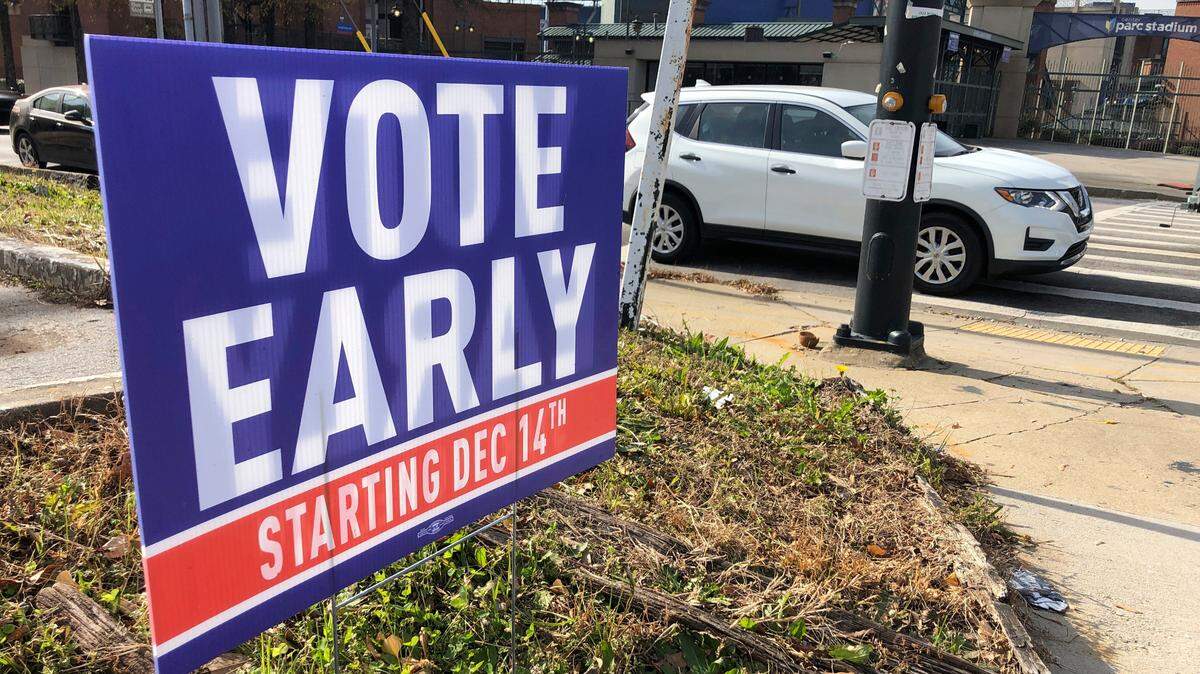
Early voting for the runoffs started Dec. 14, and turnout is proving strong.
Record-breaking turnout
More than 2.5 million Georgians have voted early as of Wednesday — surpassing turnout in any other runoff election held in Georgia, Politico reports.
The previous record was in the 2008 Senate runoff, when a total of about 2.1 million votes were cast, according to analysis site FiveThirtyEight.
So far, runoff turnout stands at roughly 33% of Georgia’s registered voters, according to the U.S. Elections Project, which tracks early voting data.
Another roughly 1.3 million, or 17.6% of registered voters, have requested an absentee ballot, the data show.
At this point in the 2020 general election, about 3.2 million people had voted early, meaning runoff turnout is about 21% lower, according to Georgia Votes. That’s to be expected, however, as runoffs typically see lower turnout than the initial election.
Who is voting?
So far, turnout in the runoffs is more diverse than it was overall in the Nov. 3 election.
While non-white voters made up 43.5% of votes cast for the general election in Georgia, they make up 44.6% of early ballots cast in the runoffs, U.S. Elections Project data show.
Black voters make up 31.3% of ballots cast in the runoffs compared to 27.7% in the general. Latino and Asian American voters make up slightly less of the runoff turnout so far than in the general. Native Americans so far make up the same percentage.
So far, voters ages 66 and up account for highest percentage of ballots cast, with 33.3%, Elections Project data show. Voters ages 18 to 24 account for the lowest, with 6.7%.
More than 91,000 people who didn’t vote in the general election have cast ballots for the runoffs, data show. That’s a turnout rate of about 3.3% among those voters.
What can the numbers tell us?
Georgia doesn’t register voters by party, so it’s difficult to tell whether the high turnout is benefiting Democrats or Republicans. But the data can offer some insights.
Early voting numbers have been a good sign for Democrats given the strong turnout among Black voters and that early turnout is higher in Democratic congressional districts than in Republican districts, Politico reports.
Black voters were a “driving national force” in President-elect Joe Biden’s victory and played a large role in making Georgia, historically a Republican stronghold, a battleground state, the Associated Press reports. Black women, who played a large role in turning Georgia blue in the presidential race, are “critical to Democrats’ chances” of winning the runoffs, CNN reports.
Republicans have historically favored voting in-person on election day, which could change the makeup of the turnout once all the votes are in.
For example, 60% of the 975,000 Georgians who voted on the Nov. 3 Election Day went for President Donald Trump, according to FiveThirtyEight. Biden still carried the state with 49.5% of the vote — the first time a Democrat has won Georgia since former President Bill Clinton in 1992.
Additionally, runoff elections have historically favored Republican candidates as the population that typically votes in them leans right — one of the main criticisms of Georgia’s requirement that a candidate win a majority of the vote, FiveThirtyEight reports.
“Take Black voter turnout, which leans heavily Democratic,” FiveThirtyEight says. “It has been disproportionately lower in runoffs, and is actually one reason why Georgia’s majority requirement is controversial: Opponents of the provision argue that the system makes it harder for nonwhite candidates to win.”
Polls have shown the candidates in tight races as Jan. 5 nears.
Importance of the runoffs
Democrats will have 48 seats and Republicans will have 50 seats in the Senate next year with the two Georgia seats yet to be decided.
Democrats have to win both seats to gain control of the chamber — as Vice President-elect Kamala Harris will serve as a tie breaker — and Republicans have to win one to keep control.
A Democratic-controlled Senate would give Biden a clearer path toward implementing his agenda, while a Republican-controlled Senate would likely create roadblocks for his policies, Cabinet selections and other things.
Trump and Biden are both scheduled to visit Georgia ahead of the election to campaign for their respective parties.
Democrats have not won one of the state’s U.S. Senate seats in 20 years but Georgia “may be undergoing a transformation,” FiveThirtyEight says, given it turned blue in the presidential election.
This story was originally published December 30, 2020 at 2:14 PM with the headline "Georgia Senate runoff sees strong, more diverse turnout. Here’s what it could mean."