
Writer Crystal Wilkinson follows ‘Birds of Oppulence’ with poetic memoir, ‘Perfect Black’
When Kentucky Poet Laureate Crystal Wilkinson started looking through her poems a few years ago, she discovered she had been writing a memoir.
Wilkinson’s fellow Kentucky writer Rebecca Gayle Howell asked Wilkinson for some poems for a project she was working on, and unsure what would work best, Wilkinson sent Howell a bunch of her poems. Howell told Wilkinson, “I think there’s a collection here.”
No, thought Wilkinson who, despite a long career as a published poet, had never published a book of her poems.
That’s in part because she had never thought of her poems as a collection. Wilkinson is known for her novels, including 2018’s acclaimed “The Birds of Opulence,” as well as for being one of the founding members of the Affrilachian Poets, a collective of Black writers from Appalachia.
“What I realized when I started pulling them out and sort of looking at them, and sometimes putting them in chronological order, or sometimes not, sometimes looking at them thematically, was that in ways that I hadn’t seen before there was a memoir, there was a narrative arc here that spanned one part of my life across to how my life is currently,” says Wilkinson, Associate Professor of English in the MFA in Creative Writing Program at the University of Kentucky.
Those poems are now collected in the new volume “Perfect Black” (University Press of Kentucky, 112 pp.) which somewhat coincidentally arrives the same year as another milestone event in Wilkinson’s career: being named Poet Laureate of Kentucky.
First Black female Kentucky poet laureate
It was a surprise to Wilkinson, earlier this year, when she was asked to join a Kentucky Arts Council Zoom call to discuss a potential project. She got on the call and they told her she had been nominated as Kentucky’s Poet Laureate and asked if she’d accept the role.
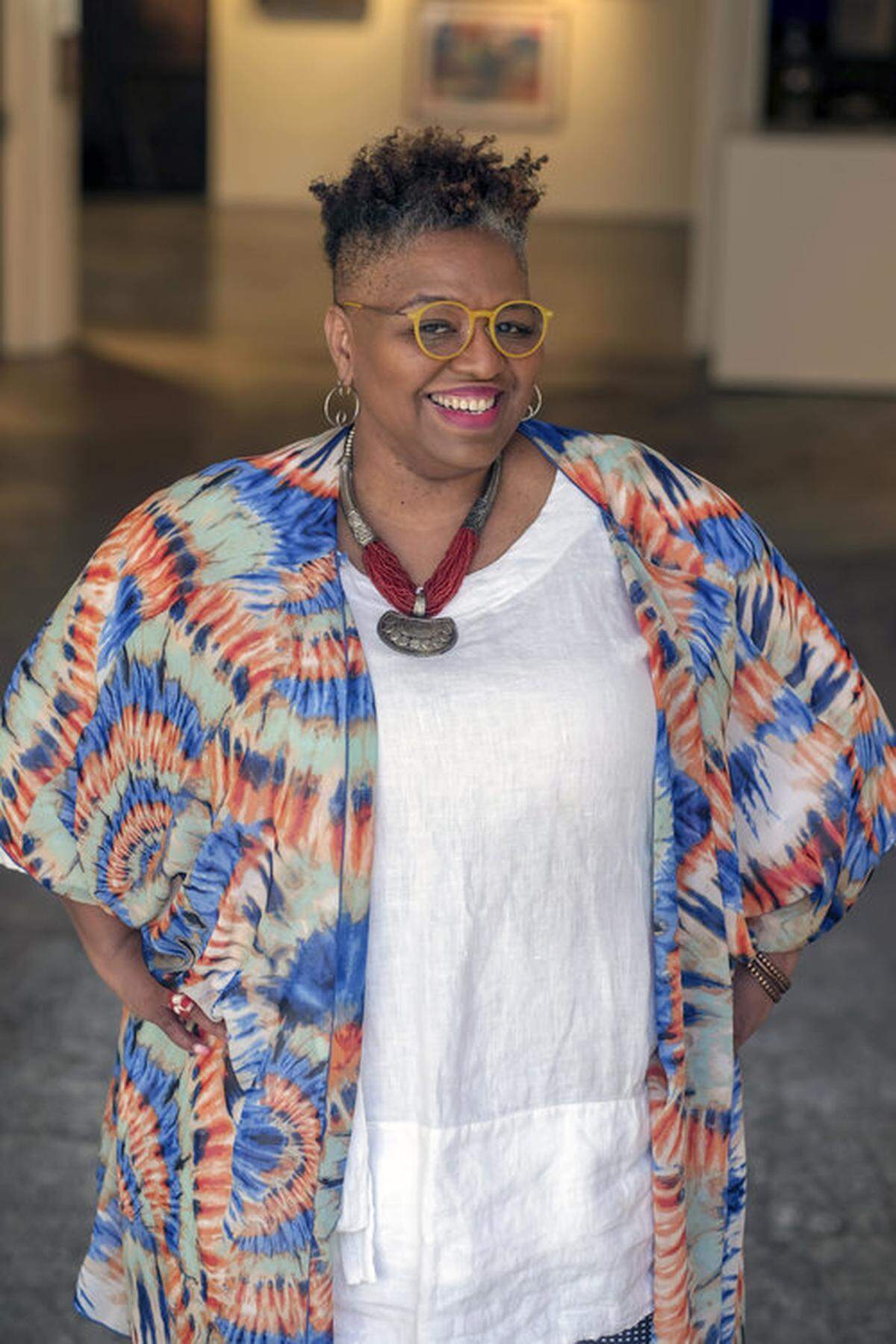
“I just burst into tears, for a lot of reasons,” Wilkinson says. “One, that’s my personality. That’s the kind of person I am. And two, all these years of being a writer I have seen or at least spoken to every Poet Laureate, since James Still.
“So it means so much to sort of officially join this legion of Kentucky writers. It means a lot to me, and feels right in this moment, and feels like a particular coming of age as a writer.”
Wilkinson takes a distinct place on the list of Kentucky Poets Laureate, a position established in 1926, as the first Black woman named to the post and only the second black writer after fellow Affrilachian Poet Frank X Walker.
“I do hope that I can model some behaviors for young women, young Black women, young girls, young Black girls, brown Girls, and girls of color can see the possibilities, that they can see that this is possible to be a writer from Kentucky and that’s a possibility for them,” Wilkinson said. “Because when I was a girl, I didn’t see any reflection of myself in literature or in a sort of community of writers.
“I grew up in Casey County thinking that all writers lived in New York.”
New book ‘Perfect Black’
Wilkinson’s roots run deep in “Perfect Black,” a memoir that traces her matriarchal lineage, particularly through food, to her young adulthood where a certain musician showed her an artist needs a wild side, to motherhood and decades-old fears for her children many are just learning about, to her life now with longtime-partner Ronald Davis, an artist whose illustrations compliment many of the poems in “Perfect Black.”
.JPG "150901WildFig-TE020 (1).JPG")
“There’s something about the way we live in the house as artists, that I knew that he would come up with an image that just immediately was like, ‘OK. That’s it. I got it,’” Wilkinson says. She says instead of being traditional illustrations, the art in the book is “in conversation” with the poetry.
In Wilkinson’s poetry, we meet a girl who is “not yet trouble,” dealing with the seeming incongruity of being part of a Black farming family in a community where there are few Black farmers. Two pieces, “A Meditation on Grief: Things We Carry, Things We Remember” and “The Creek,” explore the same subject, Wilkinson’s near drowning as a child.
Wilkinson said that was intentional as a way of exploring writing forms and, “it also speaks to the way that we tell a story. Depending on where you’re standing, and when you retell a story, there’s going to be some movement, right? You’re going to tell it a little bit differently, you’re going to move some of it around. If somebody else tells the story, they won’t tell it the same way you do. So I think sort of the aspect of storytelling and oral tradition is in there as well.”
Other traumas are revisited, including sexual assault and overt racism. One poem, “Dear Johnny P,” recounts meeting a man by whom she had suffered racial and sexual abuse when they were in school together. She says she saw a half-hearted apology in his eyes, “but I wanted to hear it/from your white mouth/to my black ears.”
The very next poem, “Mother’s Day,” recounts the 1994 shooting of Antonio Sullivan, an unarmed Black 18-year-old by Lexington police, and how it stoked Wilkinson’s fears as the mother of a Black teenager. Reading in 2021, the poem finds striking echoes in more recent extrajudicial killings from Michael Brown to Breonna Taylor and George Floyd.
“It just makes you wonder about what progress is and what it means and what we can strive for, and how do we get through any of this,” Wilkinson says. “If I’m writing a poem in 2021, and I can look at my own poem that I wrote in the ‘90s, or the ‘80s. And then I can look at a poem written by Alice Walker or someone else, Lucille Clifton, or whoever in the ’60s … there’s those same markers of time and strife, and it makes me wonder what we’re doing wrong, and will we ever get it right?”
There is plenty of joy and affirmation in “Perfect Black” as well, including plenty of passages on food, from Wilkinson’s raisin’ on Black, rural cooking, to allusions to her flirtations with vegetarianism, and her next work of fiction has a trailer of sorts near the end of the book in “Praise Song for the Kitchen Ghosts,” a warm look at seeing family in the dishes she and others continue to cook.
Influence of Prince
And then there is Prince, whose songs she says “are this Black woman’s anthem,” in a piece called “Dig If You Will the Picture,” the opening lyric of the Purple One’s hit “When Doves Cry.”
“I have a great appreciation for craft and the craft aspect of of writing and creating art,” Wilkinson says. “You have to have some wildness, and no one else, I think, in our contemporary history, had that great combination of craft -- I mean he could play you know, classical music if he wanted to -- who could play all of these different instruments, who could sing, who could also wear clothes with his behind out and all of these wild, wild things with art and sort of combine that with craft. So, I think I learned to embrace wildness from him.”
Wilkinson acknowledges some amusement being a poet laureate just now publishing a book of poetry. She says that after being named to the role, she talked with mentors, friends, and former poets laureate about how to approach it. One piece of advice she received was not to let anyone push her into putting out a poetry book just because of the title, not knowing she had one in the works.
But Wilkinson is also glad she waited until this time to publish a true retrospective of her poetry and therein, her life.
She says she never thought of her poems as “being that autobiographical, as being that close to the bone, even though, I still write about some of the same things that I write about in fiction. But what fiction does is allows you to drop a little bit of yourself in a much more sparse way. You have a little thread of truth that you might drop into a novel, or you might drop into a short story, and then you layer imagination on top of that, and you sort of build a story.
“For me, with these particular poems, they felt much more intimate. I felt vulnerable. When I looked at them, it felt like a tree in winter, with no leaves to cover, like it was just sort of all there.
“I don’t think that I was ready for this book before.”
Rich Copley is also a Prince fan, and a former arts writer and editor for the Herald-Leader who continues to enjoy Lexington’s arts and culture.