‘We’re still there.’ A year after tornadoes, still-grieving town of Bremen bounces back
READ MORE
One year after deadly Western Kentucky tornadoes
This is how communities in Western Kentucky have rebuilt following last year’s tornadoes.
Expand All
The hundreds of gnarled, twisted tree limbs were harder to see in summer’s greenery. But the leafless, winter woods have made these jagged reminders of last December’s deadly disaster in Western Kentucky more obvious.
On a recent afternoon in Bremen — a small town of less than 400 where 11 people died during last year’s December tornado outbreak — signs of resilience flanked those knotty memories. The cars of residents and construction crews rumbled over roads of fresh asphalt and power tools roared outside of collections of brand-new houses and barns.
“For those of us that have always lived here, it’s never going to be the same,” said Allen Miller, the mayor of Bremen. “…I’m 55 years old, I was born and raised here. There’s buildings that, to me, was part of the landscape. They’ve always been there, now they’re not.”
A year on from disaster, Bremen is still grieving but bouncing back, multiple residents told the Herald-Leader. Some will get to spend Christmas in brand-new homes while others say the rebuilding process has left them with near insurmountable financial setbacks. All said that this Saturday — when the community organized a gathering to memorialize those who died — will be a very hard day.
For much of his life, most people he met had never heard of Bremen, Miller said. Now when he tells them where he’s from, they remind him of the obvious: “You’re the ones who got wiped out by a tornado.”
“That’s us,” the mayor said. “But you need to come and see us because we’ve hung together. We’ve rebuilt, we’re still there.”
‘In debt for a while’
On the night of the storm, the EF-4 tornado which devastated Bremen touched down in northwestern Tennessee and moved northeast into Kentucky, devastating larger cities like Mayfield and Dawson Springs before racing through the outer farmland west of Bremen and then damaging a portion of the town itself.
Tornadoes touched down in four states and an estimate after the storm put the potential cost of the damage nationally at over $18 billion. In Kentucky, the death toll reached 80 people, making it the deadliest tornado in state history.
Danny Miller, a farmer who lives west of Bremen, said the tornado killed over 30 of his cows, toppled several of his outbuildings, including barns and storage bins. His brother Bill and sister-in-law Judy — who both lived not far from Danny — died in the storm.
“It was awful, I ain’t kidding you,” Danny said. “The next day, I didn’t know what to do.”
Over the past year, with the help of his grandson, farming has been “real, real good,” Danny said. New buildings are popping up as well as fencing. Contractors are working on his land to clear piles of tornado-blown debris that have been clogging creeks and flooding fields. The biggest obstacle remaining, he said, is insurance.
The buildings that were destroyed in the storm were built 25 to 30 years ago, Danny said, and they were under-insured. The insurance that he kept on those buildings were relative to the cost he paid to build them the first time.
“Now it’s three, four times that much,” he said.
Having to pay for the much higher insurance costs on top of the new buildings has put him in debt he didn’t anticipate a year ago.
“We’re gonna be in debt for a while,” Danny said. “It ain’t going to be me because I won’t be around much longer. I’m 75 now. I’ve never seen anything this bad before.”
Curtis McGehee, the judge-executive of Muhlenberg County, said that multiple residents are facing debt after the storm. Many of the homes in the county were built between the 1960s through the 1980s when local coal mines were booming and there were plenty of well-paying local jobs. Having to rebuild entire homes and replace multiple vehicles in the wake of the COVID-19 pandemic and rising inflation is a tall task, he said.
“Those houses built in the 60s and 70s, you know, people build a pretty nice home for $30,000 or $40,000,” McGehee said. “And now to replace that home, you’re looking at probably $200,000 or more.”
Younger families, he said, could in the long-term pay off their new homes. Older folks though, many who might’ve lived on their land for decades, likely may not.
“They were set for life, had a comfortable front porch they sat on every afternoon and now all that’s gone,” McGehee said. “And they’re trying to find their way back to a sense of normalcy, and that’s going to be very difficult, short and long term.”
Moving in again
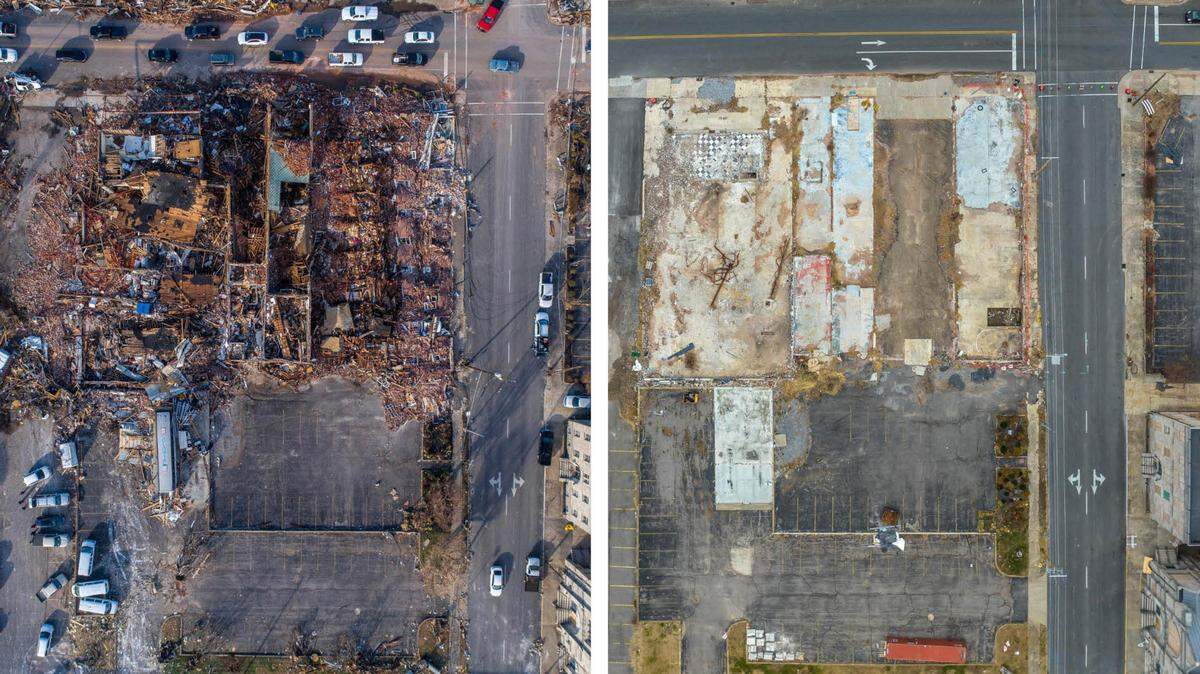
Nearly 120 structures in and around Bremen were destroyed by the storm, about 98 of which were homes, Mayor Miller said. Close to half of those homes have been reconstructed and in recent weeks, some families have started to move back into their permanent residences.
Still, between 10 to 15% of residents are yet to start the arduous rebuilding process, Miller said. A few residents have left Bremen entirely, but relocated to other towns within about a 20-mile radius, he said.
John Davis is the director of operations for Horner Services, a contracting group that responds to natural disasters across the country. When asked how bad the damage in Bremen was compared to other places he’d been, he said, “On a scale of 1-10, it’s a 12.”
“There’s nothing on God’s green earth as bad as a F-4,F-5 tornado,” Davis said. “It might not impact a large area like a hurricane but what area it impacts is usually wiped clean.”
Bremen’s Main Street is much like many other communities its size. In less than a half-mile stretch, one could find the post office, the convenience store, the community center, the only restaurant and Bremen Elementary School.
Since the tornado, the congregation of Bethlehem Missionary Baptist Church has been meeting inside the elementary school’s gym. The original church building, previously the oldest in town, was still standing after the tornado but was damaged well beyond repair.
T.J. Milam, the church’s pastor, rode out the storm from within the church. After the tornado, he said an engineer told him that the building was just a few seconds away from collapse had it stayed in the cyclone any longer. His family was sheltering in the basement of the nearby church parsonage — the house where the pastor lives — and emerged from the basement to find the house on its side.
The church, Milam said, missed one service — the Sunday directly after the tornado — and has found ways to meet since as their fellowship hall gets rebuilt. They’re hoping to be able to hold church there in January.
“It’s almost made us discover, again, what true church family is,” Milam said. “And that’s really hard for some. It’s tough on people because there’s others in the church that were three, four generations in it and they remembered mom and dad playing the organ and they had all those memories.”
The parsonage is essentially complete and during the late November conversation, Milam said he and his family had just moved back in about a week prior. Many people have asked him if he’s been excited to get a new house and all-new belongings and he’s told them no, because “we didn’t want to lose the stuff we had.”
“There’s a part of it that you’re just reminded constantly: All of this can go in 10 seconds,” Milam said. “That’s how long it took. And so you use it, but you don’t grow attachment.”
The rebuilding process has been slow and strange, he said. There’s only so many building inspectors and you can’t move forward without getting one, and the same goes for any specialized labor like plumbers and electricians.
Meanwhile, supply issues made the arrival of materials likely more expensive and somewhat unreliable. Milam said they had to order shower doors three times because they’d either come broken or in different colors. The garage behind the house is perpetually open because there just aren’t garage doors available.
Building back different
As people rebuild their homes, many are choosing to include storm shelters if they didn’t have them already, said Andrew Bullock, a lifelong Bremen resident and the magistrate for the area.
“It seems like as time has changed, we fit more of that tornado alley now,” Bullock said. “It’s moved more into our area. So we just have to brace ourselves moving forward the best way we can.”
That preparation is occurring at the community level as well. Bullock said the ball was rolling on a plan to replace the town community center with a 500-person storm shelter. Miller, the mayor, confirmed those plans and said they’d been approved for a grant but were working through the paperwork.
The reinforced, above-ground shelter would be windowless, have a full kitchen, bathrooms with showers plus an office that could be used by county dispatchers, Miller said. Like their normal community center, it’ll be available to rent for birthdays and family gatherings. Miller said he hopes those will be the only events to take place there.
Muhlenberg County is working to have needed supplies ready for the next potential disaster. After the tornado, the county made donated supplies available to tornado victims at various resource centers in and near Bremen.
Now, all of those supplies are consolidated into a single disaster warehouse that the county is renting and will eventually own, said Leah Pierce, the warehouse’s manager. The spacious warehouse, a former autobody shop, has stacks of non-perishable food, cleaning supplies, clothes, furniture, toys and much, much more. Those affected by the tornadoes still come by now to get supplies, she said.
“This building will become the permanent disaster warehouse,” Pierce said. “And that will cover anything from floods, fires, tornadoes, anything that you consider a disaster.”
Plus, other nearby counties are interested in storing their donated goods there to make it a regional warehouse open to much of Western Kentucky. Locally, the victims of some recent house fires were able to quickly access supplies. Miller said supplies from the warehouse were sent to Eastern Kentucky after the deadly summer flooding there, as well as to hurricane victims in Florida.
If anyone were to donate to the warehouse now, Pierce requested that it either be laundry supplies — “That’s the one thing we can’t keep enough of” — or simply a monetary donation.
‘We’ve come a long way’
Along with the twisted trees around the community — Miller said they’re hoping to get many of those cleaned up by next summer — the winter and holiday seasons simply conjure up bad memories from a year ago.
“Christmas time and things coming up,” Miller said, “it was a bad time of year for it to happen and we’ll get through it.”
Ahead of the community gathering on Saturday evening in the elementary school’s gym to honor those who died, Miller said he’s hoping the community can also reflect on how far they’ve come in a year.
“For me sitting here looking at it, I think we’ve come a long way in one year,” Miller said.
This story was originally published December 8, 2022 at 10:00 AM.
.png)
.jpg)