Appreciating grocery store workers on front lines of COVID-19 fight. Starting with Gail.
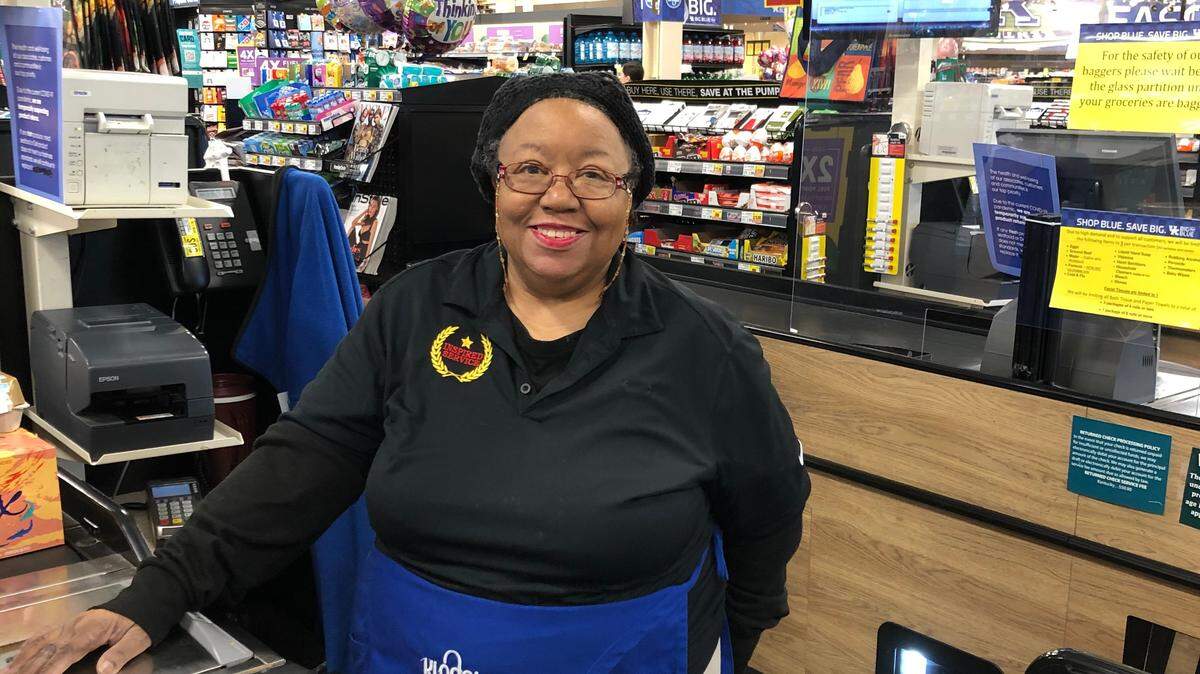
Long, long ago, in early March and the days before, I had a routine. Early every Friday morning, I would head to the Kroger on Euclid, (sometimes known as Disco Kroger), for my weekly groceries and every Friday morning, I’d make a point of getting in Gail Taylor’s checkout line.
She was always there, always smiling, cracking a joke, making sure I’d gotten out all my coupons. A reassuring part of a reassuring routine that starts with milk and dog food and moves on to cereal, spaghetti and a last stop in the beautiful produce department stacked with deep green kale and shiny red apples.
Things are a little different now. You get to the grocery when you can, with your face hidden under a mask, glad to be getting groceries for the ravening hordes at home but also nervous: Will they have toilet paper or flour or is this the day I finally pick up the virus on that box of pasta?
But on Thursday, I got to see Gail, looking exactly the same behind the plexiglass that Kroger stores have put up at checkout lines. On the whole, she said, people have been nicer these days. “They’re definitely more patient,” she said nodding at the line of people stacked every six feet behind us. “I tell them, I appreciate you as a customer because without you, I wouldn’t be here.”
I’ve been thinking about Gail lately, and Flo, who always asks if you need help finding things, and Amanda and Tanner and Nick and Laura, and all the people who work in all the grocery stores around town, how cheerful and helpful they still are even though their jobs got a lot more dangerous overnight. They are front-line workers now. They’re not intubating COVID-19 patients, but their work puts them at risk, every time they take one of our grubby credit cards or bag up another round of potato chips or sanitize another cart.
Their work is crucial because one of the main things that’s keeping people calm these days is the knowledge, borne out for the past month, that our groceries are still going to be there with almost everything we need. The first week, well, we weren’t so sure, what with the fear and hoarding, but now most stores seem to have flour and meat and milk, and if you get there early enough, toilet paper, too.
We still live in a land of plenty, whether it’s at Good Foods or Trader Joe’s or Whole Foods or Fresh Market. The hourly workers at those stores toil at night to stock shelves and accommodate our weird obsessions with rice and beans that I bet most of us will never eat. More of us are in the grocery store and for those of us lucky enough to have kept our jobs, we’re buying a lot more. Kroger announced last week that sales increased 30 percent in March.
As writer Nathanael Johnson noted on Grist.org, we’re buying lots more groceries because we’re home all the time, and despite the best efforts of restaurants to switch models from dine-in to take out, we’re not eating as much from them or from school lunches and company cafeterias. Johnson also reported that “paper giant Georgia Pacific estimated that people staying at home full time would need to buy 40 percent more TP.”
Are big groceries like Kroger, which dominates the grocery scene in Lexington, doing enough to protect and celebrate all the people who are meeting all our new needs? I’m generally a fan of Kroger, such as their willingness to hire people with disabilities, but numerous calls to their corporate office just went into the ether. Most workers there are still not wearing masks and gloves.
Still, there are some positive signs. With the help of the United Food and Commercial Workers International Union, Kroger last week announced “hero bonuses,” for hourly workers.
The raise was $2 an hour to each employee’s current rate of pay for hours worked March 29 through April 18, according to a news release. The extra pay was in addition to the appreciation bonus that Kroger had previously announced for its employees. Full-time employees get $300 and part-time employees get $150 on April 3. That included additional emergency paid leave for employees who have to self-isolate or quarantine, access to mental health services and a $5 million fund for employees in need of help, including those who can’t find childcare and those who are at higher risk for coronavirus.
Kroger called the temporary raise a “hero bonus.” (Last year, Kroger CEO Rodney McMullen received a 19 percent raise to $11.7 million, including a $2.7 million bonus.)
The thing about heroes is that no one plans on being one. You just rise to the occasion. Gail and her co-workers didn’t expect to be on the front line of the most serious threat most of us have ever faced. But there they are every day, as anxious as anyone else, yet being patient, kind and helpful. Making sure we’re nourished and smiling as they do it.
This story was originally published April 10, 2020 at 10:40 AM.