‘We must come to the light.’ Refugee from African civil war works to keep peace in protests
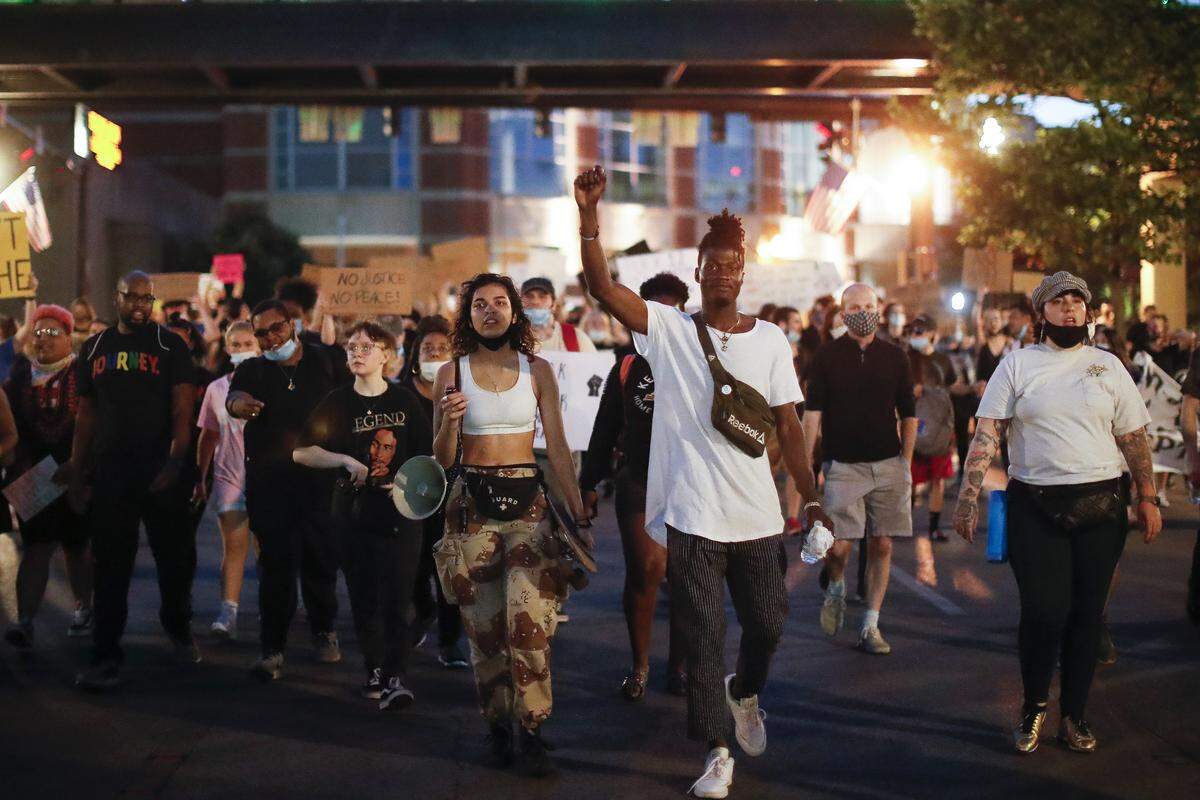
On Tuesday night, another large demonstration blanketed downtown Lexington, hundreds of protesters of every age and color who walked, stopped, spoke and prayed, walked again. The only tension was in the passes in front and behind police headquarters, where a wall of police in riot gear stood guard. Then the tension would rise, and the voices got louder and it was easy to wonder if one side or the other would provoke the kind of violence seen in so many other cities over police killings of George Floyd and Breonna Taylor.
At one point, though, when the crowd had halted again in front of police, a tall young man inserted himself between the two groups, smiling and talking, and almost imperceptibly moving the crowd forward again.
“We do not want to give anyone the chance to start another narrative,” he said that night. “We are all here for the same cause: To fight for human rights.”
Philip Manga, 27, is one of many who have met up night after night and worked to keep Lexington’s marches peaceful, people like Sarah Williams, Alivia Keseday, April Taylor, Branden Barber, and a host of others. But Manga’s own life experiences of violence and trauma give him a special perspective on this moment — one of a nine-year-old boy in the Democratic Republic of Congo who fled with his two brothers into the jungle to escape militias in a country riven by civil war.
The brothers traveled on foot for more than 100 miles, sometimes without food or water. They made it to an orphanage in Beni, in eastern Congo, and two years later were reunited with their missionary father. The four of them came to Lexington in 2005, but the boys didn’t see their mother for another eight years when she joined them as refugees in Lexington. Manga became a soccer star at Henry Clay High School, then went on to play at the University of Kentucky, where he graduated with a sociology degree.
That degree, his fluency in English, French and three African languages, his encyclopedic knowledge of the Bible and engaging manners could not keep him from experiencing American-style racism, whether in school or in stores. He remembers his first encounter with police on a night when he and several other African soccer players from Henry Clay were driving from Lakeshore Drive, where they lived, to an indoor soccer game. A police officer pulled them over, and when they asked why, she said there was a call in the neighborhood of some boys causing trouble, and they fit the description. She let them go.
Just last year, he was parking his mother’s car with a canceled license plate. An officer pulled him over, and cuffed him because, the officer explained to onlookers in the body camera footage, he saw Manga open the console and thought he might have a gun. That was also why the officer called four other officers for backup, he said. Officers took off the cuffs after about 15 minutes.
“It didn’t make me angry because I understand the problem is deeper than what I was doing,” Manga said, even though he believes he was racially profiled. “The problem has to start at the roots. I come from a society where we have a restorative process to try to understand one another, and that’s what I am trying to do.”
Today, Manga works as the youth program director at Common Good, a faith-based nonprofit that works on children’s programming in under-served North Lexington neighborhoods, and as an assistant soccer coach at Bryan Station High School. He knows many of the protesters; they are his friends and students, he loves their passion and understands their collective trauma, which in some ways, mirrors his own. So if he can be even the slightest buffer, he will.
It’s like the Book of James, he says. “Understand this, my dear brothers and sisters: You must all be quick to listen, slow to speak, and slow to get angry.”
“I understand their frustration and anger, I want them to be as loud as they can, but let’s stick to the same message,” he said of the protesters. “Human rights is the most important thing.”
As an outsider, he sees quite clearly that racism has reached this point because white America has refused to learn or recognize true American history of oppression and trauma. “I have to think about the color of my skin everywhere I go,” he said. “Why do I feel like that? But it’s all part of an education problem, and many of us are not interested in understanding.”
For example, he asked, do white people truly understand their history, a history that didn’t stop with the end of slavery, but continued on in Jim Crow laws, redlining and mass incarceration? When they lay the blame on single parent households in the black community, do they think about men who were serve their time, but can’t return to a regular life of employment? Do they ponder an educational and economic system that disproportionately favors white people? Could they try and understand what it means to be scared of police, the people who are supposed to protect us?
If more white people could try to reach that level of understanding, the country can heal, he said. Manga has seen first-hand what the worst of tribalism can do, and believes it’s possible for the United States to move forward.
“People are afraid of the light because they’re afraid their evil deeds will be brought to the light,” he said. “But it can free us, we must come to the light and have these conversations.”
Editor’s note: This column was updated on June 11 to add more description about Philip Manga being pulled over by police last year, based on video footage from the officer’s body-worn camera. The video shows that the officer pulled him over and placed handcuffs on him, but does not show him pulling Manga out of the vehicle.
This story was originally published June 5, 2020 at 10:29 AM.