The writer, the series, the chess and the Kentucky stories behind ‘The Queen’s Gambit’
In 1983, author Walter Tevis did a book tour for his new novel, “The Queen’s Gambit,” which included an interview with his home town newspaper, the Lexington Herald-Leader. He told reporter David Crumm that unlike his first two books which were made into movies — “The Hustler,” starring Paul Newman, and “The Man Who Fell to Earth,” starring David Bowie — the new book about chess wouldn’t work on film.
“I really don’ t think about movies when I write,” he said. “I was certainly aware I would have difficulties selling this to the movies, but that didn’t deter me. I think it’ s artistic death to write that way.”
Little could Tevis, who died just a year later of lung cancer, have predicted Netflix and its dazzling and faithful production of “The Queen’s Gambit” series with Anya Taylor-Joy as Beth Harmon, who learns chess from the janitor in a Mt. Sterling orphanage before becoming a chess champion first in Lexington and then on the world stage. (*Warning: Some spoiler alerts ahead.)
The book and movie are peppered with Lexington references, from New Circle Road and the Herald-Leader to the original Morris Bookstore and Ben Snyder’s Department Store to Henry Clay High School, which Tevis attended before a stint in the Navy and an English degree from the University of Kentucky.
But as much as Queen’s Gambit is infused with Lexington, it is a deep reading of Walter Tevis himself, who can be found in Beth and Fast Eddie Felson and an alien who pops up in the desert. An orphan of sorts himself, an underdog, a man obsessed with chess and pool and addiction and alienation.
“There’s a lot of my dad in all those books,” said William Tevis, his son who lives outside Athens, Ohio, where Tevis moved his family when he started teaching at Ohio University. “He was the smartest man I ever knew.”
***
“Finally she was asked how she felt about the idea that chess was a waste of time, and she looked at the woman in the other chair and said, ‘No more than basketball.’” “The Queen’s Gambit,” published 1983.
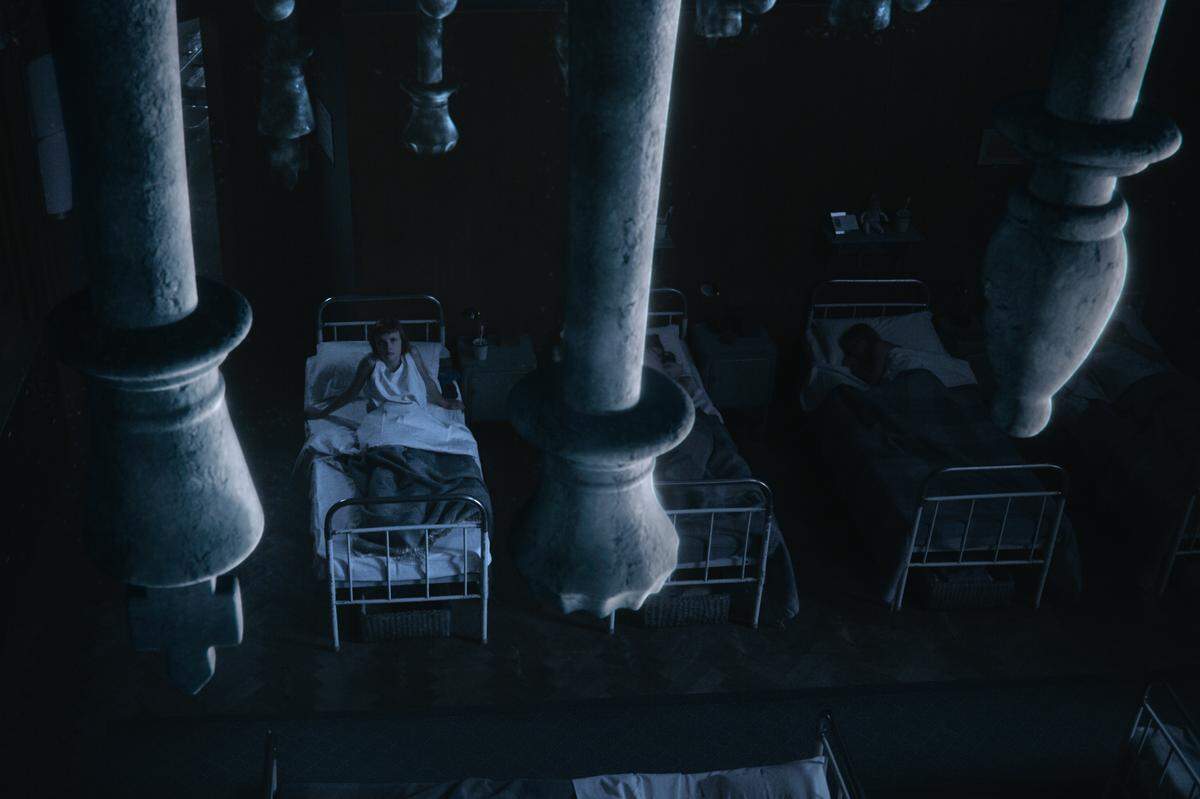
If any of us have the capacity to be shocked any more by something we see on a screen, then it’s shocking to see in the first episode of Queen’s Gambit a string of little girls lining up to be given barbiturate so they will stay calm. But that’s a scene straight out of Tevis’ early life in San Francisco, where he was born in 1928
“That was specifically from my childhood,” Tevis said in the 1983 interview. “I had a rheumatic heart condition and was put in a convalescent home in California on the campus of Stanford University, and they fed us phenobarbitol.”
After he was committed there, his parents, originally from Madison County, decided to move back to Kentucky, and left the 8-year-old Tevis alone in the hospital as he recovered for about a year. A relative finally put up the money to bring him to Lexington where the Tevises were living. He went to Ashland Elementary, a smart, lonely, sickly boy who said he felt like a Martian dumped down in Lexington’s suburban streets.
“One day after school, some of the kids took him and tied him to a telephone pole and took his pants off and left him there,” said William Tevis. “He never got over it, and it’s part of him being the underdog.”
Walter Tevis went on to Morton Middle School and Henry Clay High School, but always felt solitary and out of place. Like Beth, he was mocked by classmates for buying his clothes at Ben Snyder’s and ignored by the wealthier kids who belonged to clubs like the Apple Pi Club.
“Some of them lived in the country and owned horses, Thoroughbreds,” Tevis wrote in the book. “Girls like that never looked at you in the hallways; they were always smiling at someone else.”
In high school, Tevis met Toby Kavanaugh, a doctor’s son with a big house on South Ashland that had a pool table in the basement, where Tevis learned to play. They would sneak down to the Phoenix Hotel, the center of an older, wilder Lexington, full of pool sharks and poker games and jazz bands, and watch the great professionals at the billiards table.
Tevis dedicated his last book, The Color of Money, also made into a Paul Newman movie, to Kavanaugh. “To Toby Kavanaugh, who taught me to play pool.” In another script-worthy story, Kavanaugh for many years owned and ran Bluegrass Billiards on South Limestone. In 1994, he was found bludgeoned to death at his home, a case that police never solved, but is now at the top of their cold case unit list.
Tevis joined the Navy as a carpenter, but then returned to study English at UK, studying with luminaries like A.B. Guthrie, who encouraged him in writing stories like “The Best in the Country,” the basis for The Hustler. He sold the story to Esquire for $350.
He kept writing and playing pool, even as he moved around Kentucky, to Irvine and Science Hill and Carlisle as a high school English teacher. Along the way, he met his wife, Jamie, and soon had two children, William and Julie. He played pool in local pool halls, often for money.
“He gambled my milk money away, and the way he got it back was by selling short stories to various magazines,” William Tevis recalled.
In 1959, an agent persuaded him to turn “The Best in the Country” into a novel, so he quit his teaching jobs, took a job with the state transportation department on Versailles Road, and wrote “The Hustler.” It was a hit, and at the age of 31, he sold the movie rights for $25,000. He got a masters’ degree at the University of Iowa, and then moved his family to Mexico, where he wrote “The Man who Fell to Earth,” which was published in 1963. Then nothing. The author Walter Tevis disappeared for 17 years.
******
“She had eaten six stalks of asparagus and drunk four Gibsons. She had flirted with alcohol for years. It was time to consummate the relationship.” Queen’s Gambit, 1983.
One of the central tensions of both the book and movie is the spectre of addiction that hangs over Beth. Will she have that fourth drink and be too hungover to play? Will she get caught stealing Mrs. Wheatley’s tranquilizers which enable her to see the chess board in her head?
Tevis’ relationship with alcohol is similarly fraught, one that he, later in recovery, also traced to the early exposure to phenobarbitual. Most accounts link his alcoholism to Mexico, where he discovered cheap gin after the many dry counties he lived in Central Kentucky. But William Tevis said alcohol was omnipresent throughout his childhood.
But “he was drinking heavily long before that,” said William Tevis. On Sundays in Carlisle, when he couldn’t buy booze, he’d go to the grocery store and buy vanilla extract and drink that. “Anyone who does that on a Sunday afternoon has a drinking problem.”
After Mexico, Tevis got a job as an English teacher at Ohio University, where he more or less managed to hide his nightly drinking. Although he’d played chess since the age of 7, Athens is where Tevis got more interested in the game’s infinite intricacies.
William remembers being around 15 or 16 and coming home after sports or meeting friends, and his dad would be in his office, the night’s drinking well underway.
“We’d play chess, speed chess,” William said. “I was a lot better than he was because I had a young, quick mind and he was kind of looped.”
Then Tevis and his colleague Daniel Keyes (author of “Flowers for Algernon,”) started studying “Modern Chess Openings,” Beth’s holy grail, and then “they would beat the crap out of me.”
Tevis not only played in tournaments, he would cover them for magazines like Chess Review. Tevis, along with many others, was enthralled with the story of Bobby Fischer, the Brooklyn chess prodigy, who became the first American to win the world championship when he beat Boris Spassky in 1972.
Julie Tevis McGory is three years younger than William, and she remembers multiple attempts her dad made to stop drinking.
In 1977, “I was a sophomore in college, he went to a clinic in Columbus and that seemed to stick,” she said. “He became really active in AA, ... he wanted to give writing a try again.”
Sobriety brought numerous changes. Tevis quit his comfortable university job, got divorced and moved to New York. In 1980, he published a sci-fi novel called “Mockingbird,” followed by “The Steps of the Sun.” Then in 1983, “Queen’s Gambit,” followed by “The Color of Money,” the next year, which was made into an Oscar-winning movie in 1986. But by then, Tevis had already died of lung cancer at the age of 56. He’s buried in Richmond.
****
“Beth wanted to say something about how beautiful chess was sometimes, but she looked at Miss Balke’s sharp, inquiring face and couldn’t find the words for it.”
Tevis said he purposely set Beth’s story in the 1960s so people wouldn’t think she was a thinly disguised portrait of Fischer. Tevis’ daughter, Julie McGory, said that she was an early feminist and considered her dad one as well; making the protagonist a girl in the male-dominated world of chess also made the story more interesting.
The book is heavier on chess strategy than the movie, but both manage to enthrall even if you know nothing about chess.
“He does a really great job of bringing excitement into a competition,” McGory said. “Pool is really one on one and same with chess, they’re not team sports, and they’re very similar.”
The 1960s setting also allowed production designers to go wild with the wallpaper! Beth’s fabulous clothes!
The series was mostly filmed in Germany and Canada. The Methuen Home is actually a German manor house, and Ben Snyder’s was Berlin. The Lexington scenes were filmed in Ontario, which still looks more like Kentucky than say, the Southern California Harlan of “Justified,” but they capture the leafy, prosperous suburbs of what we presume Chevy Chase looked like back then. (And praise be, no fake Southern accents!)
McGory and Tevis inherited their father’s literary trust, and McGory said she now gets weekly requests for translations of “The Queen’s Gambit,” which is still in print. Both she and William Tevis are thrilled by the Netflix series because it has brought new attention to Tevis’ work and life.
“He made a story about a game that people don’t understand and made it interesting to people,” William said. “We all know what it feels like to play a game and be an underdog and win at unbelievable odds.”
This story was originally published November 19, 2020 at 11:47 AM.