Ky’s political districts are chaotic. Every 10 years, it’s our patriotic duty to care.

Wait. Before your eyes glaze over at the thought of political redistricting in Kentucky, think about this: Here in Fayette County, we’re represented by five state Senate seats. Only one is held by a Democrat. That means that although 53 percent of Fayette voters are registered Democrats, 80 percent of the county’s Senate seats are represented by Republicans.
Or think about the geographical craziness of other districts: Sen. Jimmy Higdon, R-Lebanon, for example, lives in Marion County, but his district snakes from Casey in south central Kentucky, up to a part of Jefferson. How many issues do Casey Countians have in common with Louisvillians?
Rep. Tom Buford, R-Nicholasville, represents part of Fayette, but also Jessamine, Garrard, Mercer and Washington. On the House side, Hopkinsville, has a population of only 31,000 people, but is split between three different state representatives.
A decade after the last census, new numbers will be coming to Kentucky soon, and the Kentucky League of Women Voters has embarked on a — possibly quixotic — quest to persuade the ruling Republicans to start drawing lines that make more sense. (They’re not being so idealistic as to think Kentucky will join other states in creating independent redistricting commissions.)
“What we’re saying to them is you can draw those districts more fairly and do it in a way that would be a lot more representative and cohesive and you’re still going to have a majority,” said Dee Pregliasco who chairs the redistricting committee for the nonpartisan League. “We want legislators to go around and have some regional hearings and get input from people about how they want districts redrawn. They need to hear from the public about how those lines affect their community.”
In other words, Kentucky Republicans have achieved a supermajority in the state House under district lines drawn by Democrats, so they have room to be magnanimous and make a better process. In decades past, (mostly) Democratic leaders designed redistricting behind closed doors every 10 years.
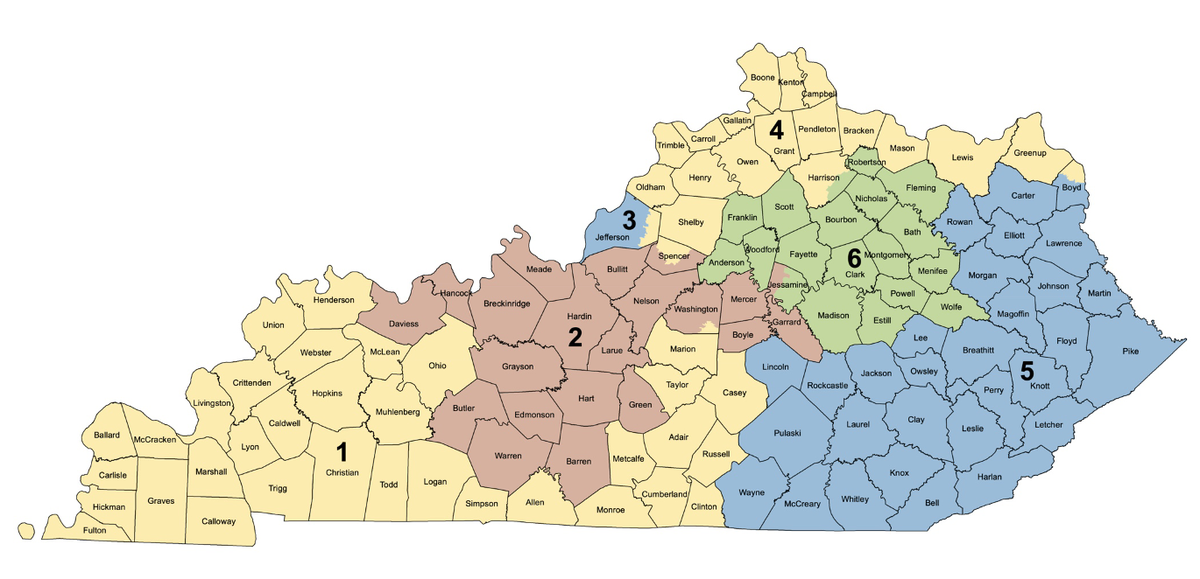
The League has gone so far as to buy its own computer program to do some hypothetical, best practice designing of its own using 2010 data so they’ll be ready when the 2020 numbers were released.
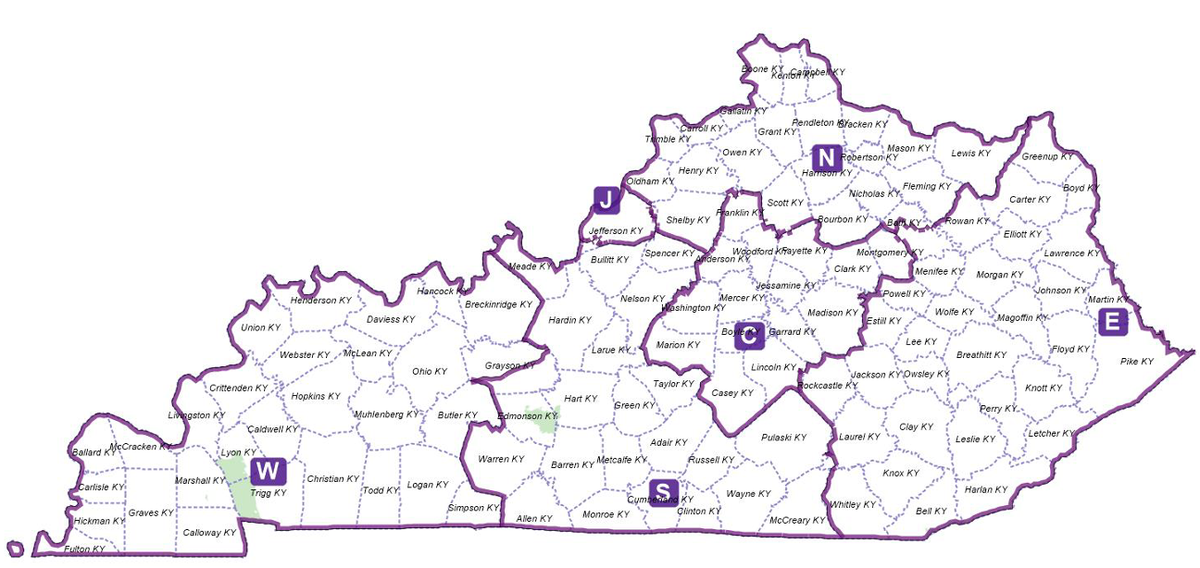
For example, with Congressional maps, the 1st District stretches in a U-shape around the bottom of the 2nd District, which means that U.S. Rep. Jamie Comer, who represents far Western Kentucky lives further east than 2nd District U.S. Rep. Brett Guthrie of Bowling Green. The League’s hypothetical map creates more cohesive vertical districts. However, politics are bound to intrude because the League’s map would unseat Comer, who lives in Monroe County.
Republican state Sen. Julie Raque Adams, who chairs the Senate Majority Caucus, says she thinks Republicans will redistrict with more transparency this time around.
“I believe the transparency message is a very positive one,” she said. “I think hearings need to be held, people need to be heard. There is so much room for progress than what we had last go around, I think it’s a really positive thing to do.”
Last time around, as you may recall, lawsuits over the 2010 plans derailed redistricting until 2013. This time, because of delayed census information, the deadlines are very tight. State leaders may not get the new information until September, and the filing deadline for office is Jan. 7.
There’s talk of a special session to deal with redistricting because otherwise legislators would have to wait until the General Assembly convenes Jan. 4. In a statement, Gov. Andy Beshear’s office said the Republican majority had not discussed redistricting with him nor asked for a special session to get it done. “The Governor and his team look forward to receiving more information from the Census Bureau later this year and determining the best option for redrawing congressional and legislative districts in the commonwealth,” the statement said.
Senate President Robert Stivers said Thursday that he had talked to Beshear’s aides, Zach Dembo and Rocky Adkins, about the very real need to bring legislators back in the fall for a special session once the census data is in.
“I thought it would be appropriate to do so for many reasons,” Stivers said. “Everybody knows what the filing deadlines are and if we do redistricting in a special session, they would remain the same. If we don’t, we would have to change them.”
In addition, until redistricting, neither incumbents nor their challengers will know what districts look like or what policies they might have to work on. If they waited until January, that would further slow down other policy matters in the General Assembly session.
“There will be intra-party and inter-party bickering, and people’s feelings get hurt,” which would further slow down policy work, Stivers said. “My example is that every Democrat wants the Highlands, every Republican wants Jackson County but that can’t be the case.” Still, he said, speculation on any of it is useless until the granular census data is in.
Sen. Jimmy Higdon, R-Lebanon says redistricting is fundamentally fair because getting the required numbers for each district requires it to be. His district pokes into Jefferson County because that’s where there was enough population to fill his Senate district. (You can only split up counties that are big enough to have their own district.)
“We have the courts looking over our shoulders, and we have to do a map that will face a court challenge,” he said.
It will get even more complicated this year because of population loss in Eastern and Western Kentucky, which pushes the numbers to the Golden Triangle.
“There should be meetings on it, but no matter who does it, three will still be people unhappy with what they do,” Higdon said.
Good government is for the people by the people and more of us should understand how this very crucial piece of our democracy works. Sign the League petition for the “People Powered Fair Maps” initiative that the national League of Women Voters has spearheaded for a more transparent process. Call your legislators and ask for hearings.
Redistricting is easy to ignore, but it’s part of our political divisiveness these days, says D. Stephen Voss, a University of Kentucky political scientist. Gerrymandering that favors one party can end up with more primary challenges that allows the most extreme candidates from either end of the political spectrum to win.
“People should care about redistricting but not so much because it controls how many Democrats or Republicans in the legislature,” he said. “They should care because it determines whether representatives feel they should work to keep their jobs, whether it’s solving problems or picking fights with the other party.”
This story was originally published July 2, 2021 at 9:49 AM.