‘Iconoclast’ Rand Paul’s stock disclosure shows he’s just one of the herd after all
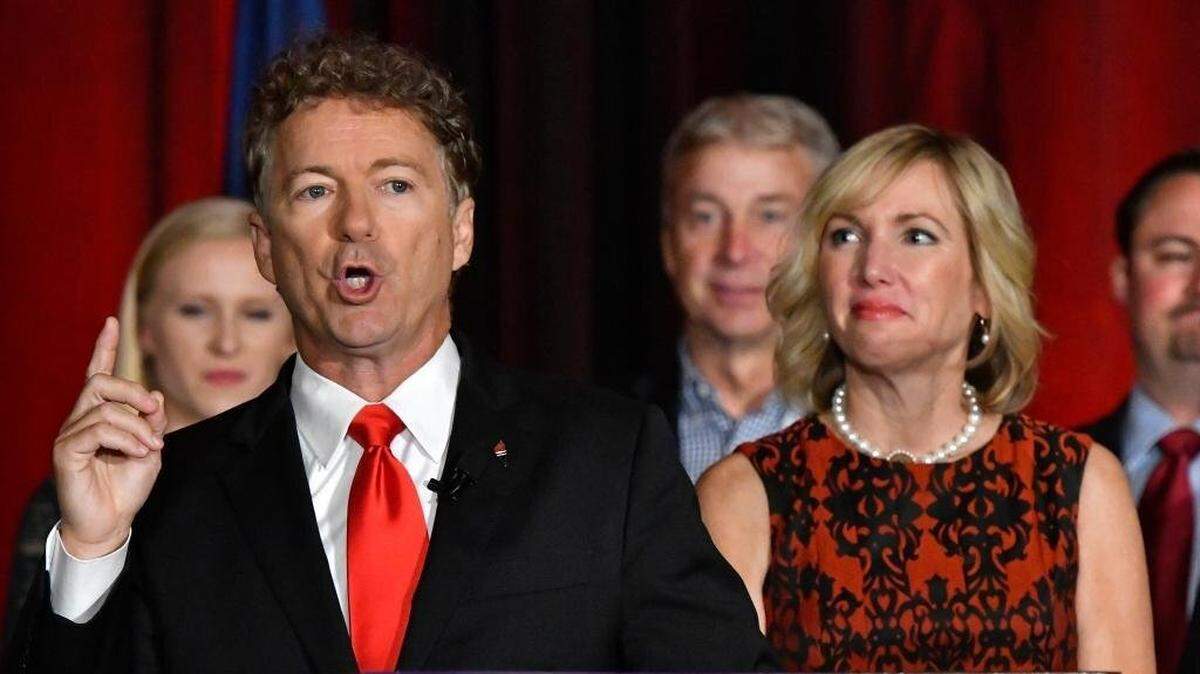
For Sen. Rand Paul, the recent news about the delayed disclosure of stock trading by his wife looks either bad or really bad.
The Washington Post reported Thursday that Kelley Paul invested somewhere between $1,000 and $15,000 in Gilead Sciences, a pharmaceutical company that makes the antiviral drug remdesivir, used to treat COVID-19. She bought it in February 2020, and it should have been reported 45 days later but was instead made 16 months later. Paul’s office said the delay was an oversight.
That reporting requirement is part of the STOCK (Stop Trading on Congressional Knowledge) Act of 2012, which bars lawmakers from using nonpublic information to trade personal stocks, otherwise known as insider trading. In January of 2020, Vox reported, the Senate Health Committee, of which Paul is a member, received a COVID briefing on Jan. 24, when the U.S. was just beginning to understand how serious the virus would become. Paul did not attend any hearings or briefings on COVID prior to his wife’s stock purchase, Paul’s office said.
Several other members of Congress also decided to play with the stock market shortly after that, including Sen. Richard Burr, R-N.C. Sen. Kelly Loeffler, R-Ga. and Sen. Dianne Feinstein, D-Ca. They were all investigated by the Department of Justice and no charges were brought.
Now, I certainly don’t think that Rand Paul has been railing against masks and vaccines for the past year because he thought getting people sicker would make Gilead stock go up, as has been suggested. That’s next level conspiracy, and Paul cares about “freedom” and looking smarter than everyone else, not necessarily in that order. This was just a way to make a little cash on the side of spreading dangerous misinformation. In Paul’s hometown, by the way, all the ICU beds are filled with COVID patients. Nearly all of them were unvaccinated.
But I also don’t think it’s an accident that a few weeks after hearing about the deadliest pandemic to hit the world in 100 years, Kelley Paul just happened to buy stock in a company that had a potentially life-saving drug against a new and deadly disease. On Friday, she tweeted that she bought the stock when Italy’s cases were surging, and the World Health Organization said remdesivir might be a cure. Also she lost money on the trade, according the Post, which is a lame defense but karmic, right? On Thursday night, CNBC reported that the Gilead purchase was the first individual stock buy the Pauls had made in a decade.
And then they “forgot” to report it, just as a bunch of Paul’s colleagues were going through the media wood-chipper over the same deal. Huh.
This deal doesn’t just reflect poorly on Paul and his wife. It also shows how the elites of either party trade on their status to get ahead in ways that regular folks simply cannot.
Members of Congress and their relations should have to put assets such as stocks or investments into blind trusts while they’re in office. That was the idea of legislation introduced last year by Texas Republican Congressman Chip Roy and Rep. Abigail Spanberger, a Virginia Democrat. You’ll be shocked to hear it went nowhere.
Guess who gave up trading individual stocks? Paul’s senior colleague, the uber-wealthy Mitch McConnell (who, to be fair, got rich the old fashioned way). Although he told the New York Times he opposed limiting other members’ investing, he said: “As for myself, I decided many years ago I was more comfortable not owning individual stock.”
The same story by Nicholas Fandos reported that a review by the Campaign Legal Center found “that between early February and early April, as Covid-19 roiled the markets and Congress approved about $2.8 trillion in relief programs that touched almost every corner of the American economy, 12 senators made 227 stock purchases or sales worth as much as $98 million. In the House, 37 members made 1,358 trades worth as much as $60 million.”
Corruption is bipartisan, of course. But this hands a lot of fresh ammunition to Paul’s challenger, Charles Booker, who has made income inequality in a state ravaged by COVID one of the primary messages of his campaign.
So maybe it was just oversight of paperwork and of potential conflicts of interest, or maybe the Pauls knew exactly what they were doing and simply didn’t care. We’ll find out which one if the Justice Department decides to look into it. Either way, whether he’s ranting about masks or denying conflicts of interest, Rand Paul loves to hold forth as a resistance iconoclast, but proves he’s just one of the herd after all.
This story was originally published August 13, 2021 at 9:12 AM with the headline "‘Iconoclast’ Rand Paul’s stock disclosure shows he’s just one of the herd after all."