’If it looks like a duck ...’ Push on charter schools fuels conspiracy theories. Are they true?
As House Bill 9, which would authorize funding for charter schools, makes its slow and tortuous way through the General Assembly, a lot of questions are coming up about how this particular sausage was made.
Why, for example, are the pilot programs for charter schools assigned only to Northern Kentucky and Jefferson County?
Jefferson County is obvious. The West End schools are among the lowest performing in the state, some community members have called for charters, and the GOP supermajority loves sticking it to Jefferson County’s powerful teacher union.
But Northern Kentucky is a bit more curious. There were various hints on the House floor about wealthy donors who want a charter school in an area filled with numerous public school districts and private schools, including a widespread web of Catholic schools that serve low-income students.
In 2019, two years after charter schools were made legal without a funding mechanism, the Newport school board turned down the state’s first charter school application made by the River Cities Academy. House Bill 9 instead names Northern Kentucky University as the authorizing body for a charter school. And that’s curious because Northern Kentucky University knew nothing about it, according to a statement.
“NKU was not consulted about being included as a potential charter school authorizer prior to our inclusion in HB9,” the statement says. “Furthermore, we have not had the opportunity to fully understand what is in the bill. However, the language in the legislation does provide us the ability to study the implications before making any decisions. Should HB 9 become law, we will have conversations with the multiple stakeholders in our community about what impact charter schools would have on K-12 education in northern Kentucky.”
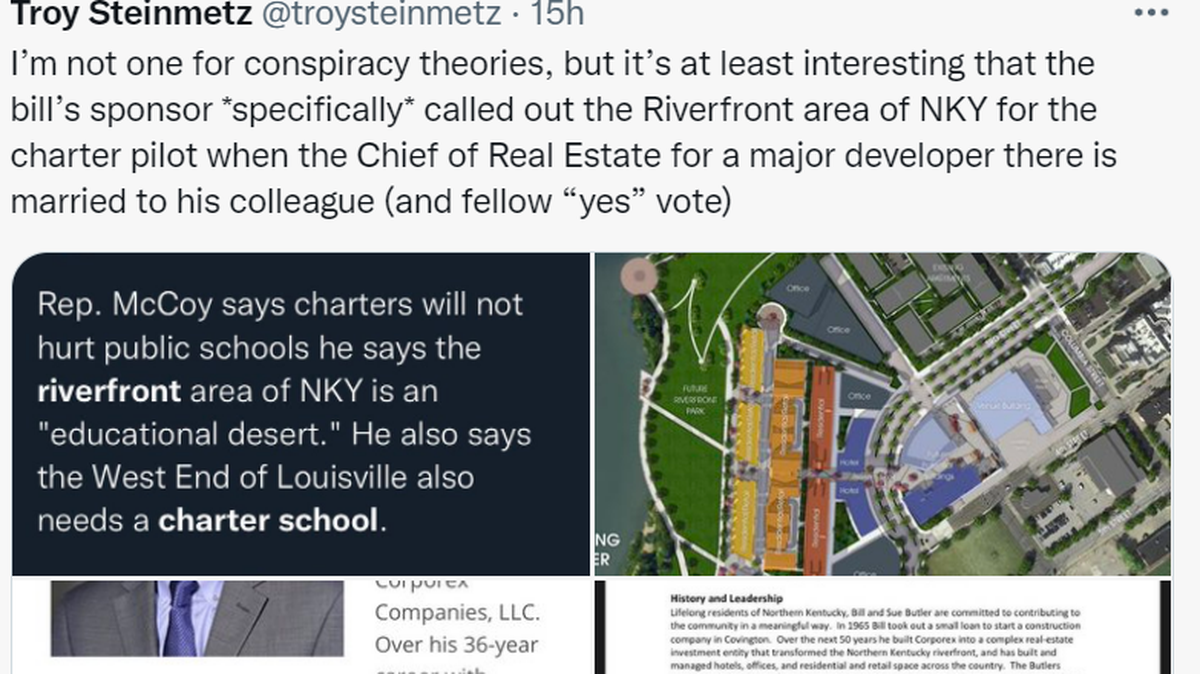
Troy Steinmetz, a higher education fundraising consultant in Louisville, put together an interesting thread of his own questions and answers about House Bill 9 on Wednesday. They’re good ones. He pointed out that wealthy developer Bill Butler, CEO of Corporex has a huge TIF-supported development being built at the junction of the Licking and Ohio Rivers directly across from downtown Cincinnati, and Butler is listed as the contact for lobbying for something called the Urban Academy, according to a listing with the Legislative Ethics lobbyist listing. “Urban academy” is a phrase used throughout House Bill 9.
The CEO of real estate for Corporex is Tom Banta, who is married to Rep. Kim Banta, who is usually considered a supporter of public schools, but voted in favor of House Bill 9. Bill Butler’s brother, Marty Butler, who is on the board of directors of Corporex is also on the board of the NKU Foundation.
Thursday morning, after I started reporting on this column, Bill Butler called me back from Florida. At 79, he is half retired from Corporex. He said he supports the legislation and had talked to its sponsor, Rep. Chad McCoy, R-Bardstown. But the Urban Academy is a private school concept that he’s envisioning and House Bill 9 is not being written for him.
“They’re saying this would be part of the Corporex development at Ovation and that’s 100 percent wrong,” he said. “There’s no connection, none at all between Ovation and the project that I’ve been working on. That’s not a company project, it’s my personal thing.”
Butler said he supports charter school legislation because too many young people move to Northern Kentucky’s urban centers but then leave once they have kids because they think the school systems aren’t good enough. But his Urban Academy is a K-8 private school with a challenging curriculum. It could not fit on the Ovation campus because the mix of high-density residential and business development won’t leave room for a school.
Young families leaving urban areas is ”the problem we’re trying to solve,” Butler said. “To the extent charter schools can solve that is not known but it’s a potential alternative. But it has nothing to do with the company and it has nothing to do with Ovation.”
Later on Thursday, Butler also sent out a press release reiterating these points. He also told me that he has a Frankfort lobbyist who works on numerous issues, including education.
Opponents of House Bill 9 aren’t so sure.
“If it looks like a duck and quacks like a duck, it’s a duck,” said Nema Brewer, founding member of KY 120 United AFT, a teachers group. “Come on, really? Don’t treat us like ignorant hillbillies, we all know exactly what’s going on around here.”
It won’t be the first time the Kentucky General Assembly did the bidding of a wealthy donor, but there are larger issues. House Bill 9 passed the House the same day it was approved in committee and 12 hours after a committee substitute was presented. It changed committees from Appropriations to Education, where McCoy was hastily added as a member. Its future in the Senate is still unknown, although it’s fair to say that teacher groups still have more sway in the House. The whole process, as we say, stinks.
Steinmetz said he started poking around because he thinks charter legislation is a threat to public school funding, and the way it went through seemed suspicious.
“I want the public to understand the ways in which charter schools pull money away from public schools and can threaten student outcomes,” he said. “I would like the public to figure out why Northern Kentucky and why West Louisville are in here and why the concepts seem fully baked.”
Several Northern Kentucky legislators said they still can’t understand why their region was singled out given the huge educational choice there.
“The choices are very broad,” said Rep. Buddy Wheatley, D-Covington. “My constituents have not talked to me about the need for charter schools. This bill does seem to be very specifically aimed at a specific project, but I don’t know.”
And Rep. Rachel Roberts, D-Newport, noted that conspiracies are easy to piece together when the legislative process is opaque.
“When we are racing bills through, moving people on and off committees, these kinds of questions will come up, and rightly so,” she said. “Whether there’s anything nefarious or not the perception is not good when we move in this way.”
Conspiracies arise when politicians aren’t open. Whatever happens to House Bill 9, funding charter schools by allowing public school funding for education and transportation to follow kids wherever they go will hurt Kentucky’s public schools all over the state. (And as Wheatley noted, it will also hurt the pension system if these new teachers aren’t part of it.) All the time that’s spent arguing over charters and who or what they benefit could be far better spent on the best ways to fund and improve the public schools that benefit all kids. That’s not a conspiracy, that’s a fact.
This story was originally published March 24, 2022 at 1:43 PM with the headline "’If it looks like a duck ...’ Push on charter schools fuels conspiracy theories. Are they true?."