Charter schools might work in Ky. But court should strike HB 9, which will not. | Opinion
We all know that while plenty of people claim to speak for children and their education, too many don’t. Politicians are too busy with cynical showboating that seizes on the fears of parents and the public; hidebound bureaucracies in school administrations too often block meaningful innovation that could help kids.
It’s possible that charter schools could be one answer in our most challenged areas, such as the West End of Jefferson County or the East End of Fayette. But the push should come from those parents, teachers and counties as to whether charter schools make sense.
They might be an answer, but not as conceived through House Bill 9, a cynical political maneuver disguised as legislation that is nothing more than a poke in the eye of the Jefferson County public schools and other urban districts. The bill is not about what’s best for children, it’s about what’s best for developers in Northern Kentucky and legislators in Frankfort who want to follow the bidding of their political overlords at Cato, ALEC and the Heritage Foundation, which have always been vocal about their disdain for public education. It would create a foundation for corruption by allowing for-profit charter operators, and further dismantle funding for our public schools.
That’s why it’s good that the Council for Better Education has sued to stop its implementation, following on their Supreme Court victory over an even worse idea, tax credit vouchers for public schools.
The legal issue is whether the Kentucky Constitution allows any public school funding to be used outside of the public schools.
But there’s another, more interesting point that CBE spokesman Tom Shelton made about what we consider charter schools. First of all, he thinks charter schools came late to Kentucky because of the Kentucky Education Reform Act, which put school councils of parents and teachers in the middle of school governance. That, in turn also allowed in places some programming — such as SCAPA, STEAM and the George Washington Carver STEM Academy for Boys in Fayette County, for example — that in other states would be considered charter schools.
“If Kentucky didn’t have to look at the stigma of the word charter schools and deal with funding issues, then we already have the system and structures and creativity to create our own types of schools that would be considered charters,” said Shelton, a former Fayette superintendent. “There’s plenty of flexibility and means of doing it.”
Back in 2014, for example, five school districts — Carroll, Gallatin, Henry, Owen and Trimble — came together with the help of the Ohio Valley Education Cooperative to improve career education for its mostly rural students. With the support of the Kentucky Department of Education and $250,000 in seed money from the General Assembly, the group founded iLead Academy, a high school of 120 students that provides computer science, engineering, pre-med and nursing to students who want it. By junior year, most of the students are getting college credits from dual credit classes, and the school has an 80 percent graduation rate.
Money does not follow students; each district gives a flat $95,000 a year, and OVEC’s Director of Innovation Alicia Sells finds the rest through grants.
“It’s an example of things districts can do under existing law to create alternative models,” Sells said. The school is now looking at expanding some of its virtual curriculum statewide.
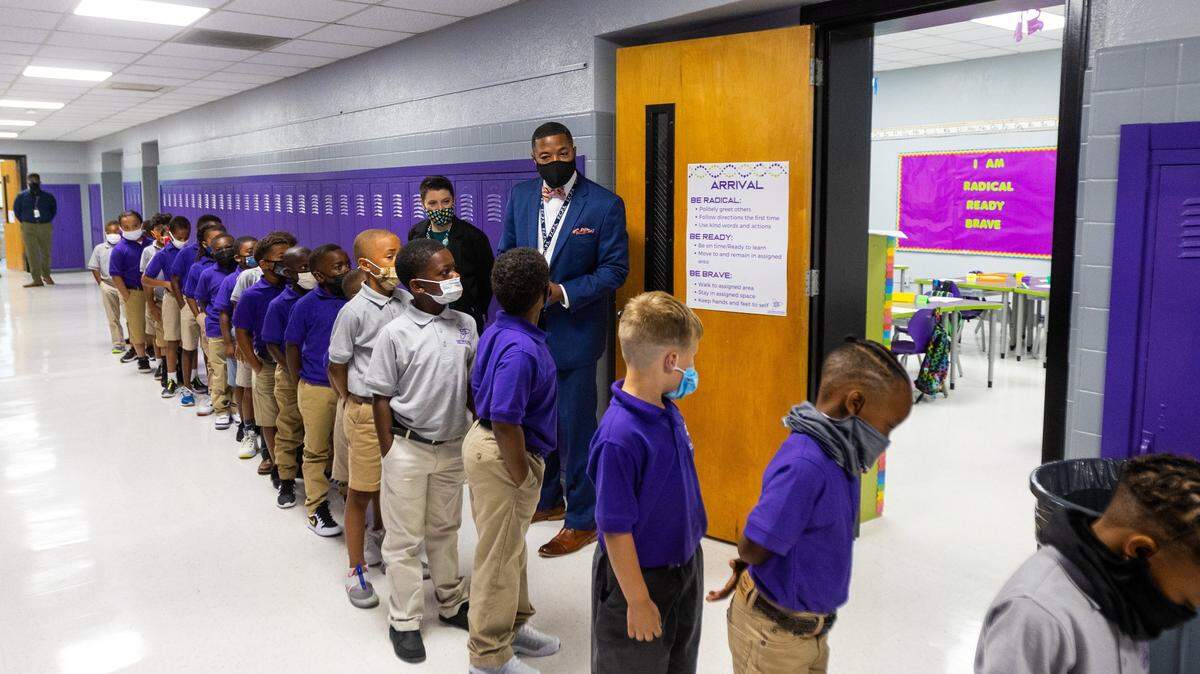
In Fayette County, educators and parents felt the need for an all male school that focused on STEM. The George Washington Carver STEM Academy for Boys opened in 2021. There’s also the Rise STEM Academy for Girls in Lexington, which met another identified need.
The General Assembly has support creativity and innovation in education before. What if, instead of pushing an out of state agenda by people who think public schools are part of an overlarge government worked instead to provide more students what they need from within a public school framework?