Beans, corn, okra, healing. How a refugee community in KY grows tastes of home.
With a kitchen knife, Serge Wiyalika carefully cut a hole into the ground cover and inserted a tiny white eggplant seedling. Then he did it again. And again.
About a foot away lay a large pile of white eggplant, smaller and a little more bitter than the typical American fruit. A large pile of amaranth piled up nearby.
“We do this every week,” Wiyalika explained. “We use machetes and kitchen knives, whatever we can afford.”
Nearby, two boys are harvesting beans, which grow interspersed between stalks of corn. The men and boys are planting and harvesting at an old farm off Old Richmond Road that features an old tobacco barn and dark soil of a typical Central Kentucky homeplace. But this is not Kentucky agriculture —these are the vegetables and planting methods of a faraway land, a taste of home for the refugees of Congo, Burundi, Rwanda and Uganda, who long for the food on which they were raised.
“People said that we can’t find food so we can’t eat well; this is the response to that issue,” said Gaston Sankayi, himself a refugee from the Congo who is the city’s African specialist in GlobalLex.
Sankayi is also a founder of Empucate, a non-profit trying to tie together empowerment and education. Five years ago, he approached the community garden group known as Seedleaf to ask about how refugees could start to grow their own food. Seedleaf responded with a few plots, then word spread. Now more than 50 families are growing food on at least three farms in Fayette County. The going rental rate is $1 a year.
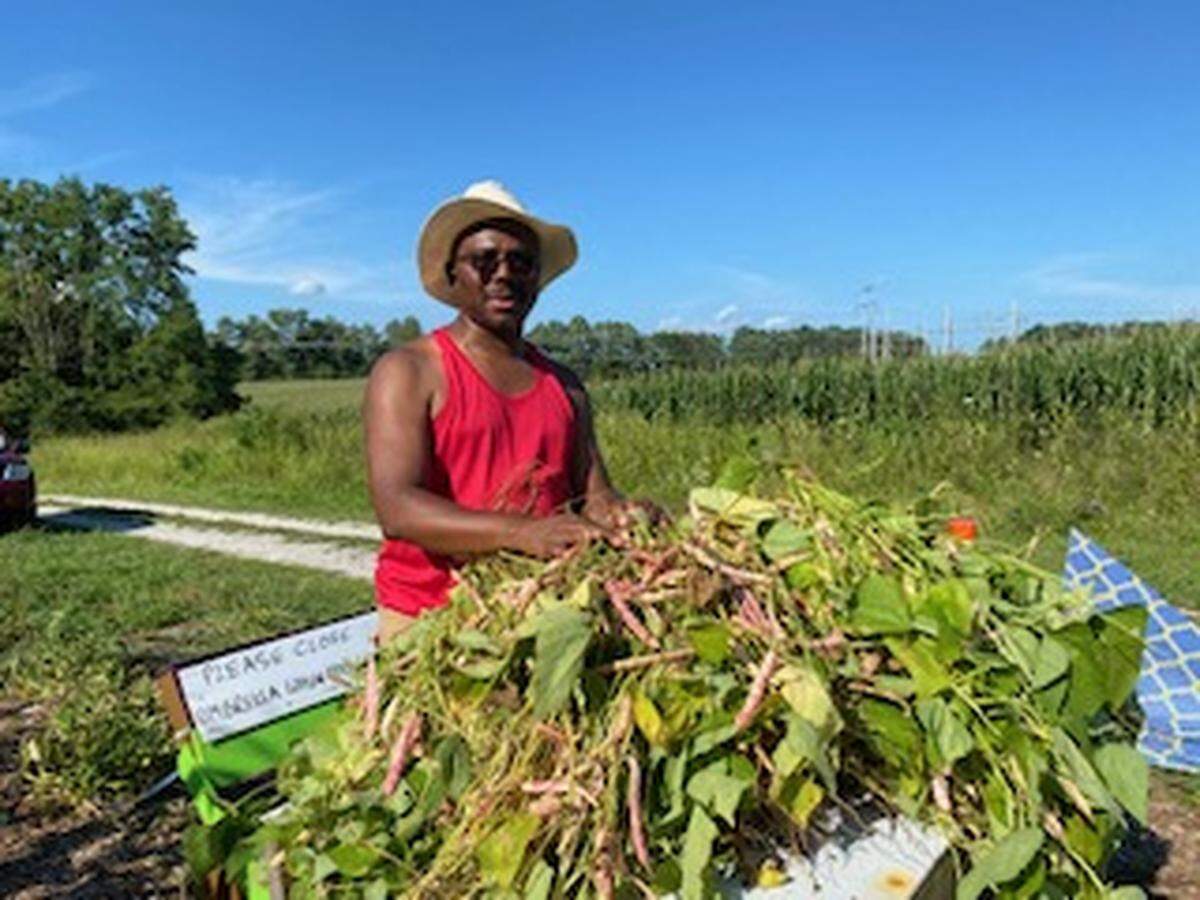
Mukamsoni Joseph who came to Lexington from Burundi is harvesting pink and white cranberry beans that she will boil and then fry. “It’s so delicious,” she said.
The Africans who work this land have transplanted their experiences from home; instead of careful rows separated by crop, they have planted corn, beans and squash in a manner similar to “Three Sisters” agriculture used by native Americans in this land for eons. They also have jalapeno pepper plants, cassava, and okra. The difference is they will often value the leaves of beans and squash and sweet potatoes above the fruit.
The roughly 20 plots are assigned to families or groups of people. Wiyalika, for example, is with a group of men from their church, the International Ministry for Propagation of the Gospel. They share the produce with the congregation.
Kavira Musayi came from the Congo four years ago and is busy harvesting soybeans. “I need fresh and organic food from my country,” she said.
The Empucate gardens have some rules: no pesticides and absolutely no politics about the often traumatic life experiences they left behind in a land filled with civil war, poverty, and strife.
“We are family here,” Sankayi said. “We have a policy, a zero tolerance policy, if you talk about what happened back home, or see someone as your enemy, we kick you out. This project is also about reconciliation and healing from trauma.”
Carpenter Scott Wilson heard about Empucate from ag-connector Jim Embry. Wilson has an 11-acre farm on Winchester Road that he farms as a hobby. He offered them about an acre. Now 12 African families are growing food there for an annual rent of $1.
“Mainly I’m proud of trying to help welcome these folks to our community,” Wilson said.
Officials differ on actual numbers of refugees from Central Africa; Wilson said he thinks the number is as high as 2,000 families. Kentucky Refugee Ministries say they have settled almost 600 people in the area in the past three years. Swahili is the second most common foreign language spoken in the public schools after Spanish.
This fall, Empucate farmers will return to Seedleaf, using 1.5 acres on the new Headwater Farm in northern Fayette County.
“Seedleaf is responsible for managing 30 acres and that is more land than we can manage ourselves, so we’re looking to people in community who have experience in agriculture that meshes with our own vision of what’s possible— an exchange of ideas and culture and skills, ” said H.P. Lovelace, the Seedleaf farm manager. “When I think about the refugee community, and specifically the Congolese community who will grow here, they come with amazing knowledge and agricultural skills, and a work ethic that’s pretty amazing.”
Sankayi and Lovelace hope to develop more market farmers, who can grow enough to sell their food.
“Agriculture is an exchange of cultures,” Lovelace said. “Everything we grow here as Kentucky agriculture is really borne of traditions and foodways, and any time that we work with others who have different knowledge and skills, we will necessarily learn from each other.”
The collaboration will continue America’s melting pot story, said Sankayi.
“When I read the history of America, it’s like the history of Congo, with colonization, and then people who suffered from religious persecution coming here,” he said. “They came here to have a better life, which is the same reason we came here.
“We all came to find the same thing and we found it.”
This story was originally published August 18, 2023 at 7:00 AM.