Lexington needs help to make the best of a bad process for opening up rural land | Opinion
First, let’s talk about what Tuesday night’s meeting on Lexington’s expansion plan will not be.
It will not be another discussion about whether to open the Urban Service Boundary.
Lexington is expanding, thanks to an overwhelming vote by the Urban County Council, some of whom wanted more space for affordable housing, some who wanted to serve the development community, which has been champing at the bit for years. Back in June, I called it a debacle, and I’ve seen nothing so far that would change my mind.
As I said back then: “Farmland is finite, important and protects Lexington’s unique brand and economic engine of horses and agriculture. That’s not to say it should never be developed; it should only be developed when it meets our most pressing need: housing. And right now, thanks to a recent vote, the council has allowed the Urban Service Boundary to open between 2,700 and 5,000 acres without anything in place that would ensure those housing needs are met. Despite this being an urgent issue for years, Lexington still has no rules that require developers to set aside some portion of their projects for affordable housing.”
What Tuesday night’s meeting will be is a chance for the public to weigh in and help the Urban Growth Master Plan Advisory Committee decide how to make the best of a hasty, poorly designed process that the council set up in an arbitrary rush to develop land.
A public hearing is scheduled for 6 p.m. in the Lexington-Fayette Urban County Council chambers at 200 E. Main Street.
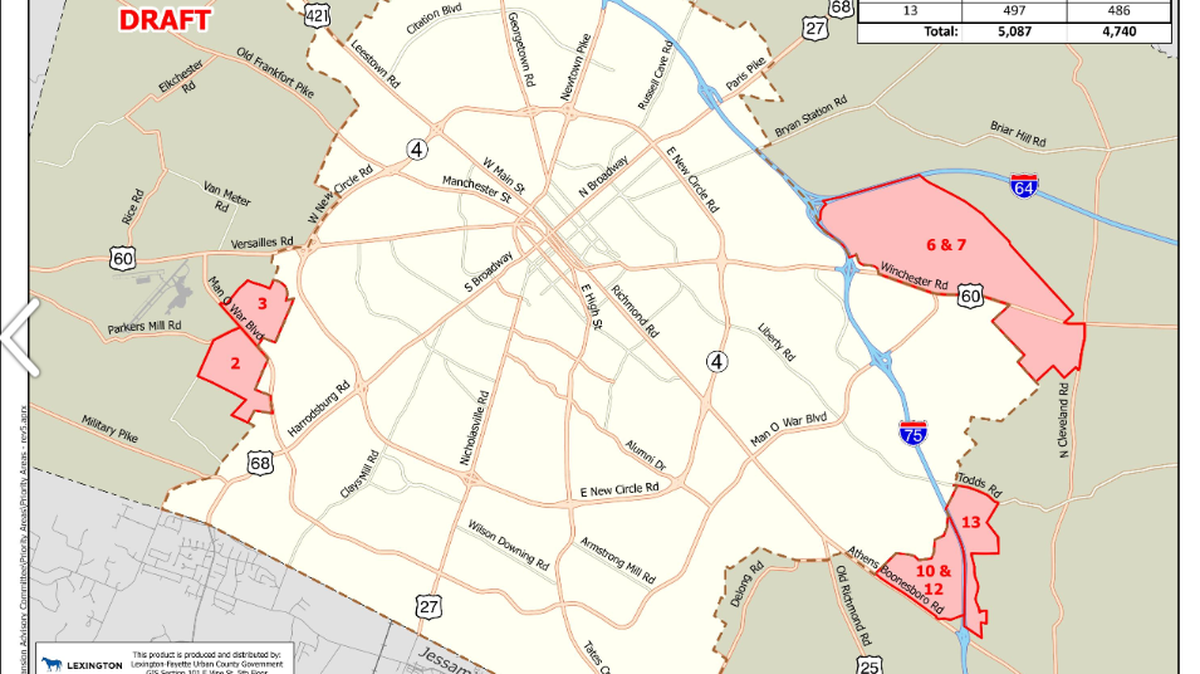
As of this past Tuesday, the task force had made the best of a bad job, agreeing to open the minimum, not the maximum amount of land allotted by council — 2,700-5,000 acres. They have tentatively voted to open about 3,000 acres between Winchester Road and Interstate 64. The other two choices are between Richmond Road and Intersate 75, and near the airport around Parker’s Mill.
As committee member and Vice Mayor Dan Wu pointed out, “Why are we rushing into 5,000 acres? This is not the last bite of this apple we’ll ever take.”
He favors a more incremental approach that uses a data-driven process as part of the comprehensive plan, not this arbitrary, close your eyes and throw the dart approach.
In my opinion, the best place to open up would be the Richmond Road land, which is not actively farmed and is close to other subdivisions and a new school, Brenda Cowan Elementary. But that wouldn’t meet the minimum 2,700 acres required by council.
Even that is not not enough acreage for the development community, which is represented on the task force by Commerce Lex and the Building Industry Association of Central Kentucky. Todd Johnson, who represents the latter group, also recommended adding another bit of land on the other side of I-75 below Todd’s Road.
There are already calls to include all 5,000 acres, and the committee still has two more weeks of meetings before they make any final decisions.Yes, Lexington needs more housing, but nothing in this process guarantees affordable housing or even accessibly-priced housing. All the council has is an earnest desire to see more of it. And judging by the fact that it’s difficult and hard to profit from affordable housing, it’s safe to say that it’s more likely we’ll see more Hartland-style suburbs and strip malls than actual accessibly-priced houses for first-time buyers.
In some ways, the Urban Service Boundary is now a victim of its own success. Advocates held the line, literally, for so many years without realizing (or caring) how much it would strangle Lexington’s housing market. The Fayette Alliance, which represents agricultural interests while advocating for smart growth, has filed a lawsuit to stop the whole process.
What makes this rush even more of a shame is that the city is pondering a new set of zoning regulations that could finally improve our infill and redevelopment regulations. As ever in government, the pace is glacial until it’s not.
Council should have stuck to its comprehensive plan, which still calls for a data driven process to decide growth, not this arbitrary pick. It should have made a clear process to create affordable and accessible housing instead of leaving it open for McMansions and strip malls.
But now we need the public’s help in sorting it out. Come out on Tuesday night to tell the task force what you think. Where exactly should we open up? Should it be the minimum or maximum acreage? These issues are mind-numbingly complicated but they are incredibly important to Lexington’s future.
This story was originally published September 8, 2023 at 7:00 AM.