‘Seizing this moment.’ Slow but steady progress on EKY housing after floods. | Opinion
On July 28, 2022, Wayne White’s house in Breathitt County was filled with 13-and-a-half feet of water after five days of torrential rain. Those floods killed 45 people, mostly centered in Breathitt, Knott, Perry and Letcher counties, and damaged or destroyed almost 10,000 homes.
White wanted to stay in the house he’d lived in for more than 20 years. He worked with FEMA to replace all the duct work in his house, but it was too far gone.
In the next few weeks, though, he’ll be moving into a brand new three-bedroom house on top of an old strip mine just over the Perry County line.
“I’ll be glad to get here,” White said as he inspected fresh paint colors in the house under construction last week, including one bright purple room for his granddaughter.
A crew from the Housing Development Alliance, helped by a bus load of volunteers from Dayton, Ohio, were bringing in doors and finishing the floors in the kitchen/living room of the sunny space.
The Alliance has worked on about 10 other houses that have already been built at the Blue Sky subdivision near the Wendell Ford Airport outside Hazard.
As each survivor’s story is different, so is the resolution to their problems, each one a complicated patchwork quilt of people’s housing needs, finding land, finding financing to build and financing for renting or buying.
Eastern Kentucky already had a housing shortage; one night in July created the kind of overwhelming crisis that can take decades to solve. Two years later, progress is slow.
But advocates and officials say the disaster also opened up huge opportunities to jump-start housing solutions throughout the region.
“It’s become an amazing group of organizations that have collaborated in a way that is unusual,” said Scott McReynolds, the executive director of the Alliance. “And if we keep working together, we can do more.”
The coalition includes an array of non-profits who are working with state and local officials to best use the huge influx of federal disaster funds that have come into the state. McReynolds, for example, has doubled his staff so they can continue to build affordable housing across the region while also helping the numerous survivors who need somewhere to live that is safe and out of harm’s way.
He’s been helped by the Foundation for Appalachian Kentucky and FAHE, which started in 1980 as the formerly the Federation of Appalachian Housing Enterprises. FAHE formally began its “Housing Can’t Wait” campaign three months after the floods.
“We can no longer wait for opportunities to be handed to us,” said Jacob Wolfe, FAHE’s director of disaster resilience. “We’ve put ourselves in a situation where we’re being proactive.”
FAHE keeps a scoreboard of what it and its partners like Homes Inc. or the Kentucky Housing Corporation have helped build so far: 68 homes and 275 major home rehabilitations since 2022.
More specifically:
▪ Breathitt County: 7 new homes and 39 rehabbed homes
▪ Floyd County: 2 new homes and 63 rehabbed homes
▪ Knott County: 13 new homes and 73 rehabbed homes
▪ Leslie County: 2 rehabbed homes
▪ Letcher County: 29 new homes and 34 rehabbed homes
▪ Magoffin County: 1 rehabbed home
▪ Martin County: 1 new home and 1 rehabbed home
▪ Owsley County | 3 new homes and 18 rehabbed homes
▪ Perry County | 13 new homes and 43 rehabbed homes
▪ Wolfe County | 1 rehabbed home
Currently, FAHE notes 34 houses under construction and more than 100 pending.
Wolfe said the group’s approach is to treat each case individually and take advantage of a multi-layered approach through numerous state and federal housing programs. In Eastern Kentucky, people have often owned land they live on for generations and want to stay on the homeplace.
“There are opportunities for rehabilitation that keep them on the same land, just as there are opportunities for rental programs,” Wolfe said.
From crisis to opportunity
The floods also pried open a longstanding knot in Eastern Kentucky housing: How to take advantage of hundreds of thousands of acres of former coal mines, stripped to flat land but lacking such expensive infrastructure as roads and water.
“It’s a tragedy that created an opportunity, and we don’t want to fumble the opportunity to make creative, meaningful and lasting impact,” said Transportation Secretary Jim Gray, one of the Beshear administration’s cabinet secretaries involved in leading High Ground Communities project.
“It took a crisis, but we are seizing this moment.”
Basically, the idea is that federal and state disaster funding can create the kind of infrastructure for development that is often too expensive for private developers.
For example, roads are currently being built at the Skyview site, a former strip mine about five miles outside of Hazard. The Ison family donated 50 acres to the state, which plans to build 105 single-family houses with the help of non-profit groups.
The infrastructure also will allow other development on the land the Isons still owns.
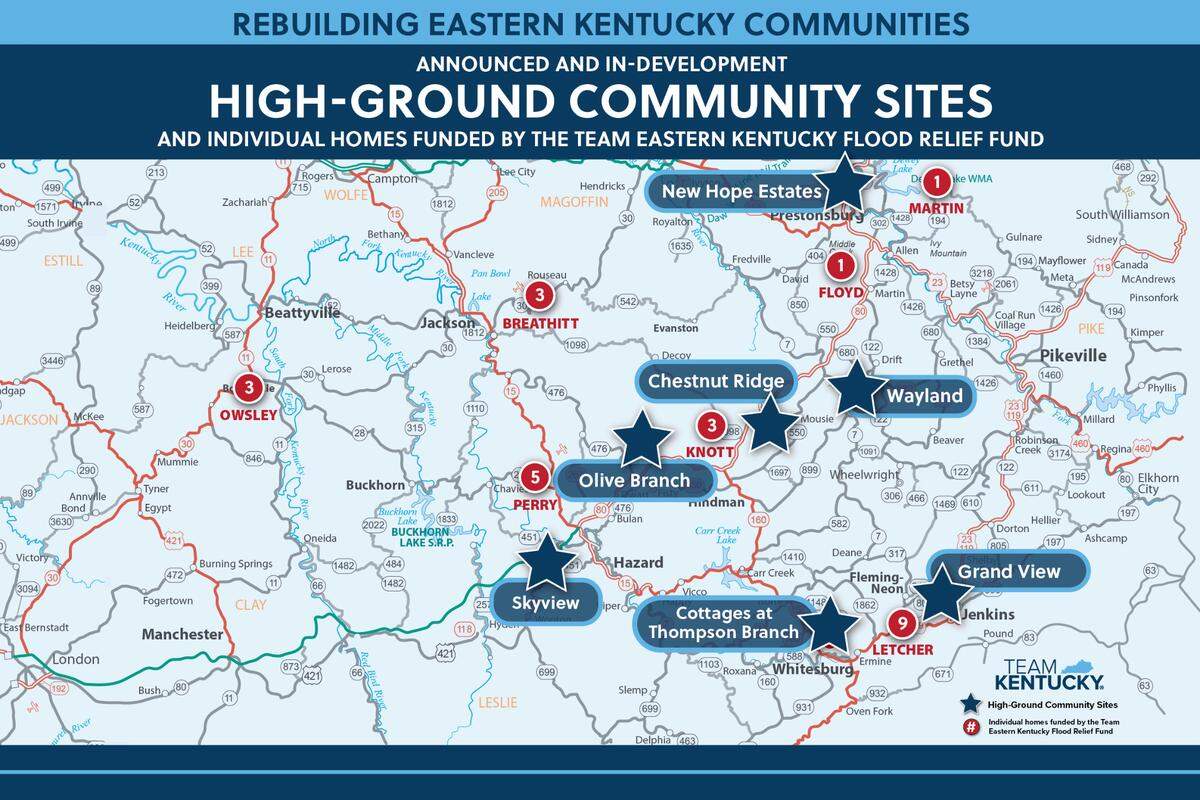
Currently, there are seven High Ground communities under various degrees of construction with the following proposed construction.
Letcher County:
▪ The Cottages at Thompson Branch: A four-acre site with plans for 10 single-family homes located near Whitesburg.
▪ Grand View: A 92-acre site, with plans for 115 homes single-family homes located off U.S. Highway 23, near downtown Jenkinsude 37°10’25.23”N and longitude
Perry County
▪ Skyview: 50-acre site with plans for 105 homes single-family homes.
Knott County
▪ Chestnut Ridge: 100-plus-acre site with plans for approximately 150 single-family homes along Chestnut Ridge Drive near Soft Shell, east of the Knott County Sportsplex.
▪ Olive Branch: A 75-acre site with plans for 142 single-family homes in the community of Talcum near the Perry County line.
Floyd County
▪ New Hope Estates — Two sites, both along Cliff Road and Old Cliff Road in Prestonsburg. One site is 27 acres, with plans for 20 single-family homes. One site is seven acres, with plans for 14 single-family homes
▪ Wayland — Four-acre site with plans for 12 single-family homes.
Slow, but steady
As chair of the state Transportation Committee who represents Knott County, Rep. John Blanton, R-Salyersville, has kept a close eye on the housing progress two years after the floods.
“It’s going slower than I would like it to, but, I think it’s going well,” he said. “There are a lot of different factors — environmental, infrastructure, construction — but that’s the reality, and I’m thankful every day it continues to move forward. It’s a joint effort from everybody.”
Back at Bluesky, White talked to Julia Stanganelli, a flood recovery coordinator for the Alliance, who has helped White piece together financing for his new home.
He got a buyout from FEMA for his ruined home, but the agency let him stay there until the new house was built. With more help from the Rural Housing Trust Fund, White, who is a retired engineer from RJ Corman Railroads, will have an affordable mortgage.
“Everyone has a unique situation,” Stanganelli. “We try to piece together something that’s affordable.”
Across the way from White’s new house is another one built for Farmer Baker, whose wife, Vanessa, is the only one of 45 victims whose body was never found. On the other side, Karensa Combs is living in a house after 18 months in a FEMA trailer at Carr Fork Lake.
Her house in Red Fox was taken out in a mudslide. Her granddaughter, Nova, 7, is still scared of rain storms.
“This is really nice,” she said of her new house.
“I couldn’t get here soon enough.”
This story was originally published July 25, 2024 at 4:45 AM.