A new Amendment 2 mailer, the same old misleading claims about what ballot measure would do | Opinion
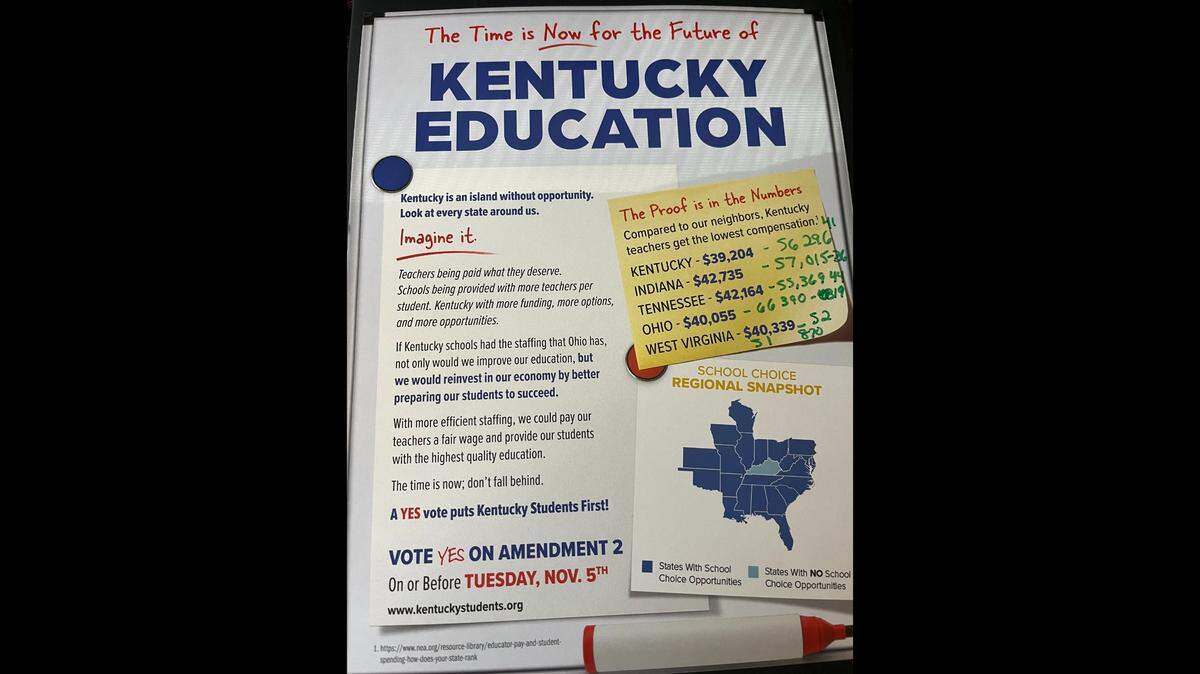
Lexington got blanketed this week with yet another mailer on Amendment 2, the ballot measure that would change the state Constitution to allow public school funding to go to private schools.
But you’d never know it was about that: Once again, advocates are touting the lie that Amendment 2 would increase teacher pay and funding for public schools.
This one also focuses on teacher staffing: “If Kentucky schools had the staffing that Ohio has, not only would we improve our education, but we would reinvest in our economy by better preparing our students to succeed. With more efficient staffing, we could pay our teachers a fair wage and provide our students with the highest quality education.”
These claims are misleading and confusing.
▪ Amendment 2 does nothing but change the language of the Kentucky Constitution to take away the guardrails put there in 1891 to guard public school funding. If it passes, the General Assembly will have to design a school choice plan, which could range from charter schools to education savings accounts to universal vouchers. If legislators wanted to, they could raise teacher pay and school funding right now without Amendment 2.
▪ The claims about teacher pay going up in states with school choice are based on economic theories about competition. Yes, in highly urban districts with lots of private schools it’s possible teacher pay could go up if droves of public school teachers suddenly left for private schools. But in 61 percent of Kentucky’s 171 public school districts, there are no private schools.
▪ The mailer says that Kentucky teachers get the “lowest compensation” compared to Indiana, Tennessee, Ohio, and West Virginia. But the mailer used the average starting salaries according to the NEA national database, not the actual average salaries.
According to that metric, Kentucky pays more than Tennessee and West Virginia. Average teacher pay in Kentucky is $56,296, ranking it 41st in the country.
Ohio has a robust school choice program with charter schools and universal vouchers, which everyone can get vouchers for public school regardless of income. That’s now costing about $2 billion a year, and the percentage of the state budget going to public schools has been cut from about 40 percent in 1975 to 20 percent in 2024.
In Ohio, as in other states with school choice program, the majority of vouchers go to families who already attend private school. In most cases, vouchers send tuition up. Also in Ohio, a group of 100 school districts have sued over the voucher program, claiming the depletion of public school funds is unconstitutional.
▪ It’s unclear what “more efficient staffing means.” In Kentucky, teacher staffing is based on student attendance. If there are fewer students, there will be fewer teachers.
Tom Shelton, the chairman of the Council for Better Education in Kentucky, said that school choice advocates used to tout choice on its aid to low-income students. But with universal vouchers, that argument has weakened, leaving them to try the teacher pay gambit.
“Now, school choice is not creating more choice, it’s funding the choice that’s already there,” Shelton said.
This mailer is at least the second one sent by Kentucky Students First, a nonprofit chaired by the EdChoice Kentucky, the largest school choice advocacy group. One of the biggest donors to Kentucky Students First is the Kentucky Education Freedom Fund, Inc., a new dark money 501(c)(4) nonprofit organization that will not have to reveal its donors to the IRS. It’s chaired by the CEO of EdChoice Kentucky.
In American politics, “dark money” describes political spending meant to influence the decision of voters where the donor is not disclosed and the source of the money is not identified.
On Wednesday, Louisville Public Media’s Joe Sonka reported that school choice advocates have spent at least $4.5 million on Amendment 2, compared to Protect Our Schools Kentucky, which reported spending $2.6 million.
This story was originally published October 11, 2024 at 9:44 AM.