KY voters want to improve public schools. Here’s one great way lawmakers could do so | Opinion
On Nov. 5, Kentucky voters decisively rejected the Kentucky General Assembly’s GOP supermajority’s idea to allow public school funding to go to private schools, an idea more gently referred to as “school choice.”
The 30-point loss of Amendment 2 — which would have rewritten Kentucky’s Constitution in seven places to allow the funding swap— made it clear that Kentuckians cherish their public schools and want to improve rather than desert them.
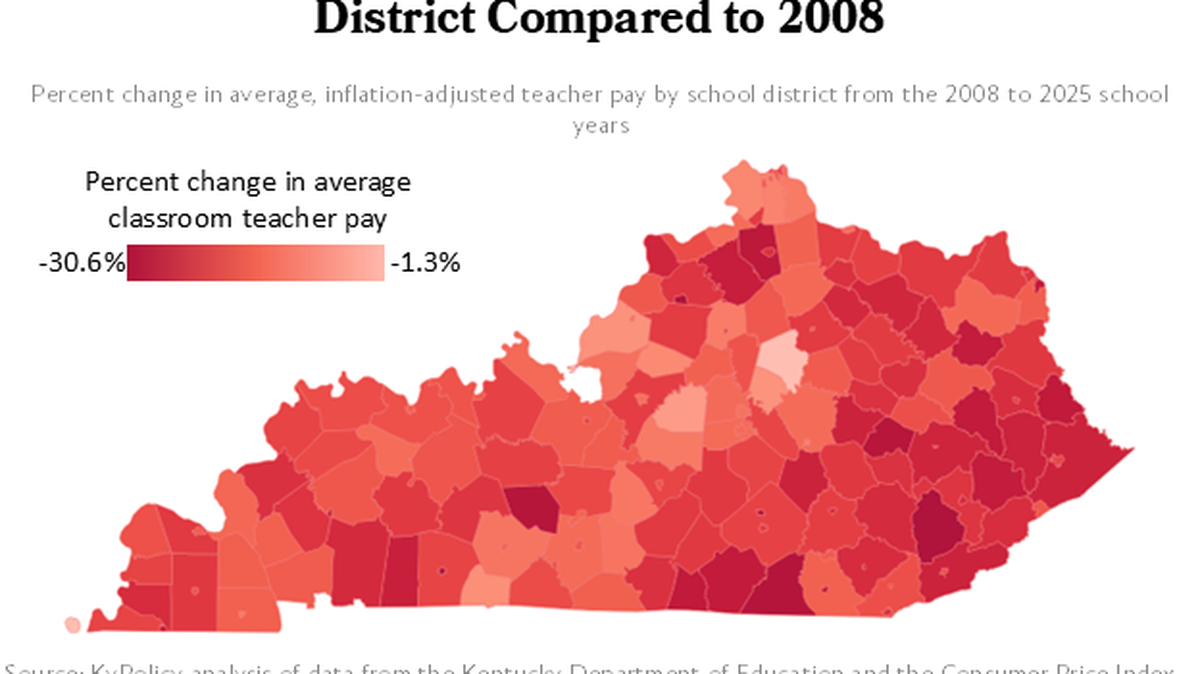
There are many,many ways the General Assembly could do this, and this week, the Kentucky Center for Economic Policy showed yet another: Teacher pay. In a new analysis, they found that teacher pay, as adjusted for inflation, in Kentucky has fallen 20 percent since 2008, leaving the commonwealth to fall to 41st in the national ranking for this measure.
This has happened despite an increase from the legislature that led to a 1.6 percent bump statewide. It’s just not enough to combat the overall decline in funding. Statewide, average teacher pay rose an inflation-adjusted $908 this year.
In recent years, the legislature has upped overall teacher funding, leaving it to local districts to find money for raises. But that can mean the increase goes to different, more urgent needs.
As the report notes: “Years of stagnant funding means that base SEEK (the core funding formula for public education) will be an inflation-adjusted 26% less in 2025 than it was in 2008.”
Report author Dustin Pugel, policy director for the center, said underfunding and inflation have combined to hurt districts.
‘The picture doesn’t appear to be getting better,” Pugel said. “If you really want to support public education, you can return funding to pre-2008 levels, you can provide dedicate funding for teacher raises.”
One thing stopping this, however, is the current legislature’s obsession with cutting the income tax to zero. This session, they would like to cut the rate from 4 percent to 3.5 percent, which would cost the general fund $650 million.
“That would be more than enough to provide substantial teacher raises,” Pugel said.
(To be fair, the underfunding started when Democrats still held the House and the governor’s office, so it’s been a true bipartisan effort.)
Shorting teachers means a teacher shortage, as has been amply demonstrated by numerous groups, including the legislature’s Office of Education Accountability, which presented its findings to lawmakers last November. Kentucky is down about 600 teachers in the past two years alone because more teachers are leaving classrooms and fewer are electing to join.
Recruitment and retention, especially in rural areas, makes it hard to find people to teach all the classes we want our children to have.
“Teacher compensation is something we’ve advocated for years, and this report clearly shows a clack of investment by the state in those important and highly critical positions,” said Eddie Campbell, president of the Kentucky Education Association. “We know we have an educator shortage right now, one of the reasons is that compensation for educators is falling further and further behind. It’s harder to recruit new educators into the field.
“The legislature has a grand opportunity to say let’s invest in our educators, and continue to move that minimum salary schedule forward,” Campbell said.
Pugel said wealthier districts, such as Fayette, have been able to do better in keeping up with teacher pay to make it competitive. But the whole point of the Kentucky Education Reform Act was to make sure poorer districts weren’t harmed by weak tax bases.
Underpaying teachers is just another consequence.
This story was originally published January 7, 2025 at 12:26 PM.