Final FCPS budget vote is Monday. Board must fix what ails district finances | Opinion
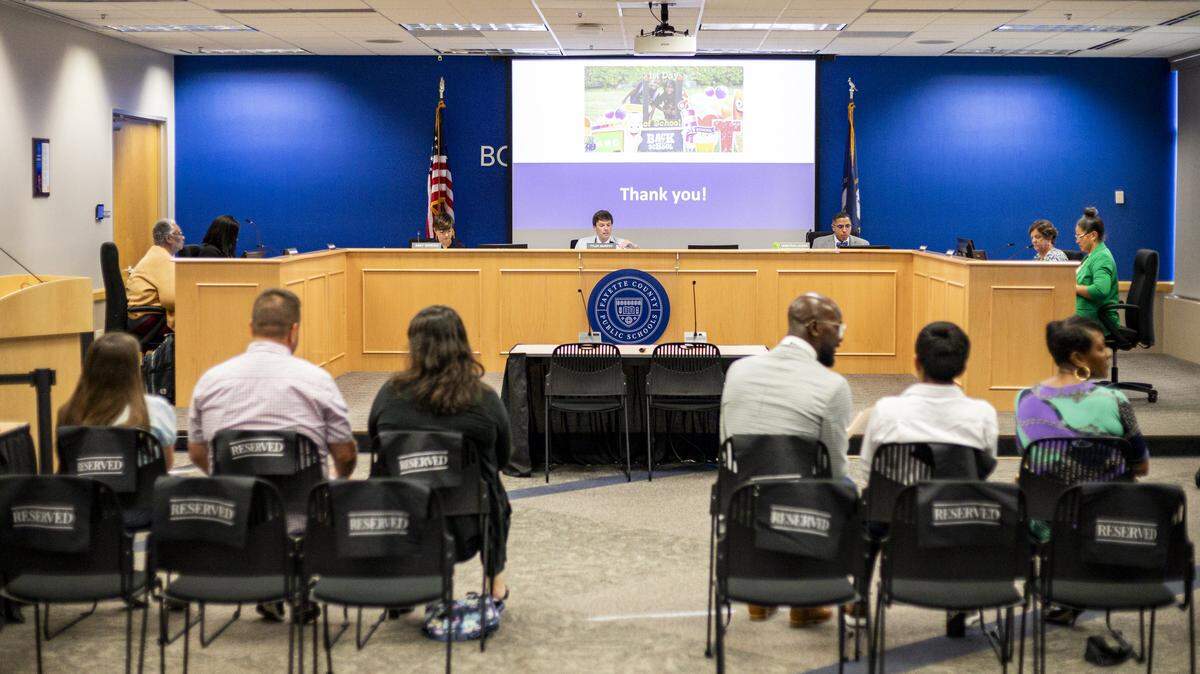
On Monday night, the Fayette County Board of Education will vote on the final version of next year’s $800 million budget, ending what has been a disastrous summer of obfuscation and denial over where the money for our public schools has been spent.
These shenanigans have resulted in a whistleblower complaint now being investigated by an Ashland lawyer and a special investigation by the state auditor. None of those things will be resolved before the school board has to approve next year’s budget.
So I asked a source I’ve known since I moved to Kentucky in 1997 — Calvin “Dee” Cranfill, a certified public accountant who spent 10 years working as a contract investigator for the Office of Education Accountability — about what needs to happen next. The agency was created by the legislature as part of the Kentucky Education Reform Act to make sure all the bad habits — nepotism, cheating, financial irregularities — remained gone after passage of the law.
As Cranfill wrote in a Sept. 10 OpEd, FCPS spent about $95 million more than they budgeted in the past two years. We are only now understanding how this happened because it’s clear district officials hoped to avoid the topic of overspending by passing a payroll tax. (Thankfully, it was stopped by Attorney General Russell Coleman.)
Cranfill said that while the budget that every school district has to pass by the end of September can have some discrepancies between what’s planned and what’s actually spent, missing it by $36 million in 2023-2024 and $59 million in 2024-25 is inexcusable. Although it does help explain why the contingency fund appears to have disappeared.
There are 11 major line items in the budget, and last year, the district overspent what it budgeted in all 11 of them.
And now, the district has presented its final budget for 2025-2026, and Cranfill says the board majority better be asking some tougher questions than they have to date.
For example, in 24-25, the budget allowed about $394 million for “instruction,” the largest line item in the budget. They spent $23 million more than that.
But the budget that the Board is being asked to approve on Monday includes costs for “instruction” totaling $ 404.5 million, several million dollars less than $417 million spent last year.
“So they’re going to budget less in instruction than they spent last year,” Cranfill said. “What are the details? What are they cutting to achieve that?
These are really complex issues the board is expected to understand.
Cranfill said that if he were putting himself in the shoes of a board member, he’d need help understanding the document. “This is an $800 million entity, and I need help as a board member that I have not gotten,” Cranfill said. “I have clearly been provided information that wasn’t accurate. Board members have a right to have information be given to them that’s accurate.”
The district has blamed a lot of its financial woes on inflation, which is predicted to get worse, especially for things like facilities. In 2024-25, the district spent $7 million more than budgeted on plant operations and facilities. But next year, they say they will spend $3 million less than they actually spent. How, exactly, will they do that?
Or take business support services, a broad umbrella that includes big departments like purchasing, accounting, and human resources. For that line item, they budgeted $34 million, and spent $45.7 million. They spent $11 million more than they budgeted, but next year, they’ve budgeted $39 million. It’s a worthy goal, but again, how exactly will they achieve that?
These are important questions because they affect the quality of education for our kids. They’re also important because if the district can’t get to a 2% contingency fund, it could be subject to a state takeover. As bad as things seem right now, no one wants that.
The school board majority — the three members who appear to believe the district, no matter what they say — can be tougher and do better.
“If I’m a school board member, every single month going forward, I want a comparison of what was budgeted to actual spending,” Cranfill said. “A budget is a monitoring document, so you make sure you are ok as you go, and you don’t get down to the end of the year and say we have to have a tax increase because we missed the budget.”
Here are some other unanswered questions from the public and school board members Monica Mundy and Amanda Ferguson:
The school district appears to have gotten caught by the end of the COVID-19 money known as ESSER. How many of those non-recurring federal funds were used for staff positions, especially at central office, and then blended into the general fund?
Where is the list of all employees, along with their salaries and positions, specifically requested by Mundy? The Herald-Leader made a similar request that was turned down under the state Open Records Law, but surely that should be provided to a school board member who requests it?
How did the contingency fund get spent down, and who authorized it?
Maybe this whole summer from hell will have persuaded board members not named Mundy or Ferguson that the best way to support the district is to make sure the budgets make sense.
It’s clear there’s been an overspending problem, and while Monday night’s meeting is not a lot of time, we at least need to know a lot more details about how the district is planning to move forward, especially with less money.
From the board’s perspective, Cranfill noted, “if you can’t tell us exactly how you are decreasing last year’s expenses into this year, then it’s just another fictional budget you’re putting in front of us to vote on.”