Frankfort to Fayette school board: You FAFOed, now you could lose your seats | Opinion
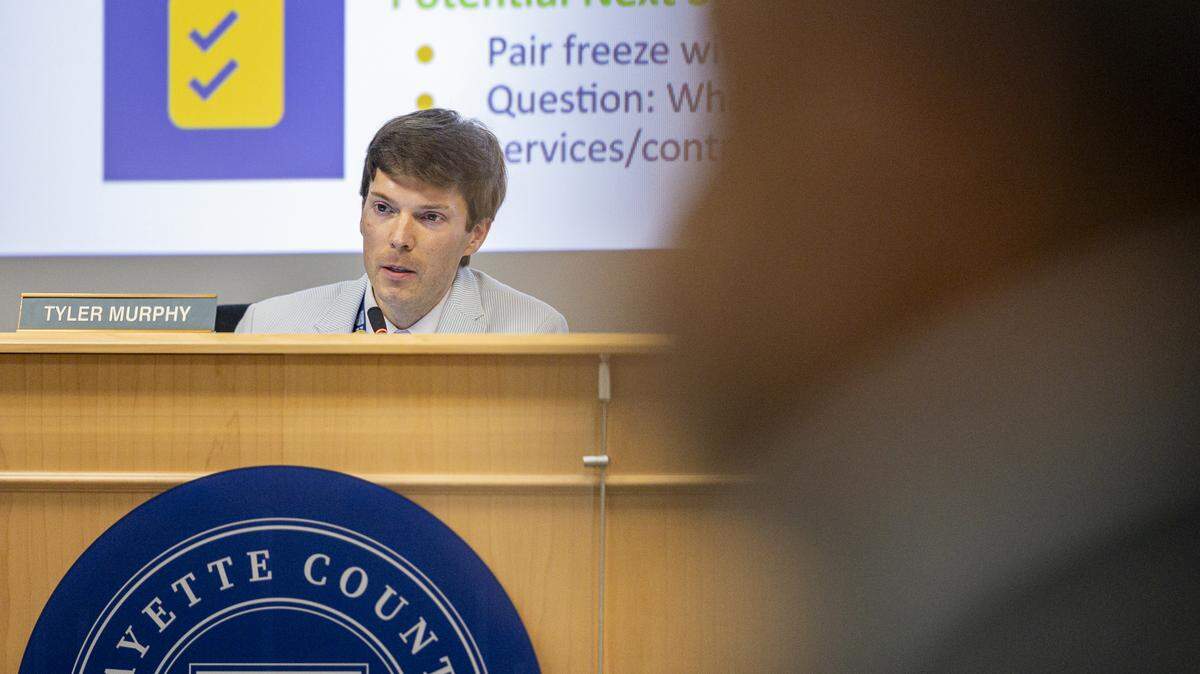
After the FCPS summer from hell, we all knew there would be, um, some corrections from the GOP supermajority in Frankfort.
The first two weeks of the General Assembly, there were a few of them: Sen. Amanda Bledsoe’s measure to clarify who can pass a payroll tax when (hint, not in secret to solve budget problems), and a couple of Senate high-priority proposals to make school finances more transparent (much-needed), and one about oversight of Jefferson County Schools.
So far, so good. Then, late Thursday, Sen. David Givens, R-Greensburg, dropped Senate Bill 114, not a high-priority bill but one that will throw thunderbolts at Lexington and Louisville anyway. If it passes, both school districts would lose their elected school boards
At first, I thought it was a joke or a warning. But Givens is a serious, thoughtful legislator more interested in policy than culture wars, who quickly made it clear he was not fooling around.
“The recent budget shortfalls, leadership challenges and poor academic performance of our state’s two largest districts magnified the need to change the school board in Jefferson and Fayette from elected to appointed,” Givens said.
Fair enough. The only thing we can thank FCPS for is creating enough mayhem to bring every political persuasion into unity that it must stop.
In particular, what works about SB 114 is the idea of adding more members to the school board. In Lexington, the five-member board has allowed a permanent three-person majority to construct a protective wall around the superintendent and administration, which has silenced debate and allowed too many problems to run unchecked. More members would break that up, allow diversity of opinion that brings more voices and more representation to running our local schools.
Some dangerous changes
But in the end, I wish Givens could have written a bill that just got rid of THIS school board in Lexington, rather than punishing all of us at the same time and creating a less democratic system.
One of the reasons we know about the FCPS problems, and one of the reasons they became so high-profile is because of outraged parents who kept these issues at the forefront of public discourse. Now, they would have no voice in school board elections. Only their council members would. Which would bring its own complications to city council elections.
But my argument didn’t cut much ice with Givens.
“The voters’ voice will be heard clearly through the mayor and the city council,” he said. “This grants these elected leaders the much-needed opportunity to construct a board with the skill sets to run a multi-million dollar organization.”
As he pointed out, state Board of Education members are appointed by the governor and confirmed by the General Assembly.
But the reason board members listen at all to the public is because they are elected. Now they would be more like technocrats — better perhaps at understanding financial issues, but largely unbeholden to the people they’re serving.
Fayette parent Matthew Vied has been one of the most outspoken critics of the district, insisting on real accountability for what he calls “gross mismanagement” at the district.
“But I’m afraid taking the decision for representation on the school board out of the hands of voters is not a wise response to the current situation in Lexington,” he said. “Speaking of those voters, I would plead with them to pay closer attention to who is on the ballot for school board; the district budget is simply too large and the community impact too important for that vote to not be a thoughtful one.”
Vied also likes the idea of expanding board membership.
“Being held hostage by just three voting members who have seemingly turned a blind eye to the obvious problems facing the district has only deepened the level of distrust that exists in the community,” he said.
School board elections should not be partisan
In addition, the bill would require proportional political representation in the appointees. I don’t really understand this part either. For one thing, Lexington is a majority Democratic city. For another, not allowing partisan politics into school board or urban county council elections is a truly healthy part of our elected government here in Lexington.
Back in 2023, when then-Sen. Damon Thayer filed his truly atrocious bill to make all council and school board elections partisan so they wouldn’t get too “woke,” Lexington Mayor Linda Gorton called nonpartisan elections “one of the greatest gifts” the merged government charter provided in 1974.
“It has worked very well in Lexington; it really allows local legislators to talk with each other about any issue, it doesn’t matter what party they are, they don’t have to go to a caucus, they can just talk,” Gorton said.
Also, when that bill came up in 2023, the Kentucky School Boards Association cited a 1989 Kentucky Supreme Court opinion that states that “the fundamental mandate of the Constitution and Statutes of Kentucky is that there shall be equality and that all public schools shall be nonpartisan and nonsectarian.”
Gorton declined to comment on the bill, but Vice Mayor Dan Wu told me he would not want to oversee school board seats, especially not partisan ones.
“I don’t think mayors and councils should be the oversight body for schools boards,” he said. “It’s the voters and the state department of education.”
I hope Givens is open to discussion on this. I can’t speak for Jefferson County. But in the end, on the Fayette side, there are only a few people to blame for this kind of legislation: the arrogant, tone-deaf school board members who didn’t pay attention when money got tight, then enabled a ham-handed attempt to secretly pass a payroll tax, then doubled down with arrogant statements about public support for public education that they have now eradicated. Oh, and who can forget the measure to try to silence board members who disagreed with the majority?
If nothing else, we should keep school board elections just to have the satisfaction of throwing the bums out.
This story was originally published January 23, 2026 at 12:08 PM.