From car wash to catcher. Why a female scientist is playing pro baseball in Lexington.
Less than three months ago, Alexis Hopkins wasn’t an internationally known baseball player.
Instead, Jan. 28 was the last day she worked full-time at a car wash in Florida.
Hopkins, 23, graduated in May 2021 with a bachelor’s degree in biomedical engineering from Florida Tech, a degree earned on a full-tuition scholarship thanks to her standout academic achievements, yet she was unable to find a job and was “barely making ends meet.”
“I was having living situation issues and, you know, not to get too much into my personal life, but it was rough,” Hopkins told the Herald-Leader. “I won’t forget working at the car wash or doing what I had to do because I had a full-time job there, and then I had a full-time job at home taking care of an animal as well as looking for jobs.”
Fast forward to now, and Hopkins has a job in her desired field while also becoming a history-making woman in baseball.
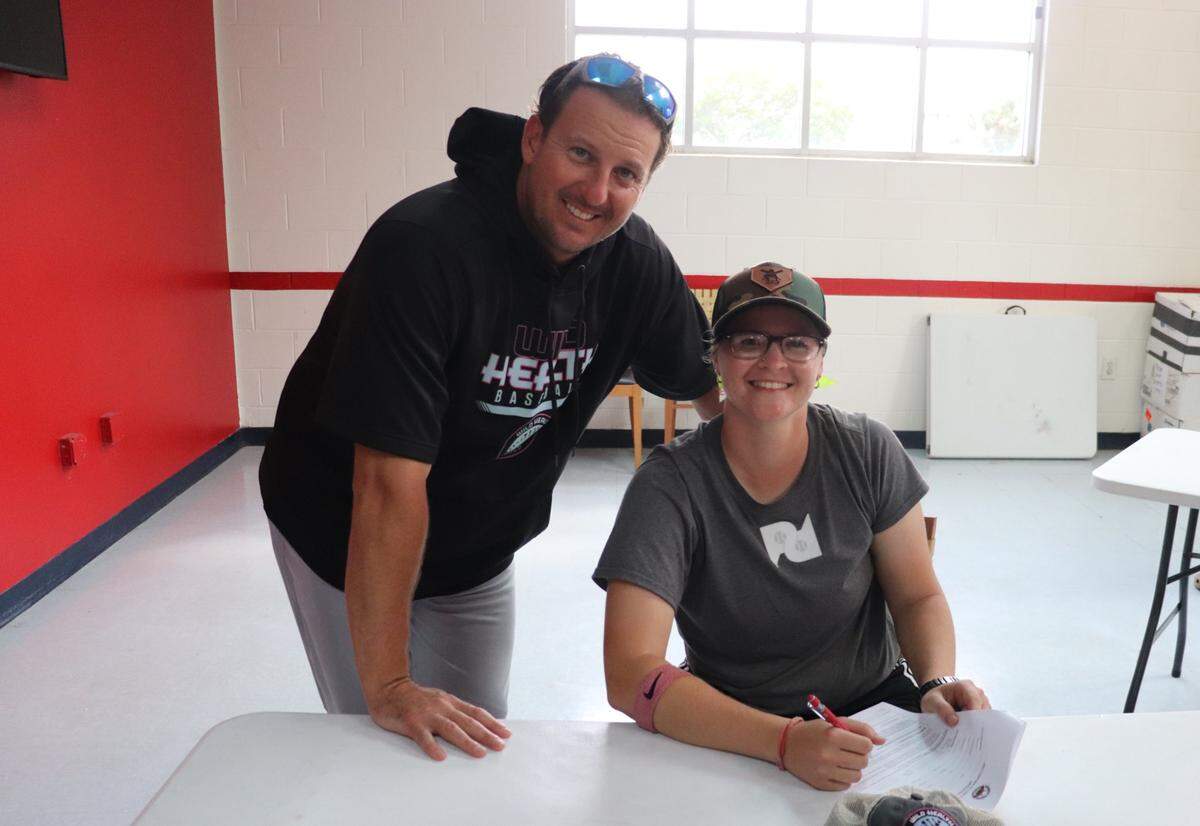
On March 23, the newly formed Kentucky Wild Health Genomes selected Hopkins, a catcher, with the eighth overall pick during the Atlantic League of Professional Baseball’s annual player draft.
According to the Genomes, Hopkins is believed to be the first female position player ever drafted by an American pro baseball team for an on-field role. She is also the first woman drafted in Atlantic League history.
Hopkins, who also goes by the nickname “Scrappy,” came to baseball late in life, but she now views the sport as essential to living itself.
“I would tell people ‘You’re going to have to drag me off the field kicking and screaming,’” Hopkins said. “I might as well be 6 feet under before I’m off of a diamond.”
From softball to baseball
Hopkins first became “Scrappy” on the soccer pitch.
She was playing the sport as a child when the father of another player asked if he could call her scrappy after watching Hopkins play. The nickname stuck and has followed Hopkins through different sports.
Hopkins began her diamond career with tee-ball, then quickly became the only girl on a youth all-star baseball team.
She switched to softball at age 7 and consistently played the sport for her travel team, West Florida Crush, and her high school, Fort Walton Beach, in the waterfront city of Fort Walton Beach in the Florida panhandle.
During each of her high school years, Hopkins also participated in the International Science and Engineering Fair.
Among her noteworthy projects was developing a disease breathalyzer that captured components of breath and a software algorithm to identify pathogens in the breath.
Projects like this one led to Hopkins receiving a full-tuition scholarship to Florida Tech, and she was a walk-on member of the softball team during her freshman year in 2016-17.
Hopkins played in seven games and recorded one hit that season, but she noticed her priorities skewed too far toward softball as her academics slipped.
So after stepping away from the team, Hopkins joined Florida Tech’s club baseball team.
“Florida Tech being a STEM (science, technology, engineering and mathematics) school is more so male dominated, so we didn’t have a softball club team,” Hopkins explained. “I could have made one if I found enough players, but I wanted to be on the baseball team, especially since all my friends were there.”
Hopkins made the team through tryouts and said she was “pretty terrible” her first two years.
“I went from being like a .500 hitter in softball to a zero hitter the first year and maybe I touched the ball the second year,” she explained. “I definitely had to learn a whole new world of softball to baseball.”
In addition to the Florida Tech club team, she also played for a men’s league team called the Purple Dragons.
“It’s just a sport that I fell in love with,” Hopkins said. “Especially when I thought my career was over when softball was done, and I kind of restarted that again with baseball now.”
Impressing the Genomes
When Hopkins made plans to take part in the two-day Atlantic League Professional Showcase in March in Melbourne, Florida, ahead of the league’s annual player draft, she did so without much expectation.
Hopkins’ fortunes had already begun to turn around, though.
On Feb. 7, Hopkins was hired as a software developer. Her day job is developing coding components in applications for the United States Department of Veterans Affairs.
She already accrued enough time off to participate in the Atlantic League showcase, essentially meaning she got paid to pursue her pro baseball dreams.
She showed up to the showcase with a bat she borrowed from a friend, a resistance band she borrowed from her gym and catching with a 5-year old softball mitt.
Hopkins replaced that mitt after the first day with a catcher’s glove that she also borrowed from her men’s league teammate. This was the first time Hopkins had caught with a baseball mitt.
Hopkins was asked during the showcase if she had experience catching pitches thrown at 90 miles per hour. Hopkins hadn’t previously caught anything close to 80 miles per hour.
But this mattered little, as Hopkins impressed the Atlantic League managers in attendance, including Mark Minicozzi of the Genomes.
Andy Shea, the CEO of Lexington-based Stands LLC, which oversees both of Lexington’s Atlantic League teams (the Genomes and Lexington Legends), said Minicozzi texted him about the potential of drafting Hopkins.
“Dude, she’s awesome. I’m telling you, man, she was the best one there,” the texts read.
Hopkins displayed her catching ability while handling pitches in the high 90s delivered to her by Hector Guance, the eventual first pick of the player draft.
“People attending our spring training will be more than how many roster spaces we have. Nothing is ever guaranteed,” Shea said. “But we have full expectations that especially in our league, when it benefits you to have three catchers under contract. I think she’s got a hell of a great shot to be here and do some really cool things.”
“I think I showed them a little bit about what ‘Scrappy’ can be,” Hopkins said. “I was super, super excited and especially more so after I found out they were the Genomes and I’m a biomedical engineer as well. I love the phrase ‘Baseball is in our DNA’ and for coach Lindsay Gardner and I, I love that they add ‘Baseball is in her DNA.’”
After the Genomes and Hopkins made baseball history with the draft selection, news of it went viral.
Hopkins did an interview for the Atlantic League’s social media channels and she recited a story from her time at Florida Tech.
The professor of her bioethics class was a philosopher, and Hopkins said he instructed members of her class to write down a dream of theirs. Hopkins thought about writing down “professional baseball player,” but didn’t because she never thought it could become reality.
“I’m realizing it still, how big this is,” Hopkins said of being drafted by the Genomes. “Especially being a woman, like, what are the chances? What are the odds? I don’t know, but I broke them.”
‘We are women and strong women at that’
Hopkins understands this is a watershed moment for women in sports and women in baseball.
In October, Hopkins watched the United States women’s national baseball team play in Cocoa, Florida. She also met Veronica Alvarez, the manager of the national team who works as a coach in the Oakland Athletics organization.
“It’s a proud moment that we are women and strong women at that,” Hopkins said. “But the fact that we’re able to do the sport that we love and get to play or coach or manage or be part of it, and it not be a factor because we are a woman, but because we are strong and we can be business women and professionals and baseball players.”
The Genomes published social media messaging aimed toward people who criticized the draft choice.
“It’s a challenge to diffuse ignorance . . . but it’s not something that even remotely concerns us,” Shea said.
Hopkins projects to be the bullpen catcher for the Genomes this summer, although Minicozzi has said Hopkins will have the opportunity to get at-bats this season.
She will also have to juggle her new job with the VA alongside her time with the team.
“Just as much as I need to write code for our vets, I also need to play baseball,” Hopkins said, noting how people like Shea have been understanding of the situation. “My company, which is Booz Allen Hamilton, they’re really excited to have me join the forces as well as be a baseball player.”
Hopkins’ selection by the Genomes means the new Atlantic League franchise has twice made history this offseason when it comes to hiring women in baseball.
In February, the Genomes hired Lindsay Gardner as the team’s hitting development coordinator, making Gardner the first female coach in Atlantic League history.
Shea says these examples, along with past actions by the Lexington Legends, have represented a commitment to do what is best for the organization and community.
“Our organization has won the female executive (of the year) multiple times. We were one of the first organizations in all of professional baseball to have a female play-by-play broadcaster. It’s not by accident,” Shea explained. “But it’s also by picking the best people, the best partnerships, the best relationships and really doing everything that we can to highlight it.”
This story was originally published April 8, 2022 at 7:57 AM.