Not much fun (other than hoops) in NCAA bubble, ‘but it’s a necessity’
Besides the excitement associated with seeking that “one shining moment” of ultimate success, what is Kentucky missing by not playing in this year’s NCAA Tournament?
Here’s a look at the living conditions in the “bubble” experience created to lessen the chances of coronavirus infection.
Teams are staying in four hotels in downtown Indianapolis. Each team’s traveling party has its own floor: one person to a room.
To help relieve boredom, the NCAA provided goody bags that included the late John Thompson’s autobiography, “I Came as a Shadow,” and a 500-piece puzzle.
The Indiana Sports Corporation provided toiletries, batteries, games of checkers, dominoes, Wiffle ball sets and met a request for 10 balloon bouquets.
“And maybe most interesting to me, someone ordered a ukulele,” said Dan Gavitt, the NCAA’s vice president for basketball.
Tennessee sophomore Josiah-Jordan James said at midweek that he planned to lead a yoga session via Facebook Live.
“I hope it has a good effect on their day …,” he said of the expected participants. “My teammates, I know they’re bored. I’m just hoping I can bring a little bit of laughter and feel-good energy for them.”
Teams were confined to their hotels until getting results of tests for COVID-19.
“We heard loud and clear from coaches that getting outside was really important,” Gavitt said.
One outlet is the nearby Indiana Convention Center, which contains nearly 600,000 square feet of exhibit hall space, 71 meeting rooms and three ballrooms. For the NCAA Tournament, a library and academic resource center were added.
The NCAA organized trips to a Topgolf arcade and the Indianapolis Zoo.
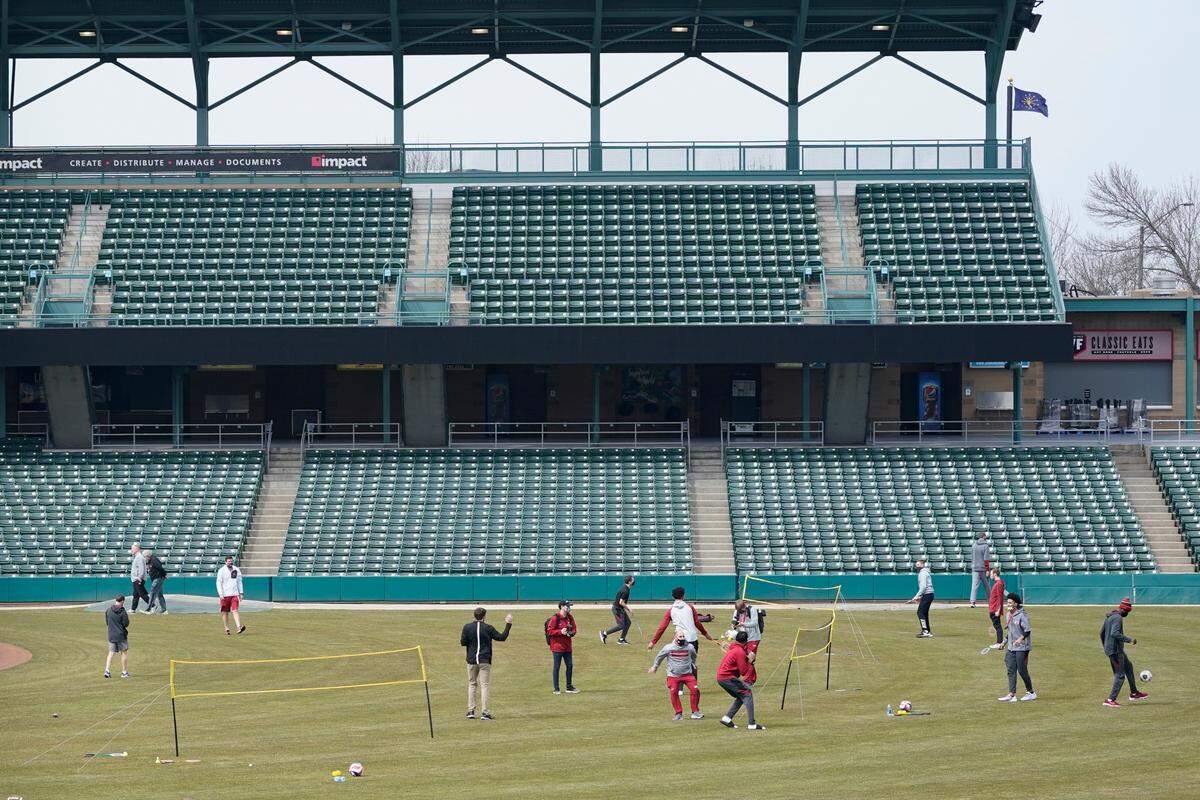
Victory Field, the ballpark for the Indianapolis Indians minor league team, is being used. Players are given footballs and soccer balls to use at the field. Badminton nets and cornhole games were set up.
Lowe’s (one of the NCAA Tournament’s corporate sponsors) provided washing machines and dryers. As of Thursday, there had been more than 2,500 loads washed and dried.
“I went old-school in my sink (and) used shampoo to wash my clothes that I worked out in,” Arkansas Coach Eric Musselman said.
“I’d love to say I was on the internet a lot. I know a lot of people know I like to tweet. If I’m not up to my normal Twitter game, it’s because the internet is very slow.”
Teams are required to use the hotel for two of their three meals each day.
From Sunday through Wednesday, 5,500 meals were served, said Gavitt, who added that corporate sponsors who helped with food included Wendy’s (1,500 hamburgers or chicken sandwiches), Buffalo Wild Wings (more than 19,000 wings over three days) and Pizza Hut (665 pizzas, 208 family pasta dinners and 4,365 breadsticks).
Of life in the “bubble,” Missouri Coach Cuonzo Martin said, “It’s not bad at all … You have a lot of time to get stuff done.”
Early in the week, Tennessee Coach Rick Barnes spoke of looking out hotel windows but not being permitted to go outside.
“The most important thing this time of year is mental …,” he said. “I think every team wishes we were playing tomorrow.”
LSU Coach Will Wade suggested games would bring relief in multiple ways.
“If we’re fortunate enough to advance, I’m sure things will loosen up a little bit,” he said. “As you dwindle teams, you have more area for movement.”
Former UK and Louisville coach Rick Pitino, who led Iona into this year’s NCAA Tournament, offered perspective on the “bubble” experience.
“The ‘bubble’ is not a lot of fun,” he said. “But it’s a necessity.”
Through Wednesday, more than 9,100 tests for coronavirus were administered, Gavitt said. There were eight positives.
One location better?
CBS broadcaster Jim Nantz suggested that the future of the NCAA Tournament might be on display as it’s played at various locations in or within driving distance of Indianapolis.
“I think this might be a model or template for the NCAA Tournament down the road …,” Nantz said on a teleconference. “Like the Olympics.”
Nantz and another member of the television coverage, WNBA player Candace Parker, noted the benefit for teams and fan bases not to have to travel from site to site to site around the country.
Nantz said the Final Four sites the next three years — New Orleans, Houston and Phoenix — had enough nearby facilities to stage multiple games simultaneously.
The NCAA’s vice president for basketball, Dan Gavitt, did not nix Nantz’s suggestion.
“I need our staff to get through this one first before we can consider if it’s a good idea for any time in the future,” he said Thursday. “So, I wouldn’t dismiss it all together.”
Feather in cap
Going into Saturday’s NCAA Tournament game against Eastern Washington, Kansas had 2,322 victories in the history of its men’s basketball program. Kentucky has 2,327 victories.
“I am aware we’ve narrowed the gap,” Kansas Coach Bill Self said the night of Selection Sunday. He said he was not aware of the exact margin.
“I think Kentucky has, rightfully so, used that as a recruiting tool for decades” Self said. “‘We’re the winningest program in the history of college basketball.’
“And, rightfully so, we’ve said we’re the second-winningest program in the history of college basketball. I don’t know if either one of those statements actually gets you players in today’s time.”
A claim to the most all-time victories can add interest in a program and infuse a fan base with pride, Self said.
To surpass Kentucky this year, Kansas would need to win six games in the NCAA Tournament, which would mean the national championship.
“If we were able to do that, then I would tell everybody in the world what was going on,” Self said with a smile. “But the reality of it is … I really don’t think something that happened in the 1930s really translates to how successful a program is now.
“But I do wish we had that feather in our cap. And I know Kentucky has been very proud that they had that feather in their cap for a long time. So, it’d be nice to catch them. … But a lot of work to do.”
‘It’s our time’
Kentucky had a losing record for the first time since 1988-89, and only the second time since 1926-27.
Kentucky lost three of its final four games in maddeningly familiar fashion: Being outplayed in the final minutes and losing by a single-digit margin.
Hence, John Calipari said on his radio show Monday that from the first day of practice heading into next season, he will order the clock set at three minutes and work on late-game execution.
“I want these kids believing (that with) three minutes to go, it’s our time,” the UK coach said. “This is our time. Not, like, oh my gosh.”
Condolences
To the family of Hall of Fame coach Bob Davis, who died last weekend in Georgetown at the age of 93.
Davis had a record of 70-61 as Auburn coach from 1973-74 through the 1977-78 season.
Prior to Auburn, Davis coached and taught at Georgetown College for 20 years. He had a record of 415-182 as Georgetown coach. His 1961 team advanced to the NAIA Tournament national championship game.
Davis was vice chairman of the U.S. Olympic Basketball Committee from 1964 to 1973. He also was head coach of the U.S. team in the 1970 World University Games. He was inducted into the Georgetown College Athletics Hall of Fame and NAIA Hall of Fame.
He was the father of the late Brad Davis, who was UK’s sports information director in the late 1980s.
Georgetown College is planning a celebration of Davis’ life and legacy in the near future. Details have not been finalized.
Happy birthday
To Skal Labissiere. He turned 25 on Thursday. … To Auburn Coach Bruce Pearl. He turned 61 on Thursday. … To Cory Sears. He turned 41 on Friday. … To Jerry Hale. He turned 68 on Saturday. … To Pat Riley. He turned 76 on Saturday. … To Jimmy Dan Conner. He turned 68 on Saturday. … To Darius Miller. He turns 31 on Sunday (today). … To Troy McKinley. He turns 58 on Sunday (today). … To Wayne Turner. He turns 45 on Monday. … To former UMass star Marcus Camby. He turns 47 on Monday. … To Zan Payne. He turns 21 on Tuesday. … To E.J. Floreal. He turns 28 on Tuesday. … To South Carolina Coach Frank Martin. He turns 55 on Tuesday.