Kentucky won’t get an elite NCAA Tournament seed. Could the Cats still play in Louisville?

READ MORE
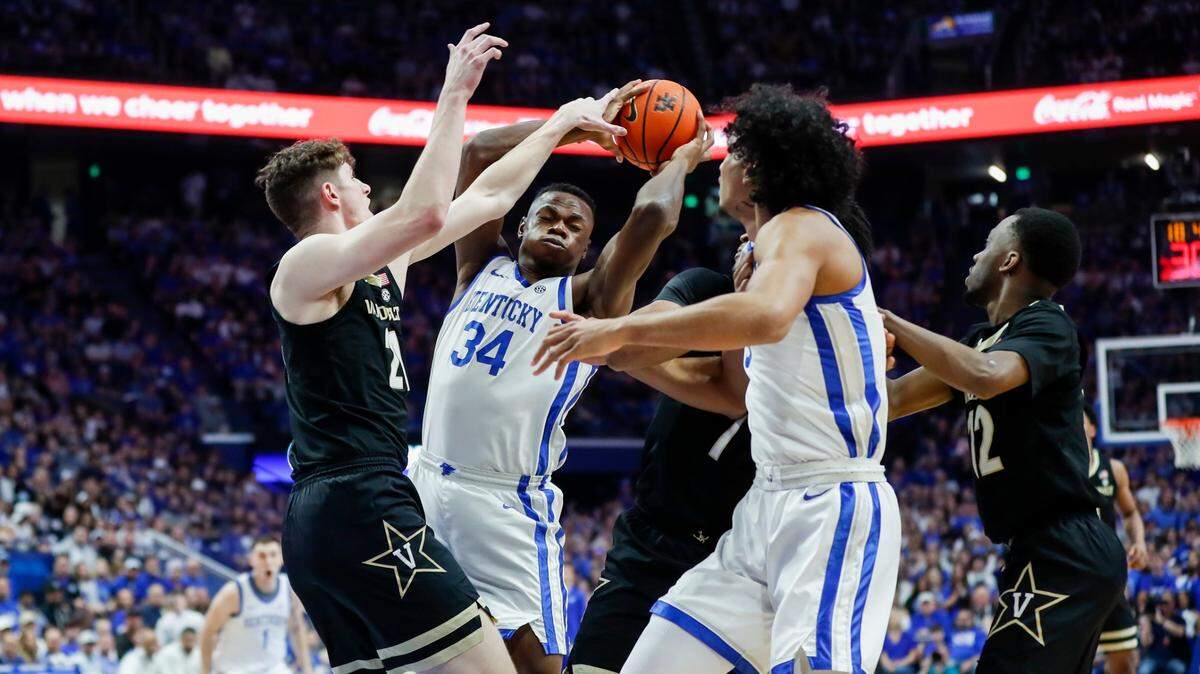
Game day: Vanderbilt 68, Kentucky 66
Click below for more of the Herald-Leader’s and Kentucky.com’s coverage of Wednesday’s men’s basketball game between Kentucky and Vanderbilt in Rupp Arena.
Expand All
Before this college basketball season began, the path for Kentucky was clear.
The Wildcats were the No. 4 team in the preseason AP Top 25 rankings and projected as a 1 seed in the 2023 NCAA Tournament. Live up to those expectations and get a dream route to the Final Four. The first week of March Madness in Columbus, less than a three-hour drive from Lexington. The second week of the tournament in Louisville, just 75 miles away. Win four games there — in front of what would surely be partisan blue-and-white crowds — and the Wildcats would be playing on the final weekend of the season for the first time in eight years.
Things fell apart fairly quickly. Losses piled up. Kentucky’s national standing plummeted. It wasn’t long before talk of a top seed turned to worry that the Cats wouldn’t be dancing at all. Even with a rally, that geographically pleasing path to the Final Four in Houston was surely out of the question, right?
Well, the Wildcats have indeed rallied. A spot in the NCAA Tournament field is as good as guaranteed. And maybe they’ll be staying close to home, after all?
The Bracketville projection to start this final week of the regular season had Kentucky as a 6 seed. First stop: Columbus. Second stop: Louisville.
Dave Ommen, who launched the Bracketville website nearly 15 years ago and has been regarded as one of the nation’s most-accurate bracketologists, explained how such a fortuitous path could be waiting for such a relatively low seed on Selection Sunday.
It starts at the top, where the first 16 teams — the 1-4 seed lines — are placed into the bracket, in order of geographical preference and taking the NCAA’s “bracketing principles” into account. (Keeping top teams from the same league separated, etc.) The selection committee then ensures that each of the four regions are as balanced as possible. (Making sure the top 1 seed, top 2 seed and top 3 seed aren’t in the same region, for example.) Once that’s finished, the committee fills in the bracket with the remaining teams, starting with the 5 seeds, then the 6s, and so on.
“They’re not as concerned with balancing the regions at that point,” Ommen said. “It’s about: where best are they going to fit?”
The best way to explain this exercise is to simply use Ommen’s projected seed list to start the week. He had Iowa State as the top-ranked 6 seed. The Cyclones would have to be paired in the same first-week tournament site as a 3 seed to make the bracket work, and — according to the NCAA’s bracketing principles — they should go to the closest possible first-round site.
In this case, the 3 seeds in Ommen’s bracket were positioned in Columbus (Marquette), Sacramento (Arizona), Greensboro (Tennessee) and Greensboro again (Indiana).
Columbus would be closest for Iowa State, but that would put them on the same side of the Louisville regional as fellow Big 12 member Baylor (a 2 seed). Technically, that’s allowed under the NCAA’s principles, but past committees have also tried to avoid such early league matchups, if possible, Ommen said. And it’s possible in this case: send Iowa State to Greensboro, where the Big Ten’s Indiana is the 3 seed, with the Pac-12’s UCLA as the 2 seed.
Then it would be Kentucky’s turn. The Cats couldn’t go to the other Greensboro pod, where league rival Tennessee would be the second-round matchup. So it’s Columbus or Sacramento. And Columbus would be closer anyway, so the Cats ended up there in Ommen’s projection.
And that pod — where Marquette is the 3 seed — just happens to be part of the Louisville regional.
Lucky Kentucky.
“The bracketing rules come first. And then, after that, the pod location,” Ommen said. “So, in this case, it worked out perfectly that Kentucky was in both Columbus and Louisville.”
That might seem unfair to anyone who’s not a UK fan. And surely Baylor backers would complain if their 2-seeded Bears had to play the Wildcats in Kentucky in a Sweet 16 game.
But, in this case, them’s the rules. And though the rules do try to avoid potential early matchups involving well-regarded teams from the same conference, those rules don’t attempt to safeguard “better” seeds from every potential geographical disadvantage.
For instance, a 6-seeded Kentucky team is not expected to make it past 3-seeded Marquette to even get to that Louisville regional.
“At that point, they’re more concerned about the pod location than the region,” Ommen said. “Because they don’t assume you’re going to win. … One thing the committee does not do — they do not project.”
Realistically, they can’t project in cases like this.
“Because otherwise you get into this all over the place,” Ommen said.
In other words, the ripple of moving one team to avoid a potential geographical advantage beyond the first week of the tournament would open up other similar cases in a never-ending cycle of bracket management.
The committee has typically been OK with such matchups. When 5-seeded Houston beat 1-seeded Arizona last season, that Sweet 16 game was played in San Antonio. When 7-seeded South Carolina beat 2-seeded Duke on its way to the 2017 Final Four, the Gamecocks got to play the Blue Devils in Greenville, S.C. Those are just a couple of recent examples.
The bottom line here: this dream route for Kentucky is one mock bracket based on an NCAA Tournament projection through the games of Feb. 26. Things will change. Teams above and below UK in those projections will win and lose, and those results will have a trickle-down effect on the Wildcats’ seeding and the bracket as a whole.
“So if you were asking me today, I would say that Kentucky’s status as far as where they might end up is very much in the air,” Ommen said.
But this is also one mock bracket that shows it’s still possible — within the NCAA’s rules — for UK to be slotted into a Columbus-Louisville track to the Final Four.
And that would be quite a path for the Wildcats.
This story was originally published March 1, 2023 at 6:30 AM.