Mark Pope wants to be the ‘CLO’ of Kentucky basketball. What does that mean to him?
At a luncheon for community leaders in Louisville over the summer, Mark Pope sat on stage in one of his first major speaking engagements as the new University of Kentucky men’s basketball coach and talked about the evolution of his own leadership style.
The co-headliner of the event was Pat Kelsey — the new U of L men’s basketball coach — and the two future rivals listened intently as the other spoke, sharing the philosophies that helped bring them to this point in their careers.
Toward the beginning of the talk — still months away from his first game as Kentucky’s head coach — Pope was asked about the fundamentals of great leadership.
“When you step into these shoes, when you step into any leadership role — there’s immense pressure to try to be something else,” he said. “But being authentic is the best leadership strategy of all.”
To set up his larger point, Pope joked that it was “super dangerous” to invite he and Kelsey — both coaches known for their enthusiasm — to a lunchtime speaking event, quipping that the two of them might carry on until 7 p.m.
“One thing we can do is we can talk, right? But I think about this,” he continued, his voice shifting to a more serious tone. “I think about the C suite all the time. CEO and CMO and CFO and CIO. And really, I think the best leaders are CLOs — chief listening officers. I think that is a skill that is becoming increasingly lost in our leadership portfolios, and I think it’s tragic. Because I think the only way that we can lead is by listening.
“In my particular case, it’s really important that I listen to my staff. If I’m up all the time — just barking out orders all the time — I’m missing out on the potential that we have to grow and the great ideas that are floating around the room, and the synergy that can happen on a staff. And if I spend all my time telling my players what to do, I can actually have no idea how to tell them what to do.”
As Pope conveyed this thought, many in the crowd of nearly 1,500 attendees nodded along with him. Up on the stage, Kelsey clearly took it in, as well. When it was his turn to speak, the Louisville coach postponed his reply to the next question in order to return to Pope’s point first.
“You come to something like this to learn, right?” Kelsey said. “I’ll go and take back to my staff: CLO. I have a title as Head Basketball Coach, but I’m gonna talk to them about the chief listening officer. Mark said it exactly right. … He said ‘CLO’ — I am one of those now.”
Pope finds his philosophy
Kentucky’s new leader hasn’t always been the cool, calm, collected coach that he’s often portrayed as nowadays.
Mark Fox — an associate coach on Pope’s first UK staff — gave him his first job in the profession 15 years ago at Georgia, bringing him on as a member of the Bulldogs’ support staff.
Fox has described Pope as an eager and willing young coach, obviously bright — he dropped out of medical school to go all-in on this pursuit instead — but he said he sat him down early in that first season and basically told him that he couldn’t get ahead of himself. If he wanted to have a long, successful coaching career, he’d need to learn the profession from the ground up.
“No job was too small” for Pope, according to Fox, and the aspiring coach became a full assistant at Wake Forest the next season and spent four years as an assistant at BYU after that.
To illustrate how far he’s come, Pope told a story of an Argentinian player — Agustin Ambrosino — from his days as a BYU assistant.
Pope — now known as an offensive innovator — was in charge of the defense for the Cougars back then. They had a pretty simple set called a “right angle zone” with a hand signal that involved putting up all 10 fingers and making right angles out of the thumbs and index fingers.
They were halfway through the season — “So we’ve been doing this for a long time,” Pope stresses — and BYU had just made a free throw, prompting Pope to frantically call out for the right angle zone.
“Auggie! Auggie! Right here! Right here!” he yelled to the 6-8 forward while reenacting the 10-finger hand signal.
Pope then recalled his player’s reaction, adopting his best, laid-back Argentinian accent: “Coach, I knowww. I knowww. Calm down.”
Pope paused for the punchline. “And so he ran back into a man-to-man defense.”
Three plays later, there was a timeout and Pope rushed off the bench.
“Auggie, this right here!” he said, emphatically flashing the hand signal. “This is zone! We’ve been going over this for three months.”
“Ohhh, I understand,” Auggie responded.
Three plays after the timeout, Pope called for the right angle zone again.
“And Auggie starts running back on the court on defense,” he says. “And he’s like, ‘Ten! Ten! Guys, we’re in ten!”
Pope comically looks at his fingers.
“It’s not ten,” he deadpans. “It’s right angles.”
In a wide-ranging preseason interview with the Herald-Leader, the new UK coach went deeper into the evolution of his leadership style, one that’s based more on observation and less on barking orders.
Pope — a national champion and team captain at Kentucky who spent six years playing in the NBA — was an assistant coach for six college seasons before getting the top job at Utah Valley in 2015, and he’s continued to find ways to grow as a communicator throughout his career.
“As an assistant coach, you’re doing a lot. Doing, doing, doing, doing,” Pope says. “If you’re a good head coach, you spend more time thinking and observing and listening, because you have to guide the ship. For me, at least, that’s a distinguishing thing. And it’s not the way we’ve always coached. I think coaching was different before. And the greatest coaches that ever lived maybe coached different ways.
“But the way that I coach now is really important. It’s kind of observing, listening, and understanding, so that I can coach a player.”
Letting his players be leaders
Pope can still be fiery on the sidelines, but you’re not likely to see the 52-year-old storm onto the court at the beginning of timeouts to shout instructions at his Kentucky players very often.
Such behavior would be in contrast to one of his underlying coaching principles.
Relatively early in UK’s offseason practices, word started spreading of a different approach that Pope brought to the program. When a player made a mistake — or a couple of Cats were involved in some type of miscommunication — Pope might stop the practice, but he wouldn’t jump in immediately to correct the issue.
Instead, he’d have the players themselves explain what went wrong. If they didn’t know — or they couldn’t agree — they’d go off to the side to talk it out until the correct conclusion was reached.
On a team with 12 new scholarship players, it led to the Cats coming together fairly quickly as communicators.
“He’s still going to keep the standard at the highest level. We’ve never had an issue with our guys playing hard,” explained assistant coach Mikhail McLean, noting the difference between poor effort and poor execution. “These guys, from day one, they came in and they’ve been busting their butt, and they’re getting after it. So if that standard is not at the championship standard that we’re going for? Like, boom! He’s gonna correct that right away. That’s different, right?
“But if a guy makes a turnover, most coaches are like, ‘Get on the line, run a sprint.’ Our guys are still going to run a sprint, but our players are telling them, ‘Hey, you turned it over. You need to go run a sprint.’ But before they address that, they’re like, ‘Hey, this is what you did wrong. This is how you correct it.’ And now they know, ‘OK, I’m gonna go get my sprint in on the side.’ So that’s different. … It’s very empowering. And it gives them a voice.”
Expect to see that empowerment in games as the season progresses.
Fellow UK assistant coach Jason Hart was a teammate of Pope’s with the Milwaukee Bucks during his rookie season and ultimately spent a decade playing in the NBA before becoming a college assistant. Most recently, he was the head coach of the NBA’s G League Ignite program, which developed high-level draft picks every year during his tenure.
Hart nodded along to the description of Pope’s “CLO” definition.
“He’s true to that, too,” Hart said. “We’re learning as coaches, as well. We’re always growing. But let the players talk and figure it out, because normally they have the answers, and at the end of the day, they’re on the court. We as coaches, we’ll get blamed for losses, but they have to understand that they’re on the court. And that’s more like the NBA-type mindset.”
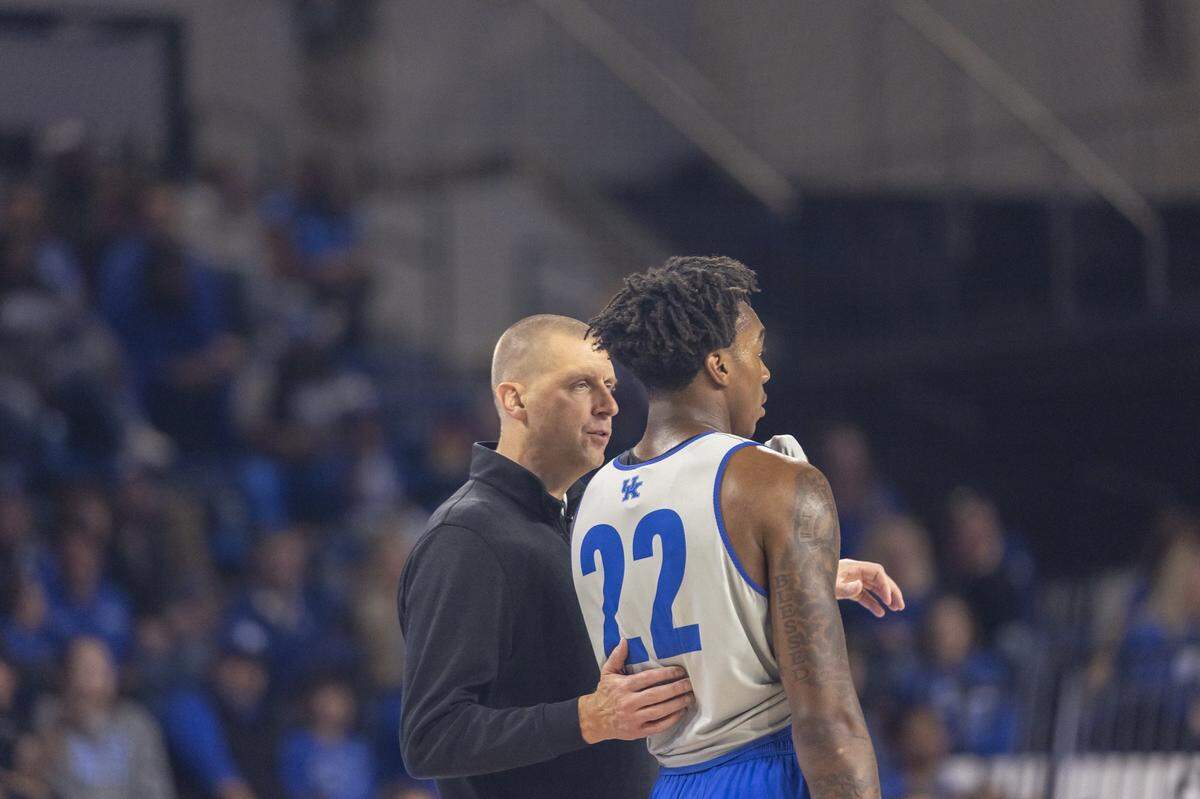
Hart and McLean both revealed — in separate interviews — that Pope wants his players to communicate on the court during game action, but he’s also extending that responsibility to the breaks. When the Wildcats come to the sideline for a timeout, the rule — according to both coaches — is that the players themselves will talk things out, and members of the staff will step in only after the players have had that opportunity.
It’s not a common approach in college.
“If you’re coaching LeBron (James) — he makes $60 million a year — what are you really going to tell him?” Hart said. “What are you gonna tell Steph Curry? ‘Sit down. What the f you doing?’ No, it doesn’t work like that. That’s why college coaches stay in college. And that’s why pro coaches stay (in the pros), because it’s more like — when you have that elite-level talent — it’s more like, ‘We’re doing this together.’
“So when Coach allows the players to talk, and they come up with what they did wrong — that can fix problems quicker that way. And I love that. … I think all coaches should do that.”
Learning from ‘The Squad’ at BYU
Not long after following Pope from BYU to Kentucky, the man who has worked with him the most over the past 10 years — assistant coach Cody Fueger — explained his style in a nutshell.
“He doesn’t want yes men,” said Fueger, who has been an assistant under Pope for all nine of his previous seasons as a head coach, explaining that his boss welcomes disagreement and wants to hear from everybody in the room.
One of the best examples of this open-mindedness was the formation of “The Squad” at BYU.
After attending an NBA academy a couple of years ago, Pope became intrigued with the use of psychology in basketball, to the point that he was not only willing, but eager, to let outsiders into his program.
Pope reached out to the Department of Psychology at BYU — where he coached from 2019 through last season — looking for some expert assistance with his team. He thought they might end up sending him one person, perhaps a graduate student. He drastically underestimated the interest.
Word spread throughout the department that the basketball coach wanted their help and was curious about a more forward-thinking approach to dealing with his players, and Pope was sent a proposal. The result was four faculty members who specialized in different areas of psychology — a health psychologist, a social psychologist, a neuropsychologist and a psychotherapist — joining the basketball support staff on a volunteer basis.
“And they became a massively integral part of our program — really, really important,” Pope said. “We had our clinical psychology people that were dealing with our players in emergency situations. Like real in-depth, you know, suicidal ideation, major depressive episode, all those things. And then we had what’s become more and more trendy now … which was like the elite-level sports psychology, that niche. And then we had these four guys occupying where you get the payoff (on the court) is helping people communicate. And listening is number one in that. So it was an incredible education for me over the last two years, for sure.”
Pope said “The Squad” was there for everything related to the team. The professors attended practices and film sessions. They observed huddles and were present in the halftime locker room. After games, Pope would meet with the psychologists — those conversations could go on for more than an hour — about what they observed, listening to feedback that he used to improve his team and better connect with his players, even switching up his own approaches midseason based on their advice.
He’s already incorporated some of this into his early UK tenure, with psychologists present during preseason practice sessions and likely to play an important role in the future of the program.
“They dedicated a massive amount of time,” Pope said. “And they’ve been a huge continuation of this idea of like, ‘OK, let me try and understand how communication is actually (processed).’ Not just me saying things and expecting the guys to understand it and hear it and get it the right way. But listening to the communication and listening to the feedback cues that you get from everyone. And listening, you know, not saying, ‘Hey, this is how it is. And you have to live up to this mode.’ But actually, like, ‘What is working best for you?”
“I mean, I could talk about this for days, but I think this listening is wildly important.”
Building something special at UK
Jaxson Robinson, the only Wildcat who has previously played for Pope, noticed something different in his early days at BYU.
Robinson began his college career at Texas A&M during the 2020-21 season, when strict COVID-19 precautions were still in place. He transferred to Arkansas after that and ended up with Pope at BYU the following year.
Early on, Pope called Robinson into his office. The young player thought he’d done something wrong. But Pope was just checking up on him, wanted to know how he was doing and reminded him that he could come talk to him about anything at any time. For Robinson, this was new, and it continued throughout his two seasons at BYU.
Two years later, the player showed just how close a bond he’d formed with Pope. When it came time to pull out of the NBA draft over the summer, Robinson — at that point one of the most coveted transfers in the country — didn’t give anyone else a chance. His announcement that he was withdrawing from the draft was simultaneous with one saying he would follow Pope to Kentucky.
His new teammates are already seeing this side of Pope.
“I think he’s one of the most genuine, loving people that I’ve ever been around,” said Andrew Carr, who previously played at Wake Forest and Delaware. “He cares so much and so deeply about things. And so I think that’s been great for us. We see how much he cares, and it’s infectious. That bleeds into us and how much we care and we love each other, love the staff. And it just creates such a great energy around the team.”
Otega Oweh, who spent the past two seasons at Oklahoma, said he had just been telling someone that the Pope he encountered as a recruit in the spring is the same head coach he’s seen in the five months since he’s been on campus.
“He has a whole entirely different approach,” Oweh said. “… The whole recruiting process, he was obviously a nice guy. He was just talking to me about different things — family, you know, just not all basketball stuff. But he’s been the same exact person ever since I’ve gotten here, and usually, like, you see a change. Obviously, coaches say what they want to get the recruit so they play a part. But, nah, he’s been the same person.”
Collin Chandler, who had been committed to play for Pope for more than two years before the coaching change led him to flip that pledge — becoming the first UK recruit of the Pope era, as a result — echoed Oweh’s observation.
“His passion doesn’t change. I mean, maybe your expectation for what a coach is going to be like when you’re getting recruited as to when you’re playing for him might be a little bit different, but he’s always had the same motives in making me better,” Chandler said. “Coach Pope is just a good person and wants to make people better basketball players and just experience the love of the game. And that’s what I’ve felt playing for him and being recruited by him — my love for the game grows, and my interest in the game of basketball grows. And I love that.”
Chandler said that — before he and his new teammates got to campus — Pope held a Zoom meeting with the entire squad. In that meeting, Pope made clear that he wanted to see players in the coaches’ offices, and whenever a player came to see him or one of his assistants, they would stop whatever they were doing and give that player their full attention.
“Because we come first on the priority list,” Chandler explained. “So when we walk in a coach’s office, everything kind of stops. And they’re there to talk to us, and all of the coaches are trying to get everybody in the offices to talk. And not just about basketball, but to grow a relationship.”
Once he gets them in the office, Pope is really there to listen.
“You can’t lead people if you don’t know people,” he says. “You can’t actually connect with people unless you know people. You can connect on a really surface level by giving them great information, and giving them information that they believe in, and giving them information that’s functional in their life. That’s actually a connection. But it’s super generic, right?”
Pope wants to find something deeper with his players, and he’s shown in the past he’s willing to go to great lengths — and try new approaches — to do so.
“I think about comedians all the time. I’m fascinated by comedians,” Pope says, promising this is going somewhere.
He recounted that standup comedian Nate Bargatze came by his office over the summer, and he attended his show in Rupp Arena that night. Pope marveled at the thought of a person who could command the attention of 20,000 people for 90 minutes with nothing more than a spotlight and their voice.
Being able to do something like that goes well beyond the ability to purely entertain.
Pope also reminded that his wife, Lee Anne, was a personal assistant to late-night comedy icon David Letterman for five years, and she observed that unique quality of understanding in him.
“I think comedians are probably some of the greatest listeners in the world, even though he just stands up there and he just talks for 90 minutes,” Pope says, circling back around to his point. “But listening to people and paying attention to the universal condition and all those things — they’re just some of the most insightful people. Lee Anne worked for Dave for five years, and she says the same thing about him. She doesn’t know if she’s seen somebody that actually saw people better.
“And I think that’s the magic of it. I think that’s the magic of being a leader — is when you’re not leading people, but you’re leading a person, and you’re doing that with a bunch of persons, and then you’re helping persons listen to each other and understand each other. Then all of a sudden, I think you build a framework that you could actually do something special. I really believe that.”
This story was originally published October 31, 2024 at 6:30 AM.