From ‘distractible’ to dominant. The evolution of Otega Oweh and Mark Pope
AI-generated summary reviewed by our newsroom.
- Otega Oweh shifted from distractible player to consistent clutch contributor.
- He delivered game-winning plays, buzzer drives and scoring streaks for Kentucky.
- Coach Mark Pope credited focus and growth for Oweh’s rise during the season.
A few minutes after Otega Oweh cooked up one of the defining moments of his breakthrough season at Kentucky — a length-of-the-floor drive to beat the buzzer and his old basketball team in one fell swoop — Mark Pope had this to say about his star player.
“Otega was one of the most distractible guys that we had on our team when we started this season,” Pope said then. “Like, he was one of the most distractible guys. You talk about a brilliant moment of not being distractible. It’s so awesome. So proud of him. That’s probably the more fun part of the story.”
Distractible? This guy?
The guy who — in the second week of the season — ripped the ball away from Cooper Flagg, the eventual national player of the year and No. 1 NBA draft pick, before taking it the other way to help cement Kentucky’s statement win over Duke?
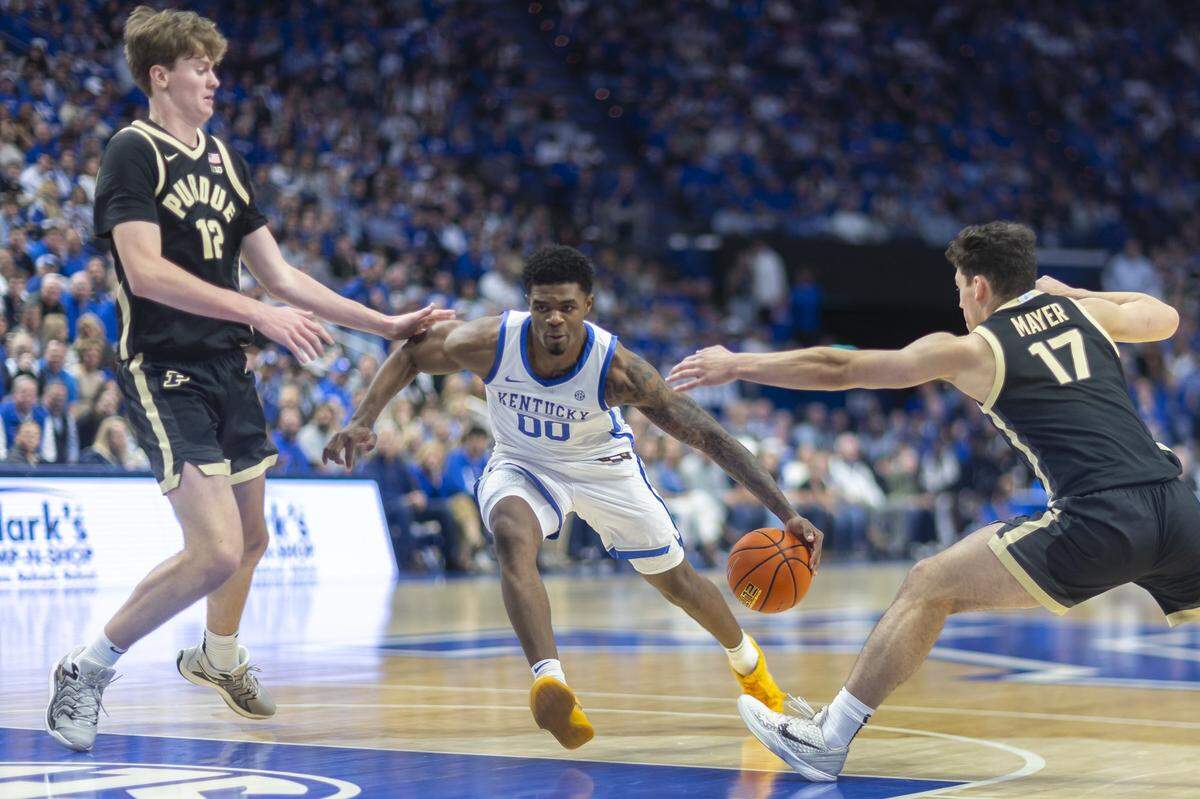
The guy who scored in double figures in each of his first 26 games as a Wildcat, seemingly always coming up with a key play at the very moment that his team needed it?
The guy who shook off the worst game of his UK career — the one that snapped that streak of double-figure scoring — and four days later returned to Oklahoma for the first time since leaving as a transfer, listened to his old fans boo him every time he touched the ball, hit clutch free throws amid chants of, “He’s a traitor!” and ultimately scored UK’s final 18 points in a thrilling 83-82 victory?
The guy who — two weeks after that — shook off a series of mistakes down the stretch to deliver that buzzer-beating layup, driving around two defenders and rising over a third to sink a dagger into his former team and eliminate the Sooners from their first SEC Tournament?
Distractible? That guy?
It was a curious comment from Pope, and it wasn’t explored any further on that night.
Seven months later, sitting in his office in the Joe Craft Center, the Kentucky coach reflected on that night and the days and weeks and months that led up to it. He took a moment to gather his thoughts, his brow furrowed, and he started speaking in that philosophical tone that is pure Pope.
“Everybody’s got strengths and weaknesses. Sometimes our strengths are our weaknesses,” he said. “So Otega is like a pure competitor. He just wants to compete for something, right?”
Right. Anyone who watched Kentucky play last season saw that.
What they didn’t see were the moments behind the scenes, those early days when Oweh and Pope were getting to know each other from a purely basketball perspective.
Oweh, the uber-competitor, often had one speed when it came to competition, but he yearned to become a better version of himself. Pope, the first-year coach at his beloved alma mater, eager to live up to the stature of the job and always searching for ways to become a better teacher.
In that first year together, Pope found a student who had layers to his game that had not yet been discovered. Oweh found a coach who was willing to listen and let him progress at his own speed.
“Drill work is not a natural place for him,” Pope said. “It’s not a natural place for him to have juice or focus or energy or anything else. But his on-off switch with competition, that same skill is what makes him an elite-level competitor that most people can never actually become — that guy that’s so laser focused when the scorebook is open, right? …
“And so that’s his natural state is in the arena of competition. And what he’s made such huge strides on is finding ways to make practice, to make school, to make being on time, to make communicating with his teammates — to make all of that a game inside his mind, where he’s living it.”
And then he arrived at that word again.
“That’s what I meant by being distractible,” Pope continued. “If he’s not locked in on a major, highly important competition — like a game — then it was hard to get his focus.”
.JPG "LEX_92_250125KentuckyVanderbilt_rh (2).JPG")
Otega Oweh meets Mark Pope
Oweh, who played two seasons at Oklahoma before entering the transfer portal last year, was one of Mark Pope’s first commitments in his new job as Kentucky head coach. He didn’t go public with it for a couple of days, but Oweh actually made up his mind on his recruiting visit to Lexington.
During that trip, he saw an opportunity to prove himself on the biggest stage in college basketball. He also formed a quick connection with Pope, a former Kentucky player himself — co-captain of the 1996 national title team — and a man who seemed like he could unlock more of Oweh’s potential, on and off the court.
Oweh was a good player at Oklahoma, but he wasn’t a great one. He broke into the Sooners’ starting lineup as a freshman and remained there for most of his sophomore year. But Oklahoma missed the NCAA Tournament in both of those seasons, and Oweh had higher aspirations, for his team and for himself.
His first season at Kentucky was a revelation. Oweh ended up as the Wildcats’ leading scorer. He played himself into the NBA draft conversation. He decided to return to Lexington for one more year, and he’s since been named the SEC preseason player of the year, with expectations of being the top performer in the top league in all of college basketball.
None of that came by accident.
As Pope’s “distractible” comment from several months earlier was read back to Oweh, the 22-year-old sat in the Craft Center and nodded along. He’d heard that directly from Pope?
“Yeah,” he said with a grin.
Had he ever heard it before coming to Kentucky?
“No,” he replied.
Maybe as a kid, he quickly added, but never since he established himself as a promising recruit in high school or a starter at the high-major college level. It was a new concept. And while the word caught him off guard, Oweh didn’t object.
“It was a surprise at first, but I understand it, for sure,” he said. “Because I know — like, I felt it — but I just thought it was normal.”
Oweh acknowledged that he hadn’t always been locked in away from the arena of competition. He admitted that he had lapses there, too; the time spent with Pope highlighted those shortcomings and, ultimately, led him in a new direction.
In previous years, Oweh would get down on himself when he made the wrong decision or the ball didn’t bounce his way. That feeling would linger as the game went on around him. He was still playing, but he wasn’t all there. He was distracted.
“It used to take me a little bit to get to the next play,” Oweh said. “But Coach Pope, he always preaches ‘Next play! Next play! Next play!’ So, for me, coming in … I wanted things to be a certain way. Like, I have an idea of how I need things to go. So when it doesn’t, I’m like, ‘Ah, shoot!’ I’ll get down on myself. But I feel like, as the year went on, Coach Pope — we’ve had meetings, and he’s just always told me, like … with your game, if you hold on to the last possession, your next possession isn’t gonna be right.”
Moving on is easier said than done. As time went on, Oweh got the hang of it.
Becoming a UK basketball star
So, how exactly did Oweh make the transformation from distractible to dominant?
“I think a lot of it just went with Coach Pope and his style of coaching,” he says now. “It was just different. He talks to his players. He tries to understand what’s going on in your head, instead of, like, drilling what he wants to do inside of your head.
“He’s not like one of those coaches where he’s just upstairs all time. Or we only see him in practice. Like, he’ll just pop up in the locker room, the training room, weight room. We see him. So even though he’s our coach, you feel comfortable having conversations with him.”
There were a lot of conversations.
The UK coach tried to fit Oweh with a sports psychologist to help him become less distractible.
“I did it one time,” the player said. “But that’s not really for me.”
His parents have always been a resource in such cases. His two older brothers — Odafe was a first-round NFL pick and is now in his fifth year in the league; Kaylen was also a Division I athlete — have been there for him, too.
“I have a strong support system,” Oweh said. “So if I ever need to talk to anybody or let something out, I could go talk to my brothers or my parents. So I feel like what I’m doing with a sports psychologist, I could do that with someone in my family.”
Pope said that he wants all of his players to see sports psychologists.
“And just mental health experts, in general,” he continued.
“Because this is the piece right here,” Pope said, pointing to his head.
“And this connection right here,” he went on, putting his other hand on his heart, “is the piece of this where there is so much potential for all of us to grow. Like, grow so much.”
Oweh wanted to grow, that much was clear. He just didn’t want to go about it in the way that Pope initially suggested. And that was OK. By that point, Oweh had realized that Pope and the rest of the UK coaching staff were receptive to alternative solutions. They were willing to listen. And they were willing to work with him to do it his way.
“They’re big on communication,” Oweh said. “So they’re not going to tell you. They’re going to ask you why you do certain things. And if you can explain it and they understand it, they’re going to work around it.”
Oweh wasn’t comfortable — or didn’t see the benefit — of talking things over with a sports psychologist. He found a lot of comfort in discussing things with his head coach, however.
The pair had their shared time together on the practice court. But they also had those conversations in Pope’s office, the Kentucky coach drawing on his own experiences — as well as his own interest in the field of psychology — to get through to his college-aged star.
They talked about basketball and life. They talked about letting things go on the court and finding ways to lock in when the stakes seemingly aren’t so high.
Oweh began to channel the force that makes him so good on game days into something else altogether. He became a better player in those games. He became more productive in practices. Even amid the basketball glory, he was a star student in the classroom.
“It’s a daily practice. It’s just practice,” Pope said. “And he’s grown so much — it’s really remarkable — to where this summer, he was an insurmountable force on the defensive end. It was just like he messed up every drill we tried to run. We couldn’t actually get through a play call, because he was just blowing up everything. And that’s in drill work.
“So, now can he incorporate that when he’s just doing work on the court by himself? Or with a coach? Where it’s really hard to manufacture his deep desire to go compete. It’s just, first, identifying it, then talking about it, then practicing it, then getting better every day, which he’s done.”
What’s next for Otega Oweh?
Oweh is back at Kentucky for one more season. His short-term goal is to win a national championship. His long-term goal is to become an NBA draft pick and spend a long time in that league. Pope has done both of those things already.
“I really felt this when I got to the league,” he said. “I always say this — and I don’t know what the real numbers are — but there’s probably 5,000 or 10,000 players that are good enough, skill wise, size wise, athleticism wise, to play in the NBA. There’s only 430, give or take, guys that actually are in that league. And the separator has nothing to do with what happens on the court, with the exception of maybe 20 guys. For all the rest of us, it’s just your ability to be here.”
The coach pointed to his head and his heart one more time.
The story that Pope wanted to tell on the night in Nashville — where Oweh saved Kentucky on the court in the SEC Tournament — was this one. It wasn’t the story of a last-second shot, but a tale that had been months in the making.
Oweh’s transformation in his first season at Kentucky was a chapter in that story. But it wasn’t the final one.
Over the past year and a half, Pope has helped Oweh become a better version of himself in college basketball. The work continues. He can still improve at this level, and he’ll need to if he and his fellow Wildcats are going to go as far as he hopes.
Oweh is also trying to elevate himself to no-doubt NBA draft status.
“I know what I have to do,” he said. “I’ve been locked in since I decided I’m coming back. I’ve been locked in on what I have to do, how this year has to look. So every day — even if I can’t do it physically in practice — mentally, I’m keyed in, thinking about it, and just having a vision of how I need it to go.”
Oweh started fall practice as a spectator, a turf toe injury pushing him to the sidelines. A year ago, perhaps that would have been a bad thing. He’s back on the court now, but those few weeks spent watching might have served him well. The way he talks about the experience sure sounds like he’s learned something during his time as a Wildcat.
Before the conversation even arrived at Pope’s use of “distractible” to describe him, Oweh spoke of being “locked in” and “laser focused” heading into the 2025-26 season. He listed off the things NBA decision-makers had told him to get better at — shooting, handling the ball, making decisions on the move — and explained how he was going about the process of improvement.
When it was pointed out that he was the “kid” on last year’s team — the youngest player in a Wildcat starting lineup stacked with seniors, all of them now gone — Oweh smiled.
“Yeah, I’m ‘Unc’ now,” he said, the grin getting a little bigger.
He spoke of this team’s three freshmen — Braydon Hawthorne, Jasper Johnson and Malachi Moreno — and wanting to be there for them as they started their college journey.
“Because you have to set the example,” Oweh said. “So for me, I have to make sure I’m just always laser locked in on our principles, so that I’m setting a good example for that.”
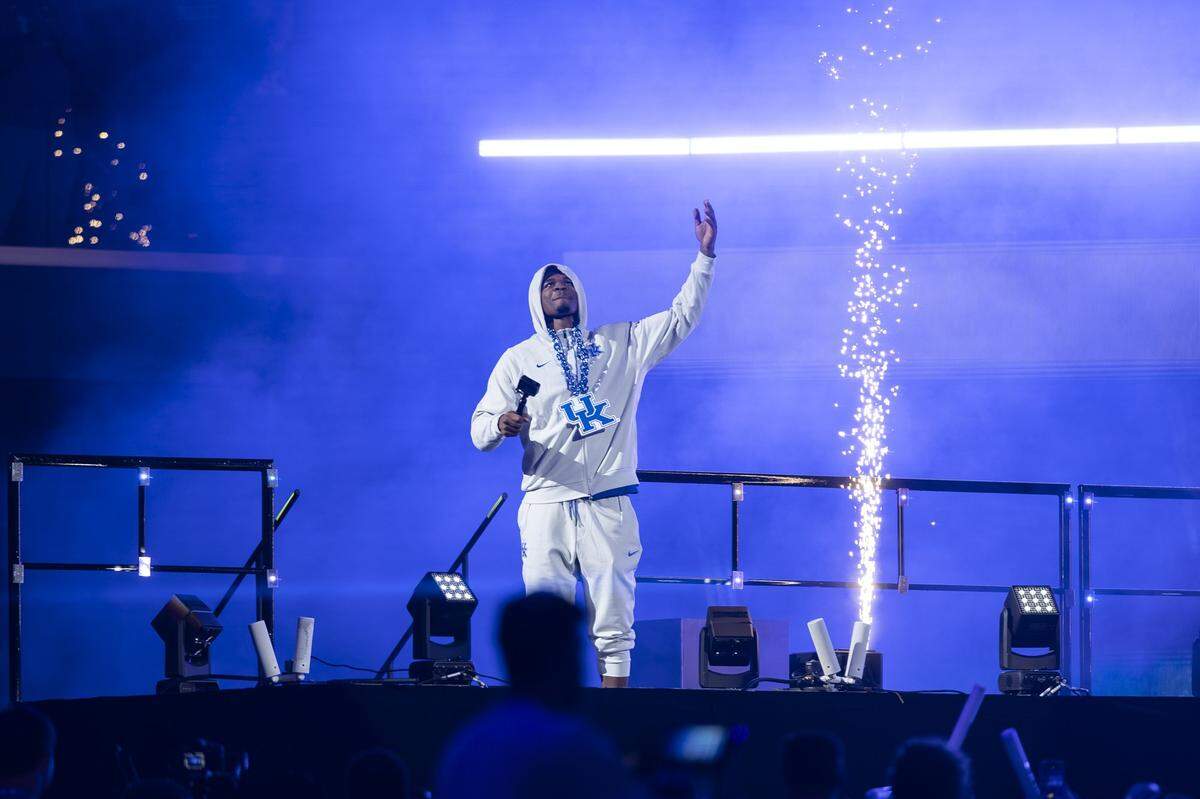
A Kentucky basketball connection
It’s been said that Pope is in a unique position to relate to his players. He faced adversity in college, and he won an NCAA title. Most importantly, for the current context, he did it at Kentucky. And then he went on to play several seasons in the NBA.
After that, he went to medical school. He also developed a keen interest in psychology, but that didn’t happen as he was training to become a doctor. Pope said he probably took one psychology class as an undergrad and did just enough to fulfill those obligations in med school.
Several years into his head coaching career — while working with “The Squad,” a group of BYU psychologists he called upon to help his team — Pope hit on something else.
“It wasn’t until The Squad at BYU that I started to just be a massively big believer that there is room for us to get better as coaches in how we run an organization,” he said.
Years later, that interest has persisted.
“I mean, every coach has their style. And it works for a lot of coaches,” Oweh said. “But I feel like Coach Pope is different. He wants to tap into your mind. … Psychology, all that type of stuff. He’s just a cool guy in terms of, like, he just makes his players feel comfortable.”
That work continues, too.
Pope questioned the premise of whether he’s in a better position than other coaches to help his players due to his previous time spent as a Wildcat and a veteran of the NBA.
“Two rational human beings could have a rational debate about whether it’s better to be able to relate to your players (in that way),” he said. “I mean, that would be like a super-interesting conversation.”
That might be a conversation for another day. For now, Pope returned to this one.
“I mean, clearly, I got to experience a lot of things these guys are experiencing,” he said.
And then he went down the list. He knows what it’s like to walk into Rupp Arena, prepare for games in that locker room and deal with the pomp, praise and pressures of the UK fan base. He also knows what it’s like to fight your way into the NBA and earn a lasting place there.
“So, in that sense, there’s a lot of moments that I can kind of call back where I’m like, ‘Oooh, I’ve kind of been in that space, and I wonder if they’re experiencing this in a similar way as me?’ So for sure, yes, it helps in that way.
“I do think that one of the skills that I’m really, really trying to grow — that I think coaches are very poor at — is I’m really trying to listen. I’m not a great listener, but I’m trying to become a better listener, because I think that makes us 10x teachers, when we actually listen, right? Because then we know what to teach.”
It’s been about 18 months since Oweh told Pope he would play for him. There’s been a lot of listening over that time. Pope has listened to Oweh, and Oweh has listened to Pope.
The results have been mutually beneficial. The growth process, for both coach and player, will continue into this season and extend beyond it, as Oweh embarks on his pro career and Pope tries to get the most out of his next wave of potential Kentucky basketball stars.
They’ll spend one more season together first. More big moments on the court and breakthroughs away from it. More listening and learning. And both sides will be all ears.
“There’s no better person that can advocate for it than Coach Pope. I mean, he’s won it. He’s won it here. He’s been here,” Oweh said. “And I feel like if you don’t believe him or trust him, you just don’t want to succeed. Because why would you not trust someone who’s done everything that you want to do? I mean, everyone on the team’s aspiration is to win a national championship and go play in the NBA. He’s done all that.”
.JPG "LEX_49_250327UK_Indy_rh (1).JPG")