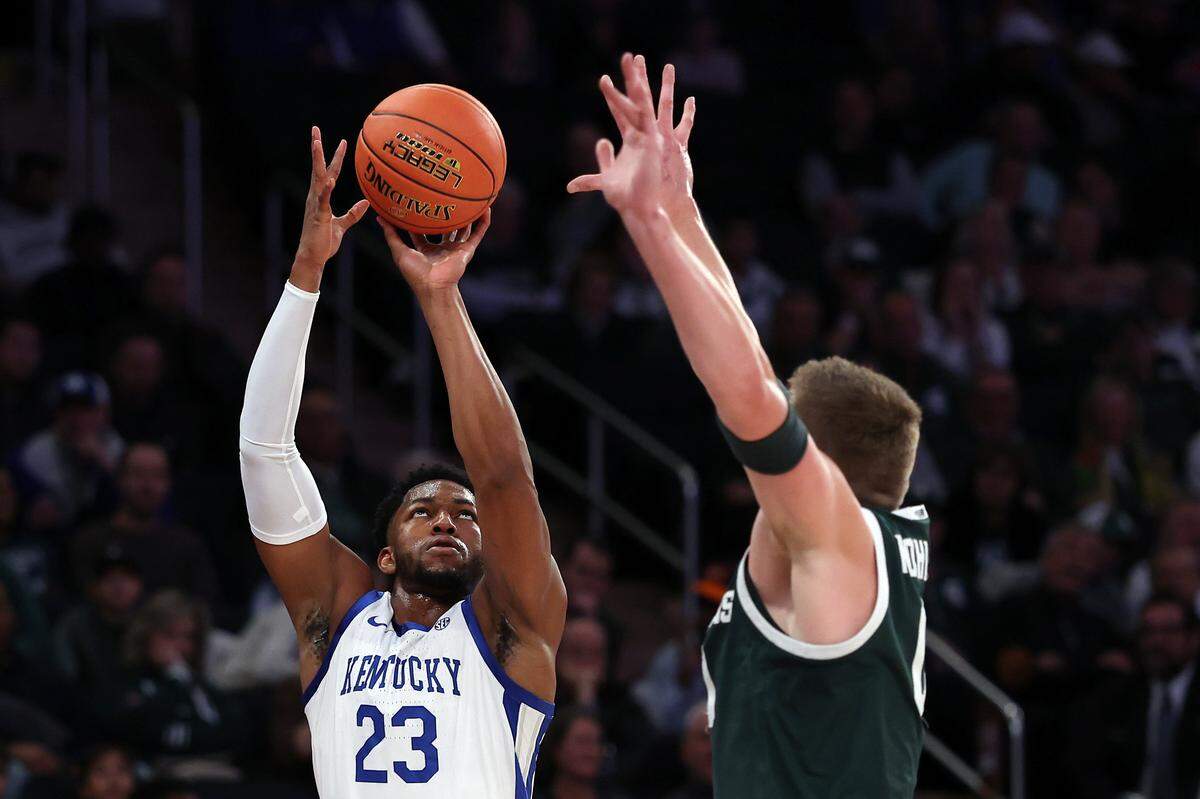
Poor defense isn’t Kentucky’s only issue. A potential strength isn’t panning out
AI-generated summary reviewed by our newsroom.
- Kentucky’s 3-point shooting collapsed, dropping team percentage to 31.9%.
- Team promised it would be better than expected form 3-point range but hasn’t delivered.
- Coach Pope must improve communication and ball movement to unlock offense.
For this Kentucky men’s basketball team to reach its unquestionably high ceiling, the Wildcats will need to shore things up on defense.
Figuring out how to guard good teams is long-term priority No. 1 for Mark Pope and the UK coaching staff.
In the meantime, it would help matters if the Cats could make some shots.
So far, they haven’t done it.
On paper, 3-point shooting shouldn’t have been expected to be a strength for this Kentucky team. But that wasn’t the narrative coming into this season. Contrary to demonstrated results, the Wildcats spent the summer and fall talking up their prowess from the perimeter.
In a one-on-one interview with the Herald-Leader before the 2025-26 campaign started, Otega Oweh — the Cats’ leading scorer in Pope’s first year and the SEC preseason player of the year heading into season two — was asked about the biggest surprise he’d seen to that point.
“We can really shoot it,” Oweh said. “When we first got here, we probably would have been thinking like, ‘Oh, last year, maybe we were a better shooting team.’ Because, you know, we had Koby Brea, Ansley (Almonor), (Jaxson Robinson) — all those guys. But we’re actually shooting really well. I’d say that kind of took me by surprise just a little bit.”
From coaches to teammates, everyone in the UK basketball orbit backed up that claim.
It was surprising because these Cats hadn’t shown an ability to shoot from long range at the college level. Sophomore guard Kam Williams — a transfer from Tulane — was the most prolific shooter on the roster during the 2024-25 season. He made 63 3-pointers as a freshman.
Jaland Lowe, the expected starter at point guard, was next with 41 makes, but he shot just 26.6% from deep as a sophomore at Pittsburgh. Denzel Aberdeen made 36 3s as a junior at Florida last season. Oweh was next in 2024-25 output, making 27 3-pointers as a junior at Kentucky, where he was viewed as more of an afterthought from long range.
Still, these Cats claimed they could shoot it. So far, those claims are unfounded.
Those who would argue that this is too small a sample size to make any sweeping judgments would be correct. Kentucky has played five games. There’s a lot of season left. But, right now, the numbers are staggeringly bad.
And combined with the pitiful defensive performances in losses to Louisville and Michigan State — the only two quality opponents UK has played — this should be a worry for the Wildcats, who have been consistently poor from the perimeter.
Through the first five games of last season, the Cats shot 40% or better from deep on four occasions. Their low point was a 36.1% showing in a 100-72 win over Bucknell. After those five games, UK was shooting 63 for 149 on 3s, a 42.3% hit rate.
Through the first five games of this season, the Cats have shot 40% or better zero times. Their low point was a 7-for-30 showing in the 83-66 loss to Michigan State on Tuesday night. That maths out to 23.3%, the second-lowest number in Pope’s 41 games as UK’s coach. After these first five games, Kentucky is shooting 46 for 144 on 3s, a 31.9% hit rate.
The Cats finished last season at 24th nationally in 3-point percentage. This UK team woke up Wednesday morning ranked 204th nationally in that stat.
Kentucky has been a combined 19 of 64 from deep (29.7%) in their losses to U of L and Michigan State. Throw in the two exhibition games against high-major opponents — Purdue and Georgetown — and UK is 35 for 123 on 3-pointers (an even worse 28.5%).
If the Cats can’t guard anybody good — and they haven’t been able to so far — they’d better be able to shoot their way out of trouble. And they haven’t been able to do that either.
Kentucky’s 3-point shooting problems
Collin Chandler has been Kentucky’s saving grace so far. The sophomore guard has made 15 of 29 attempts from deep, a 51.9% rate that is likely unsustainable in the long run. That number, if Chandler somehow keeps it up, would rank fourth in program history, behind Cameron Mills (53.2% in 1996-97), Travis Ford (52.9% in 1992-93) and Reed Sheppard (52.1% in 2023-24).
After that, freshman Jasper Johnson is second in hit rate — 35% on 7-for-20 shooting — and Aberdeen has the most makes, with just eight in five games, shooting 33.3%.
Oweh has gone 5 for 17 (29.4%) and hasn’t looked like himself in any aspect. Williams, who declared himself the best shooter on the team in the fall, is 4 for 15 (26.7%).
Trent Noah, who might actually be the best shooter on the team, is just 2 for 7 after missing time with an ankle injury. Lowe, who is out with a shoulder injury, is also 2 for 7. International addition Andrija Jelavic is 2 for 11.
Alabama transfer Mouhamed Dioubate came to Kentucky, in part, hoping for a better opportunity to show a more all-around game. He was 12 for 26 from deep in 37 games as a sophomore with the Crimson Tide last season, an eye-popping 46.2% hit rate, albeit in a small sample size.
Dioubate wanted to shoot the ball more this season. He’s done that. It hasn’t gone well. The 6-foot-7 forward is now 1 for 11 on 3-pointers as a Wildcat, and the loss to Michigan State on Tuesday night summed up the struggles — both his own and those of the entire UK team.
In the first half alone, Dioubate was 0 for 4 from the perimeter. One was a heave to beat the halftime buzzer, but the other three seemed out of the flow of what Kentucky wanted to do, and all of those came when the game was still very much undecided.
Pope said after the 96-88 loss to Louisville last week — when his Cats went 12 of 34 from deep — that he was just “OK” with the shot selection so far. He used words like “distracted” and “lost” and “undisciplined” to describe his team’s approach, at times, to shot-taking.
“Instead of using the skills and the techniques we’ve learned to buy yourself more time to make a decision, we kind of raced into forcing ourselves to be in positions where we had to make split-second reads and decisions with no bailout, no safety,” Pope said. “And so that is an issue for us that sometimes leads to poor shots and sometimes leads to poor execution.
“It will be a work in progress for the rest of these guys’ careers, but it’s a work in progress for us (right now).”
A week later, the Wildcats looked much worse in that regard.
There was a noticeable lack of ball movement. With Lowe out of the lineup, it’s unclear who on this team can consistently penetrate the first line of perimeter defense, crucial to getting the opposition on its heels and making something happen offensively.
With Michigan State’s defense playing in relative comfort, the Cats rarely found enough space to shoot the ball. So they often settled for bad shots on the perimeter. And with Kentucky unable to carve up the Spartans’ D in any way, potential drivers like Oweh — who feasted in open space last season, when guys like Brea, Robinson and Almonor were major 3-point threats — had nowhere to go with the ball.
It all added up to a sorry performance. According to the adjusted offensive efficiency numbers, the Cats had just two games last season — an 82-69 loss at Georgia and a 99-70 loss to Alabama in the SEC Tournament — that were worse than what they did against Michigan State.
UK had eight assists and shot 24% from 3 in the Georgia game. The Cats had 12 assists and shot 26% from 3 in the Bama loss. Against the Spartans, they had 13 assists and shot 23% from deep, both season lows.
Those who follow what Pope has to say know that he typically associates low assist totals with bad team basketball. Those who watched the Wildcats on Tuesday night didn’t need that background to know that these Cats weren’t on the same page.
To unlock the 3 ball, they’d better get there.
“It’s a work in progress,” Pope said. “I gotta do a better job. My messaging is not resonating with the guys right now. That’s my responsibility. We’re not playing like our teams play. And that’s my communication issue. And so that’s a place we got to work.”