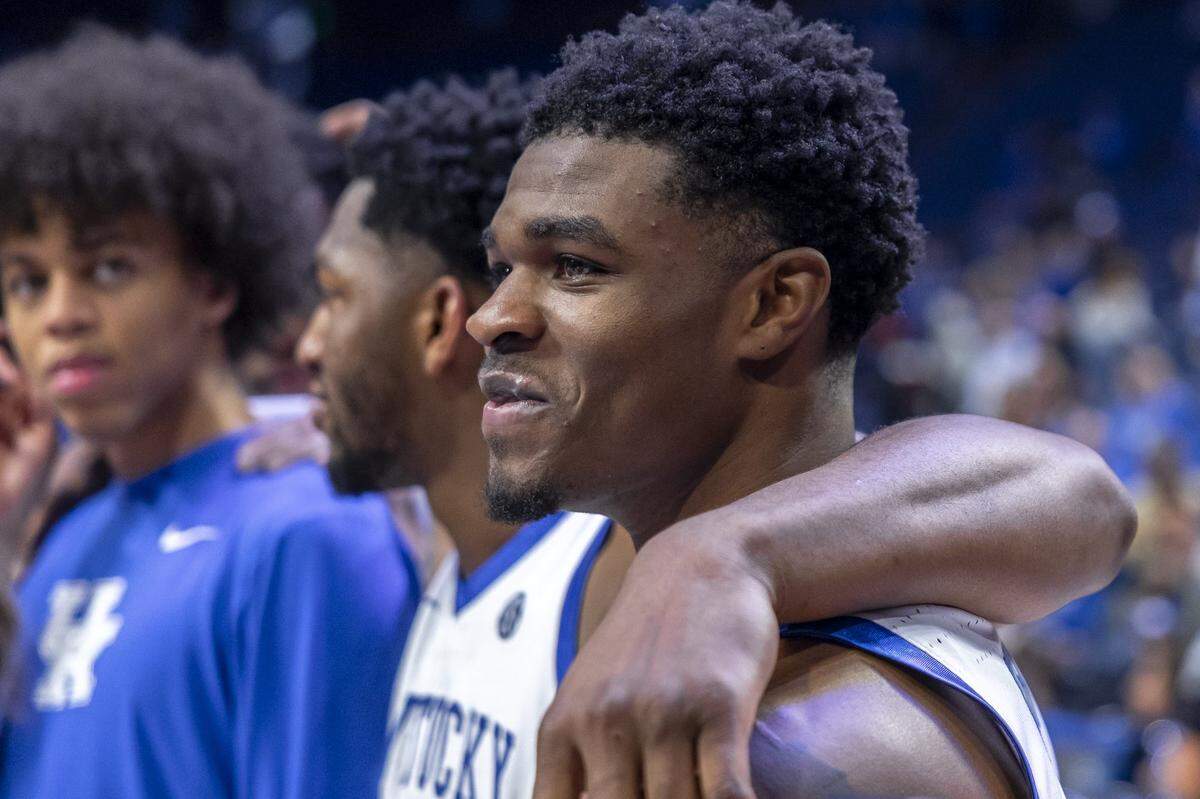
A glaring question after six games: Who’s the leader of this UK basketball team?
AI-generated summary reviewed by our newsroom.
- Kentucky lacks a clear on-court leader after six games; Pope favors committee.
- Oweh emerges as likely leader by example; team must increase vocal accountability.
Anyone who watched the first few games of this Kentucky men’s basketball season surely saw it. The question was obvious. The answer was difficult to figure out.
Who was the leader of this Wildcats team?
There was Mark Pope and the UK coaching staff, of course. But those guys aren’t on the court.
There was Jaland Lowe, the junior point guard — a transfer from Pittsburgh who Pope personally picked to lead his second Kentucky team — but he started the season on the sidelines, too, a victim of an October shoulder injury.
Even when Lowe returned to the court, he was trying to feel his way back into game action, and then he was gone again, reinjuring his right shoulder in practice two days after UK’s loss to Louisville.
A few days after that, the Wildcats hit their low point: an 83-66 loss to Michigan State in Madison Square Garden, an all-systems failure that revealed the rudderless nature of Pope’s roster.
When the going got tough in MSG, the Cats looked lost. There was a lack of communication on the court and quarreling in the huddles. A season on the brink, just five games in?
Two days after that lopsided defeat, Pope seemed to acknowledge that his roster had a leadership void, though he didn’t necessarily think one voice needed to rise above all others.
“I don’t think you have to have that,” he said. “I think you can have niche guys. You know, last year we didn’t have a clear voice that was the leader on this team. I think most of the time, for my teams, it’s been a committee deal. I do have some guys that are emerging. That’s actually super fun.
“But we’re definitely in the process of figuring out so many things and growing so many things. But I don’t think we’re going to have one voice that kind of runs this whole thing. I think it’s going to be by committee, and I think that’s really healthy.”
Maybe. But, if that was the case, he would need a lot of guys to step up.
And this seeming lack of leadership wasn’t some media nitpick. No lesser a figure than Jamal Mashburn — a player who belongs on the Mount Rushmore of UK basketball — saw it, too.
In the aftermath of that MSG debacle, Mashburn — in his new role as a college basketball studio analyst for TNT — was asked about the current state of his alma mater.
“They’re not shooting the ball well from 3. They’re not guarding the 3. They’re not rebounding,” the UK great said. “They look like kittens more than Wildcats, in my opinion.”
Harsh. But hard to argue with. And he wasn’t finished.
Mashburn referenced the high-dollar price tag of this UK roster — the Herald-Leader was told that number was $22 million before the season began — and basically said there was a disturbing lack of accountability for that much money spent.
Where was the “alpha” on this team?
“I’m not seeing it quite yet,” Mashburn said. “Because, usually, the alpha is the one that takes control of that locker room. And I’m hearing the head coach, Mark Pope, doing a lot of taking control of that particular locker room. And when it’s not player-led, that’s going to be difficult to transition to from a head coaching standpoint to get the guys going.”
A different Kentucky basketball roster
Back to Pope’s point about last season and not having one clear leader on that team …
Perhaps that’s true. He would know better than anyone. But that was a different roster.
That team had several seniors in key roles. Lamont Butler was the Wildcats’ “heart and soul” — Pope’s own words — and their de facto leader, as the point guard. Andrew Carr often rallied the troops when times got tough on the court. Koby Brea, Jaxson Robinson and Amari Williams — all in their fifth years in college, just like Butler and Carr — projected cool, calm demeanors.
That core wasn’t the most raucous, but they seemed to never get rattled. They were also experienced college players who came to Kentucky already secure in their own games.
There was a learning curve with Pope’s system and an adjustment to the world of UK basketball, but that group appeared to naturally grow into each other — and trust in one another — from the start. As that happened, the younger players on the team followed their lead.
Otega Oweh was one of those younger players, and he quickly thrived in the veteran ecosystem that Pope had created. He was a college junior, but he was surrounded by fifth-year seniors. He was, in effect, the kid in Kentucky’s starting lineup and remained in that role during crunch time.
He didn’t have to lead. For the most part, all he had to do was ball.
This UK roster looks much different. It’s a team filled with other upperclassmen who have never had to lead a college basketball team and underclassmen still trying to find their own games.
It’s obvious to look to those older players for leadership, but this bunch isn’t as naturally suited to slide into those roles. Oweh and Denzel Aberdeen, a national champion at Florida but a reserve player in all three seasons there, are admittedly quiet types.
Lowe can still talk from the sidelines, but he can’t jump into the huddles in the heat of game action. Fellow junior Mouhamed Dioubate might have that potential, too, but he was also a backup player the past two years at Alabama. He’s new to his role and still learning Pope’s system. Brandon Garrison, a junior returnee from last season, is still figuring out his own game.
Sophomore guard Collin Chandler, another returnee from Pope’s first team, appears to have those leadership chops, but he’s also still finding his way after dropping basketball for two years to go on a church mission before he arrived in Lexington. Of all UK’s players, he’s often the one most on the same page with Pope. And that was the case when the subject of leadership came up after Kentucky’s 88-46 victory over Loyola (Maryland) on Friday night.
“I think there needs to be a lot of loud voices on the court,” Chandler said, rejecting the idea that one primary leader was necessary. “Because everybody sees the game differently, and one guy can’t see everything that’s going on. So when we huddle, everybody’s talking about what they’re seeing, so we can all come together and figure it out together.
“And that’s been super important for our team, and something we practice. And ever since we stepped on campus, we practiced talking to each other. We practiced expressing what we’re seeing and talking it out. And so I think a collective voice is just as important as one.”
That work continues. It will be vital for these Wildcats moving forward. And while Chandler is almost certainly correct, that doesn’t make observers like Mashburn wrong. When things go sideways on the court — as they will so many times over the course of a season — who will be the first to step up and take charge?
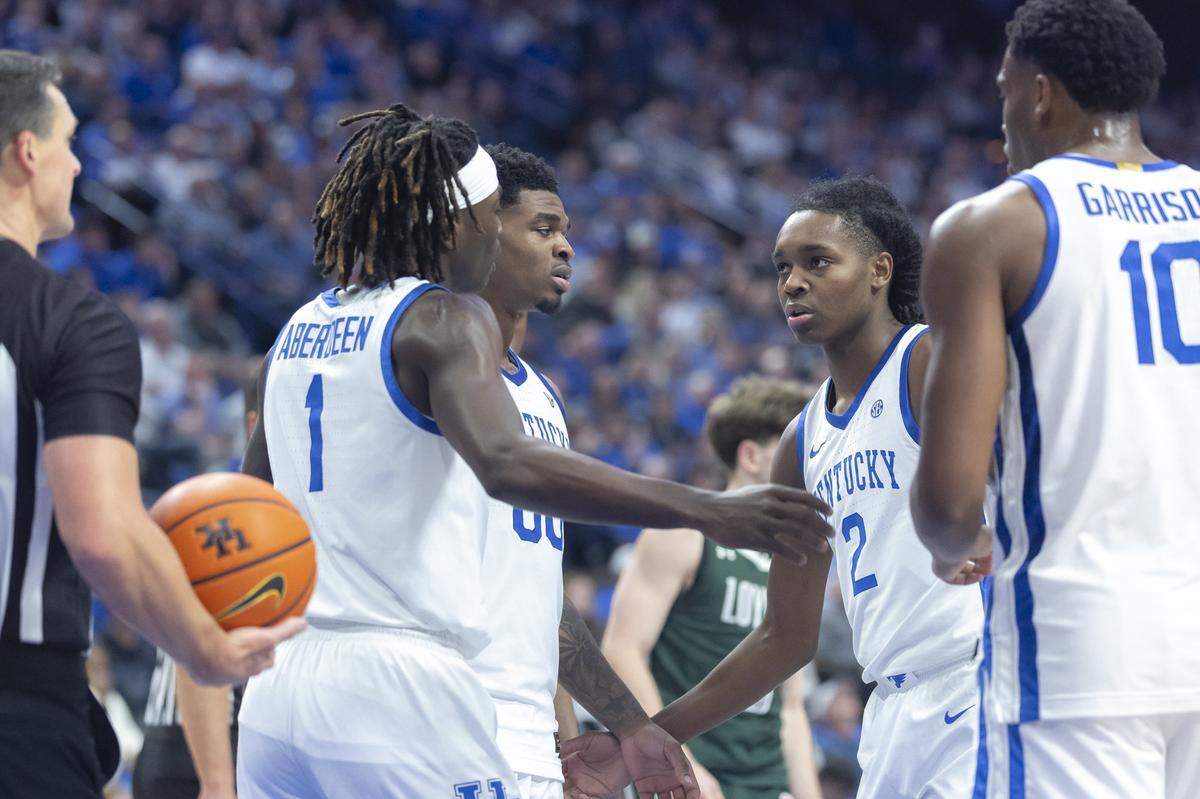
Is Otega Oweh emerging as Kentucky’s leader?
Perhaps the most likely leader on this UK team is also the most obvious candidate.
Oweh said after the win over Loyola — maybe the first time he’s actually looked like himself all season — that “everyone” had stepped up as a more vocal presence in the wake of the loss to Michigan State.
As far as his own approach to leadership in what will be his final season of college ball …
“I just gotta be that consistent piece,” Oweh said. “I’m gonna go out there and play hard, bring good effort, have a high motor, and I feel like everything else will fall into place. But, you know, I’m trying to bring that consistency, in terms of my game — both sides of the ball.”
That’s lead-by-example-type stuff, and that’s what Oweh has always been used to doing.
The 22-year-old often has a lot to say in interviews, but he’s fairly quiet in doing it. He’s not the kind of guy to get in a teammate’s face. It’s not his nature, and it’s not something he ever had to do in his first three years of college, either as an underclassman at Oklahoma or as the kid on last season’s Kentucky team.
That doesn’t mean he shouldn’t be doing it now.
“There’s always room for improvement,” Oweh said Friday night. “I definitely think I could be more vocal on the court. Because I’m such a lead-by-example kind of guy, I tend to get quiet sometimes, but I’m trying to get out of that and be more vocal.”
Has that time finally come?
There was one sequence in the victory against Loyola that could be looked back upon a few months from now as a potential turning point.
Kentucky was up 42-18 with about three minutes left in the first half. Garrison grabbed a defensive rebound and looked up the court. Aberdeen and Oweh were streaking up the left side in transition. Chandler was heading up the right side with plenty of room to run.
Garrison chucked an outlet pass to his left. It flew over Aberdeen’s head — well in front of him — and landed in the hands of a fan sitting courtside. The dead ball resulted in a TV timeout, so those watching at home didn’t see what happened next.
Oweh, who had sprinted on through the baseline with an expression of clear frustration, stormed back down the court and caught up with Garrison before he got to the huddle. The senior guard wasn’t happy, and he let his teammate have it.
“It don’t matter who we’re playing — if we’re playing fifth graders or the best team in the country — I just told him that was a play that we gotta capitalize on,” Oweh recalled after the game. “Like, I was open. And DA was open. I just told him, like, ‘Brah, we gotta capitalize on that play. Like, I know we up 20-plus, but all those possessions matter.’
“And he knew it, too, in the moment — that he had a simple play to make. Collin’s on the other side, too. So he could have hit Collin, and Collin could have kicked it up. But those are plays that BG can make. So it was just more of me telling him, like, ‘If you’re gonna do it, you gotta complete the play.’”
Yes, the Cats were already winning by 24 points. As far as Friday night’s game was concerned, that play didn’t matter. One lost possession in what ended up being a blowout. But that’s not the point, and Oweh knew it. He wanted to make sure Garrison knew it, too.
For these Cats to compete with opponents like North Carolina, Gonzaga, Indiana and St. John’s — all on the December schedule — and the SEC foes to follow, they won’t be able to let plays like that get away. In some of those games, every possession could matter in the end.
How did Garrison respond to Oweh getting in his face? In the second half, the UK big man pulled down seven rebounds in 11 minutes. Toward the end of the game — with the Cats up 82-39 — he flung himself toward an offensive rebound opportunity with such vigor that he ended up flinging a Loyola player to the floor, resulting in a jump ball. Possession arrow to Kentucky.
As Garrison walked over to the UK bench for the final TV timeout of the night, some of his teammates greeted him with high-fives and pats on the back.
A little while later, Oweh sat backstage in Rupp Arena and talked about leadership. He said that Lowe could still be that guy while he’s recovering on the sidelines. But he made it clear that other Cats would need to do their part, too.
“Definitely, everyone’s gotta step up,” Oweh said, “and hold each other accountable.”